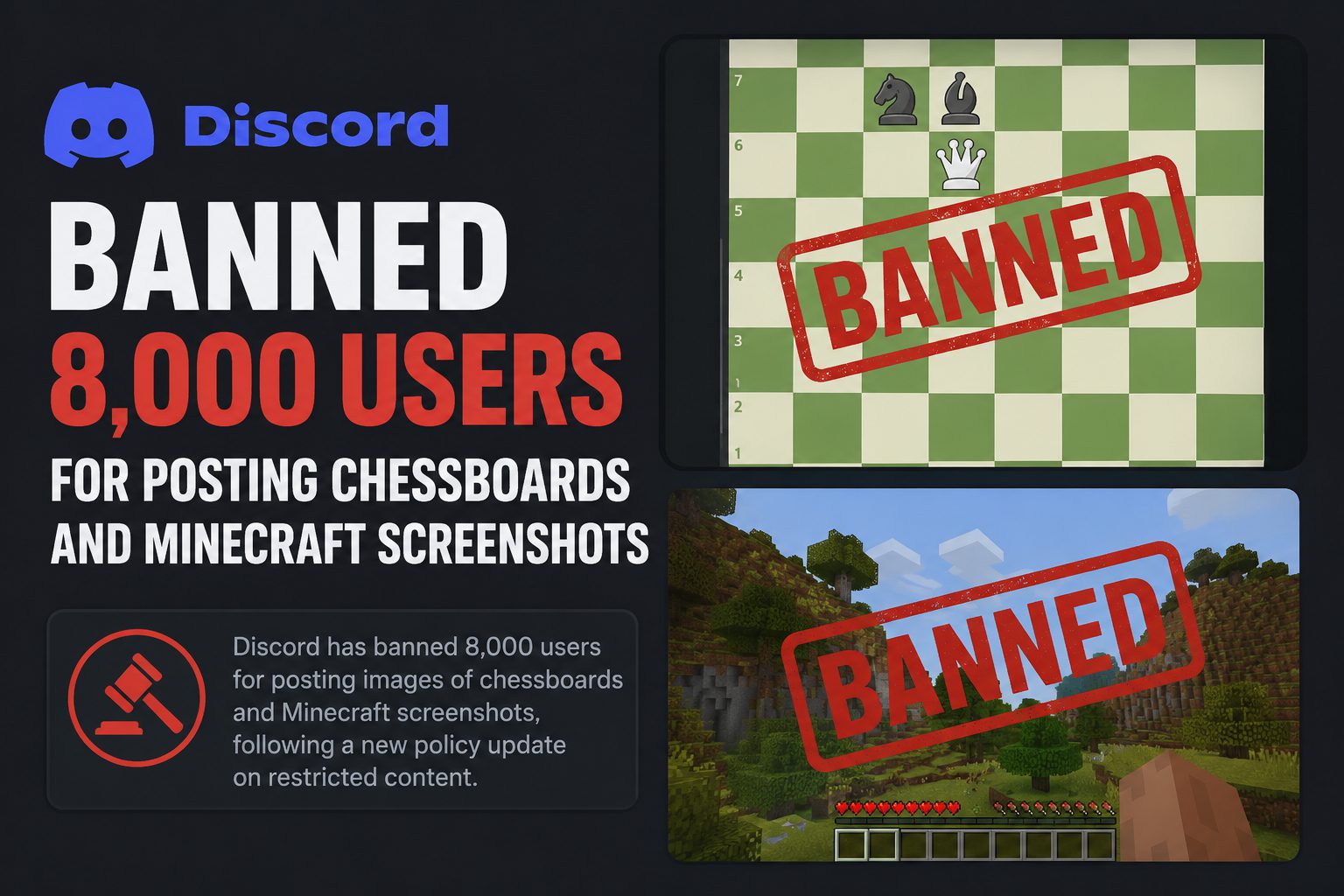
Post a Minecraft inventory screenshot. Receive a child safety violation notice. Get permanently banned. That was the reality for over 8,200 Discord users starting in May 2026, thanks to a hash-matching system that confused grid patterns with known harmful material. The culprit wasn’t some rogue AI deciding chessboards are dangerous. Two bugs stacked on top of each other inside Discord’s content moderation pipeline, and the result was a fire suppression system that triggered the sprinklers while simultaneously locking all the exits.
Two Bugs, Zero Safeguards
Discord’s safety system was designed to pause uploads and wait for human review — instead, it skipped straight to the nuclear option.
Discord scans uploaded images using hash-based similarity matching against databases of known harmful content, including CSAM. When a match fires, the system should pause uploads and queue the account for a Trust & Safety staffer to review. “This kind of similarity matching can produce false positives, which is why a member of our Trust & Safety team always reviews flagged content before any action is taken,” according to Discord’s own explanation, as reported by Dexerto.
That’s how it’s supposed to work. Here’s what actually happened. Bug one: the system bypassed the upload-pause stage entirely and issued permanent bans. Bug two: even after staff reviewed and cleared flagged accounts, the bans stayed locked in place. CTO Stanislav Vishnevskiy confirmed both failures publicly. A Discord developer using the handle “advaith” pushed back on viral claims that AI moderation had gone haywire, pointing instead to a single faulty hash incorrectly matching innocent grid patterns, according to Dexerto. The distinction matters — this wasn’t an autonomous model freely banning users; it was a flawed hash entry breaking an otherwise human-supervised pipeline.
The images that triggered bans included:
- Chessboard screenshots
- Minecraft inventory grids
- Game texture patterns
- Google Drive and spreadsheet tables
- Standard UI grid layouts
Reddit threads and social posts warned users to avoid sending any grid-like image on Discord until the issue was resolved. Vishnevskiy confirmed all 8,200 affected accounts have since been unbanned and the problematic hash neutralized, according to The Verge. One Reddit user summed up the collective experience bluntly: banned without warning, no clear explanation, only discovering the trigger after the fact.
The Bigger Trust Problem
This bug arrived alongside Discord’s aggressive push for age verification — a system already under fire for a separate breach that exposed around 70,000 users’ government ID documents.
No current age-verification technology is fully privacy-protective or consistently accurate, according to the Electronic Frontier Foundation — a sobering backdrop to Discord’s grid-ban fiasco. The incident lands in uncomfortable proximity to Discord’s teen-by-default settings and age-verification rollout, which requires facial estimation or government ID uploads to confirm adult status. That system has already drawn significant backlash following reports of the ID document breach.
The grid-ban episode exposes a structural tension that no patch fully resolves. Aggressive child-safety detection is necessary, and hash-based matching is a legitimate tool for finding known harmful material. But when two bugs can convert a routine false positive into 8,000 permanent bans — and prevent those bans from lifting even after human review — the reliability of that entire pipeline comes into question. The fix is in place. The problematic hash is neutralized. Every account is restored. What remains is the harder question: what’s the audit trail that catches the next cascading failure before it reaches thousands of users who just wanted to share a screenshot of their Minecraft chest?