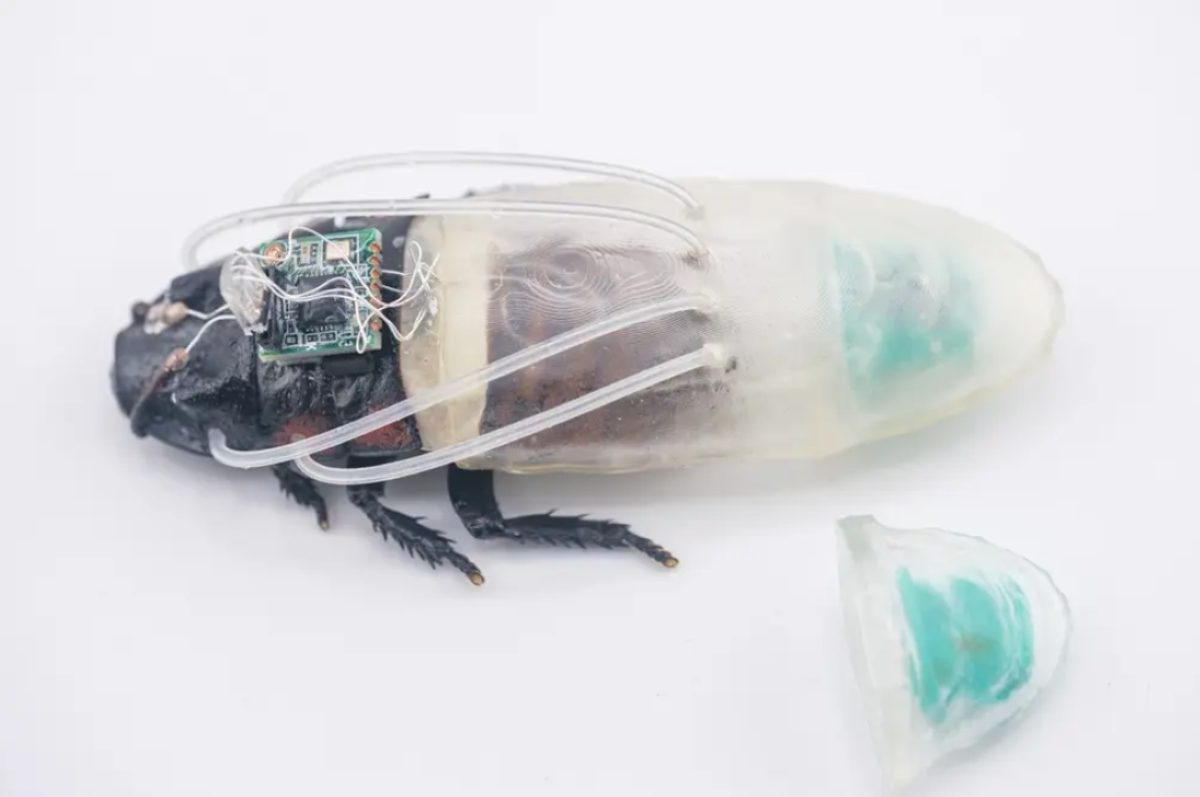
Most people spend their lives trying to keep cockroaches out of places. Scientists at NTU Singapore and Waseda University are engineering them to go in. Their 2026 Nature Communications paper details something that sounds like rejected sci-fi: Madagascar hissing cockroaches fitted with electrode “backpacks” that steer them like remote-controlled drones, now wearing 3D-printed diving suits with built-in oxygen generators. These cyborg roaches walk underwater for up to three hours. No, seriously.
A Miniature Scuba System That Actually Works
Three components turn a land insect into an amphibious search agent capable of navigating flooded rubble.
The suit has three parts: a flexible waterproof shell, a chemical oxygen tank, and four silicone tubes delivering air directly to the roach’s spiracles — tiny breathing holes along its body. Think of it as a scuba tank scaled down to the size of a breath mint. A hydrogen peroxide and manganese dioxide reaction generates breathable gas on demand. Underwater walking speed hits 78.4 millimeters per second, barely slower than on dry ground, according to New Scientist.
- Underwater endurance: up to three hours with no adverse health effects
- Target environments: flooded tunnels, submerged rubble, confined pipes
- Deployment timeline: real search-and-rescue use expected within two to three years, per NTU
- Mars ambitions: Prof. Hirotaka Sato describes the suit as a step toward “space suits for cyborg insects,” though actual planetary deployment remains speculative
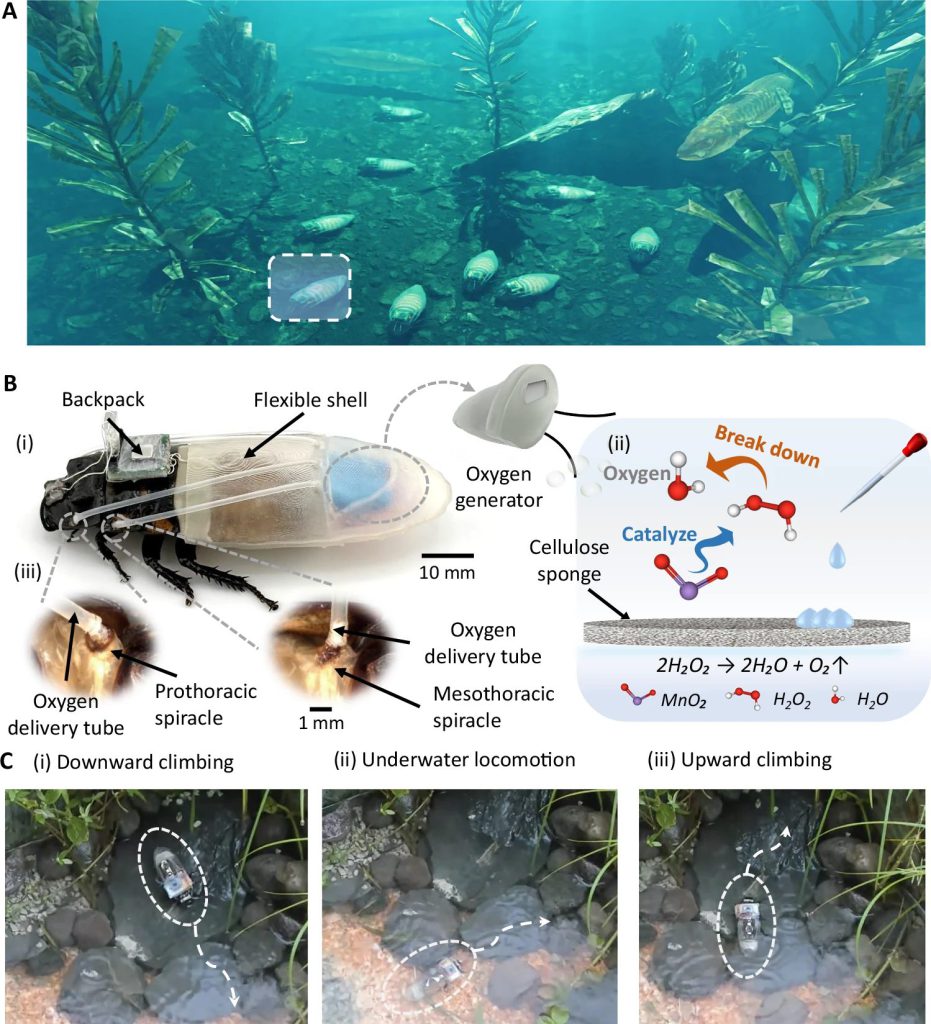
“Our new insect diving suit works like the oxygen tank used by human divers. It generates oxygen and delivers it directly to the insect’s breathing holes, allowing the cyborg cockroach to survive and move in underwater or low-oxygen environments,” said Prof. Hirotaka Sato of NTU Singapore.
Cockroaches outperform tiny robots in almost every metric that matters here. They navigate cluttered disaster zones using their own muscles, drawing far less power than motor-driven machines. They can even find food to self-replenish energy mid-mission.
That’s a biological advantage no battery can match.
Saving Lives With Something You’d Normally Stomp On
The technology forces an uncomfortable question about where squeamishness ends and survival begins.
Public reaction has leaned dystopian — social media commentary has ranged from animal-welfare concerns to surveillance anxieties. Those concerns are legitimate. Startups like SWARM Biotactics already develop cockroach reconnaissance platforms for security applications. Some roboticists prefer fully artificial alternatives to sidestep animal-welfare debates entirely, though they concede insects remain unmatched at this scale for power efficiency and environmental adaptability.
“By expanding the operating parameters of our cyborg insects to include underwater travel, we believe that they can enhance search and rescue efforts,” Sato told TechXplore.
The trajectory points from earthquake rubble to flooded infrastructure to, eventually, Mars. Whether that final destination ever materializes matters less than the immediate reality: the most despised creature in your home could become the thing that locates survivors under collapsed concrete. Uncomfortable? Absolutely. Worth it? That depends on which side of the rubble you’re on.