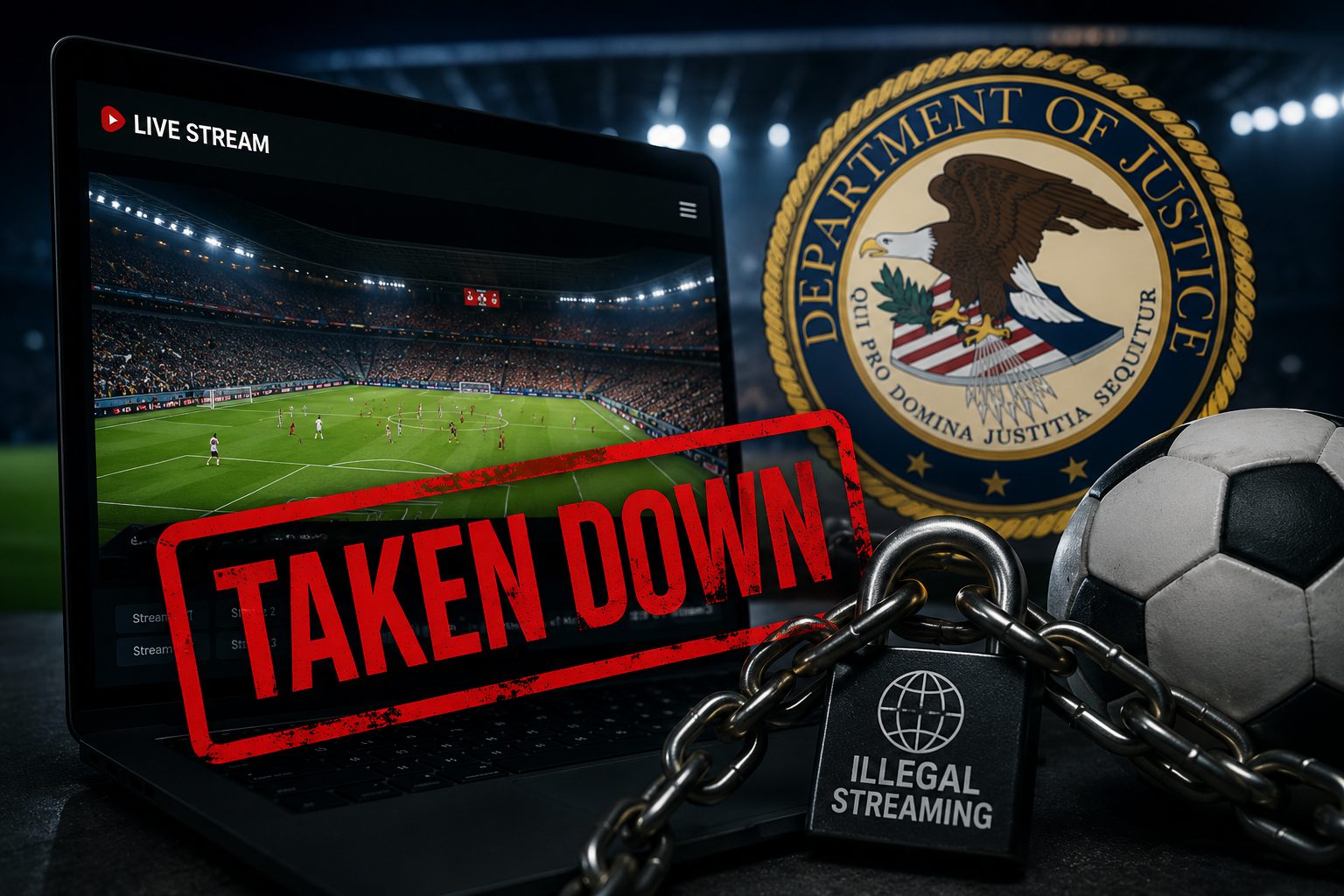
A fan clicks a sketchy link for a “free” World Cup stream. The match loads. So does something else. According to the U.S. Department of Justice, nearly 400 internet domains offering unauthorized live broadcasts of 2026 FIFA World Cup matches have been seized in a coordinated international crackdown called Operation Offsides. With the tournament co-hosted by the United States, Canada, and Mexico, American authorities hold stronger jurisdictional leverage than they did for previous World Cup tournaments. The result, per Tom’s Hardware: roughly five times the domain seizures that followed the 2022 Qatar tournament.
One Big Coordinated Takedown
Six countries, dozens of partners, and a piracy network that stretched from Lima to Sofia.
While most fans watched through licensed broadcasters, a parallel network of pirated feeds operated across at least six countries. The operation was led by the National Intellectual Property Rights Coordination Center, with support from Homeland Security Investigations, DOJ prosecutors, and international law enforcement. Infrastructure was traced to servers and domains in Peru and Bulgaria, with additional disruptions in Croatia, Romania, Poland, and Colombia. Private-sector intelligence from FIFA, beIN Media Group, NBCUniversal, UFC, and Warner Bros. helped identify the targeted sites, according to the DOJ, a pattern that has ensnared millions of people across similar digital exploitation schemes.
- Nearly 400 domains seized — roughly 5x the Qatar 2022 enforcement action
- Operation led by the National IPR Coordination Center with HSI support
- Infrastructure identified across Peru, Bulgaria, Croatia, Romania, Poland, and Colombia
- Private partners included FIFA, beIN Media Group, NBCUniversal, UFC, and Warner Bros.
The Risk You Didn’t Sign Up For
Those “free” streams carried a price tag measured in personal data.
Clicking an illegal stream is roughly equivalent to accepting a USB stick from a stranger at a music festival — there’s no way to know what’s on it. ICE HSI officials warned that unlicensed streaming sites expose users to malware and insecure connections capable of compromising personal and financial data. Fans who clicked those links weren’t just dodging a subscription fee. They may have opened a direct line to a compromised server without realizing it.
Here’s the uncomfortable reality: domain seizures are disruptive, not permanent. Piracy operators routinely migrate to mirror sites and fresh domains — a whack-a-mole cycle that predates Napster. Whether criminal charges will follow, or whether the operators behind these networks have been identified, remains unclear from available reporting.
NBCUniversal holds U.S. broadcast rights for the 2026 World Cup, so legal options exist. At this scale, the DOJ’s message is hard to miss: piracy enforcement is now framed as a public safety operation, not just a copyright dispute — and that raises the stakes for anyone still hunting free streams.