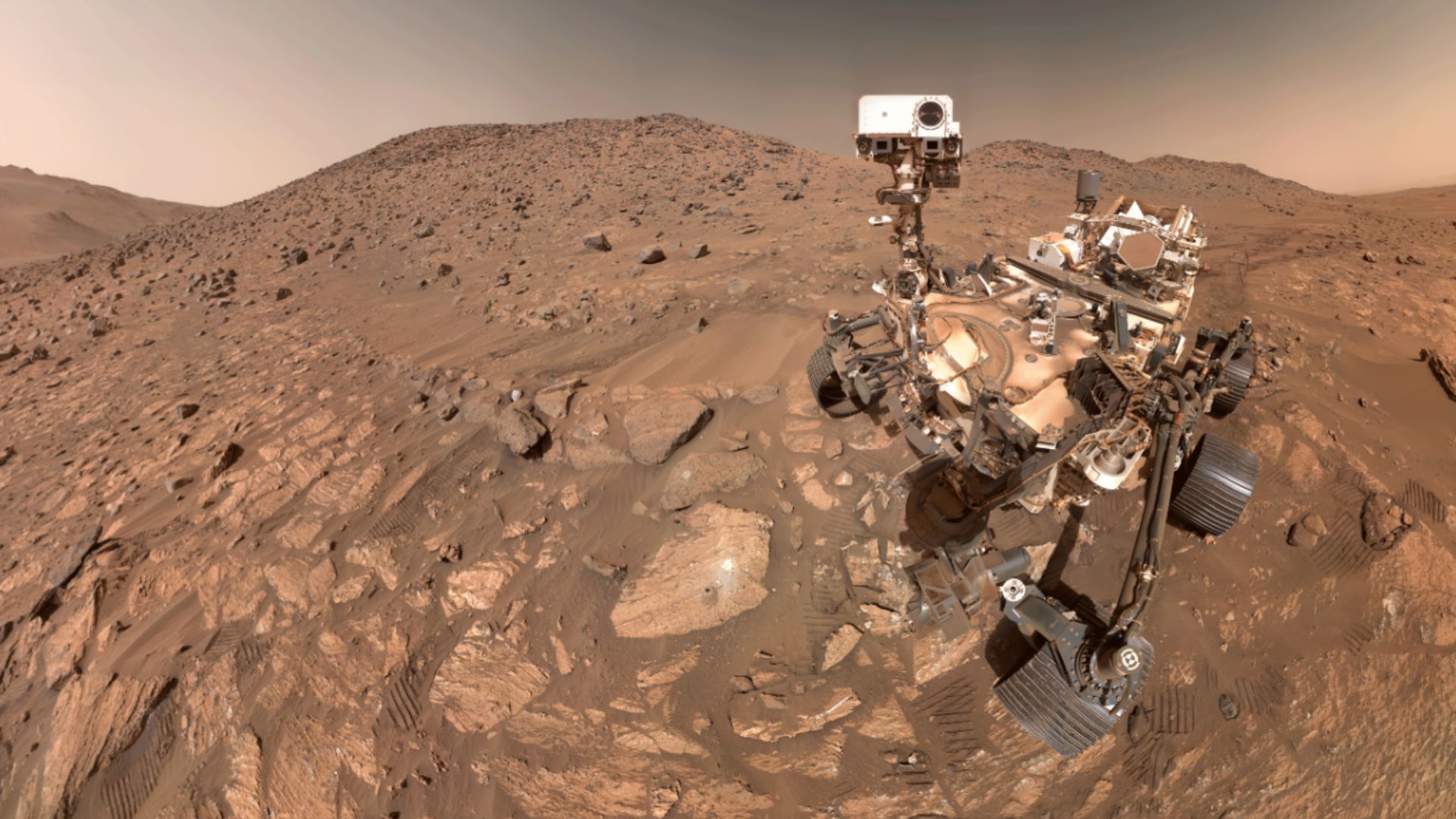
Hundreds of organic detections in ancient Martian mudstones make this Perseverance’s strongest find yet — but the gap between “complex carbon” and “proof of life” remains enormous.
NASA’s Perseverance rover has delivered the most robust organic carbon signatures ever recorded in Jezero Crater. The instrument responsible is SHERLOC — a deep-UV laser spectrometer mounted on the rover’s robotic arm that maps carbon molecules at near-microscopic resolution. It scanned mudstones in a region called Bright Angel, part of an ancient lakebed that once held standing water. What it found is tantalizing. What it proves is something else entirely.
Across rocks nicknamed Cheyava Falls and Walhalla Glades, SHERLOC detected a spectral fingerprint called a Raman G-band peak. Think of it as the calling card of macromolecular carbon — large, complex carbon structures tough enough to survive billions of years. The detections weren’t sparse or ambiguous. They numbered in the hundreds, scattered abundantly across multiple targets.
According to reporting in Eos, these findings represent “an unambiguous confirmation and corroboration of previous reports of organics on Mars” — and the first intact macromolecular carbon identified in Martian mudstones.
A few details sharpen the picture further:
- Bright Angel sits along an ancient riverbed connected to Neretva Vallis, a channel that once fed water into Jezero’s lake.
- Cheyava Falls contains iron phosphates and sulfides tightly associated with organic carbon — minerals that on Earth frequently form through microbial activity. A 2025 Nature paper classified these as “potential biosignatures.”
- Walhalla Glades shows organics linked to carbonate and sulfate minerals, pointing to a distinct water chemistry history.
- Researchers describe this as the most robust organic detection yet made anywhere in Jezero Crater.
What Complex Carbon Doesn’t Tell You
Confirming carbon’s complexity is not the same as confirming its origin — and that distinction matters enormously.
SHERLOC can confirm that material is carbon-rich and structurally complex. It cannot determine whether biology or geology put it there. As experts told New Scientist, the instrument “can’t give detailed information on the actual make-up of the compounds.” Macromolecular carbon forms in meteorites. It also forms through volcanic and hydrothermal processes. Complex doesn’t mean alive.
Context matters, though. Curiosity already found 3.5-billion-year-old organic carbon preserved in Gale Crater mudstones. Perseverance now confirms organics in a second ancient lake system. The Viking missions returned ambiguous results decades ago. The picture keeps sharpening — slowly, but unmistakably — just as discoveries about Lunar Interior continue to reshape our understanding of planetary science.
Think of it as a cold case file sitting on a detective’s desk: compelling evidence, still no conviction. The forensics lab capable of cracking it is Earth. Mars Sample Return would bring these cached rocks home for isotopic analysis no rover can yet perform. Bright Angel and Cheyava Falls are now high-priority targets. Humanity may be one lab result away from the most consequential answer science has ever been asked to deliver.