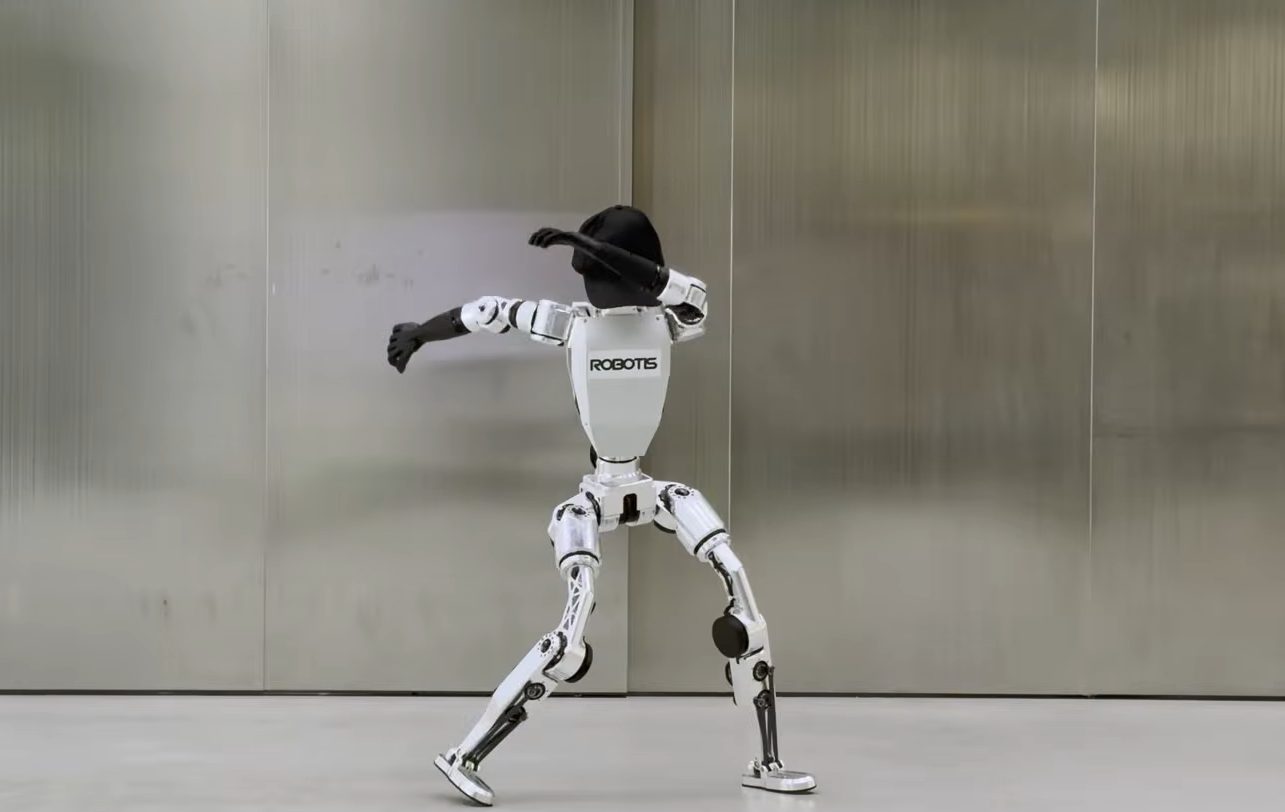
Teaching robots complex dances typically requires motion-capture studios costing hundreds of thousands of dollars. But ROBOTIS just shattered that barrier—their AI Sapiens humanoid learned the viral CORTIS “REDRED Challenge” from ordinary smartphone footage, no fancy equipment required.
Smartphone to Stage in Four Steps
How a phone video becomes robot choreography through open-source wizardry.
The process sounds like science fiction but runs on surprisingly accessible tech:
- Record human dancers with any smartphone
- Software converts those videos into digital motion data
- AI Sapiens practices the moves thousands of times in virtual reality—its digital twin stumbling through choreography until perfection emerges
- Learned behavior transfers to the physical robot through “Sim2Real” technology
This eliminates the traditional bottleneck where every robot motion required expensive motion-capture studios and teams of engineers hand-coding movements. Your TikTok could become tomorrow’s robot performance.
Hardware Built for the Dance Floor
Why AI Sapiens can nail complex choreography while others shuffle awkwardly.
Standing 1.3 meters tall and weighing 34 kilograms, AI Sapiens moves through 23 degrees of freedom powered by DYNAMIXEL-Q actuators. These aren’t typical robot motors—they’re quasi-direct-drive systems with high backdrivability, meaning the robot can react naturally to pushes and maintain balance during dynamic movements.
An NVIDIA Jetson Orin NX handles the computational heavy lifting, delivering 100 TOPS of AI processing power. Compare that to early humanoids that moved like arthritic mannequins, and you understand why smooth K-pop choreography was previously impossible.
Open Source Meets Open Market
The motion-learning pipeline goes public, democratizing robot training.
Here’s where things get interesting for developers and researchers: ROBOTIS plans to open-source the entire motion-generation pipeline. That means anyone can download the code, modify it, and train robots to perform custom movements from video demonstrations.
This positions AI Sapiens against competitors like Unitree’s G1 in the emerging sub-$10,000 humanoid category. While G1 focuses on agility, AI Sapiens bets on openness—providing bills of materials, CAD files, and now the learning algorithms that enable viral dance replication.
The implications stretch beyond entertainment. If robots can learn complex full-body coordination from casual video, manufacturing workflows and household tasks become trainable through demonstration rather than expensive programming. Your smartphone just became a robot training tool.