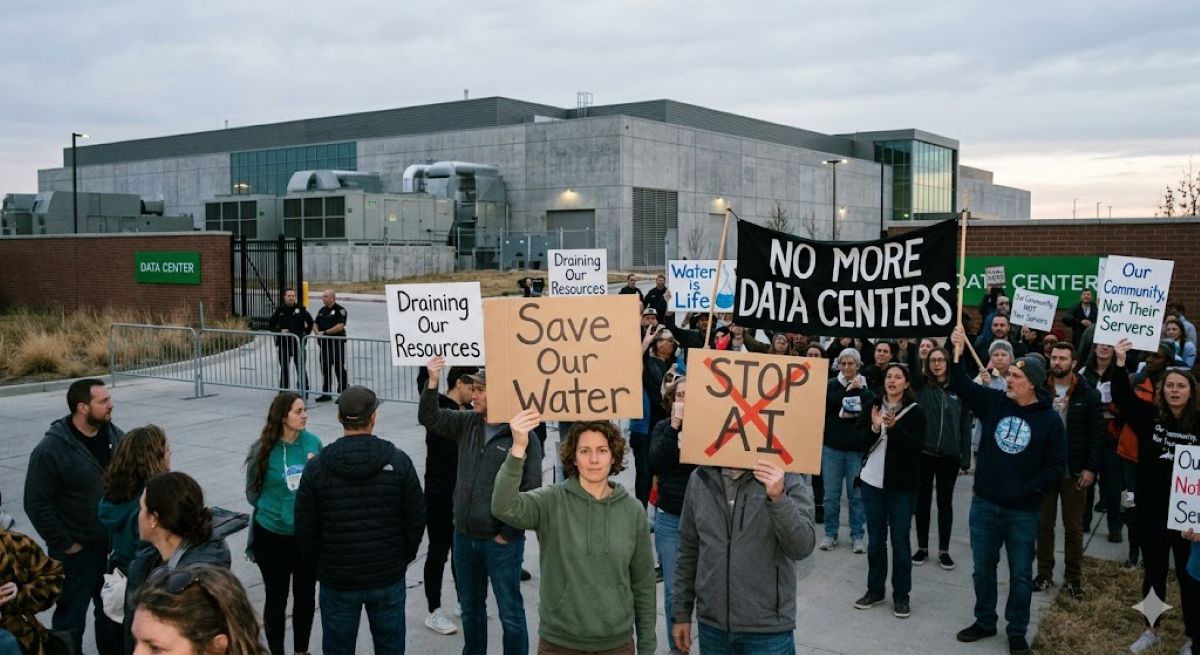
You are sitting in a packed town hall where neighbors who never agreed on anything unite against a proposed AI data center. They cite water usage, electricity bills, and noise—but something deeper echoes in their voices: fear about a future they didn’t choose and can’t control.
Gallup polling confirms this isn’t isolated anger: 71% of Americans oppose having AI data centers in their communities. That makes these facilities less welcome than nuclear power plants.
The numbers behind this revolt are staggering. Communities have blocked or delayed $64 billion worth of data center projects across the country. In Virginia, support for local data centers collapsed from 69% to 35% in just three years—among both Democrats and Republicans.
The grievances sound practical: these hyperscale facilities consume as much electricity as a million households while employing just 20-50 workers once operational. Residents watch their tax dollars subsidize tech giants who extract resources without delivering meaningful jobs or community benefits.
This isn’t really about noisy buildings or utility bills. Data centers have become America’s punching bag for AI anxiety—the one tangible thing ordinary people can fight when everything else about artificial intelligence feels remote and inevitable.
Congress hasn’t passed comprehensive AI rules while workers worry about job displacement and parents fret about their kids’ screen-dominated futures. The NAACP calls them “dirty data centers” that threaten climate goals while disproportionately burdening communities of color. Communities are witnessing democracy’s immune response to technological change that feels imposed rather than chosen.
Here’s the problem: blocking individual data centers won’t meaningfully slow AI development. Tech companies will simply build in more permissive jurisdictions or countries with weaker protections. Like previous fights over highways and wind farms, local veto power becomes a blunt instrument that can hinder beneficial infrastructure while failing to address underlying power imbalances.
What would actually matter? National AI policies that tie productivity gains to shorter workweeks, give workers say over workplace automation, or create public ownership stakes in AI development. Without credible visions where AI expands human agency rather than diminishing it, expect more communities to keep fighting the buildings because they’re the only part of this transformation they can actually see.