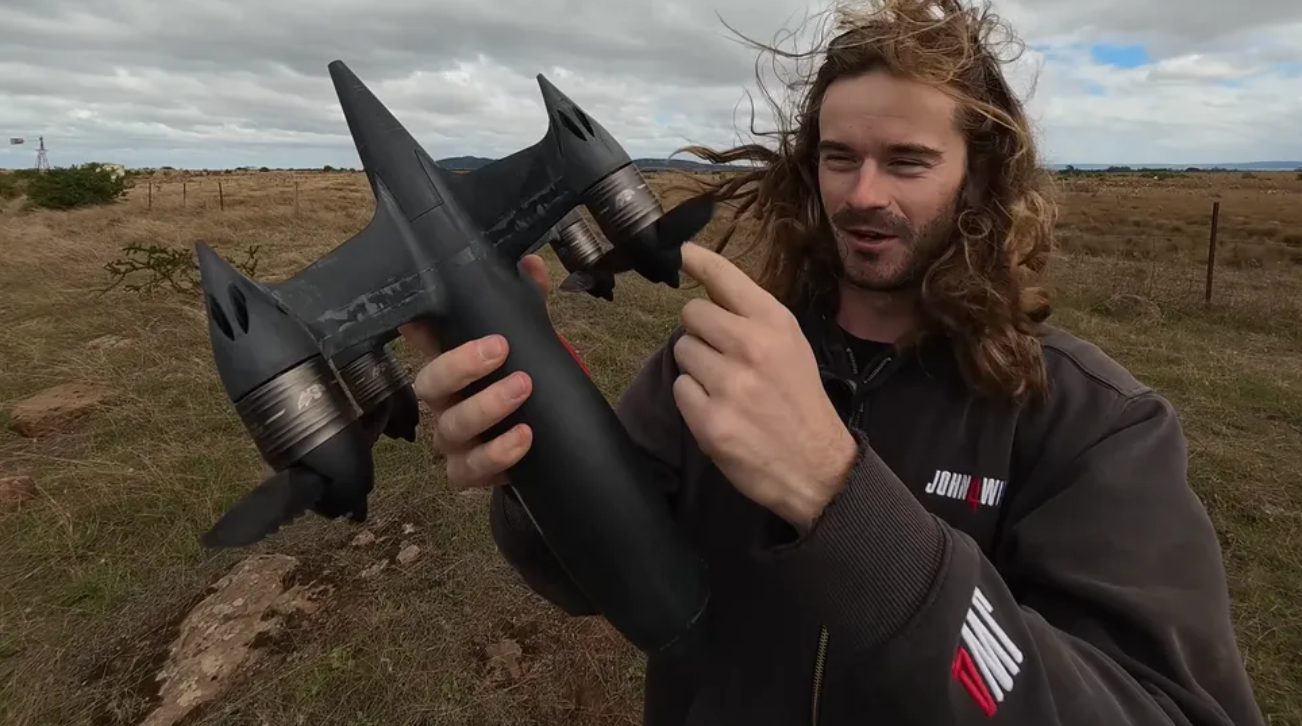
Your typical Sunday flight at the local park just got embarrassed. Aidan and Ben from Drone Pro Hub pushed their garage-built Blackbird drone to 453 mph during testing in Australia—faster than many regional aircraft cruise, approaching supersonic speeds.
That’s not a typo, and it’s not marketing spin. These two builders just redefined what’s possible with carbon fiber, batteries, and some seriously aggressive engineering.
Sawtooth Edges Solve High-Speed Propeller Problems
The breakthrough lies in their handmade propellers. Unlike conventional props that struggle at high speeds, these feature much steeper pitch angles—essentially tilting the blades closer to the direction of flight. Think of it like adjusting a ceiling fan blade: steeper angles work better when air is already moving fast but provide terrible performance when starting from zero.
The real innovation? Sawtooth leading edges that look like something from a shark documentary. These serrated cuts generate tiny vortices along each blade, preventing airflow from sliding sideways instead of moving straight back.
This boundary layer control lets the props run at angles that would normally cause conventional blades to stall and “act like a blender” instead of generating thrust.
Radio Links Fail at Fighter Jet Speeds
Reality hit hard during early testing. At 393 mph, the Doppler effect and signal overload caused complete radio failure between controller and aircraft. Once that connection dropped, recovery became impossible—the drone traveled several miles during its uncontrolled descent, ending up “completely mangled” according to the landowner who found the wreckage.
The successful 453 mph run came on their second airframe with limited battery power for just two passes. Factoring out the 34 mph tailwind gives a true airspeed around 419 mph, still crushing previous unofficial records like the Bell team’s Peregreen V4 at 408 mph.
The upwind pass hit 397 mph, averaging about 425 mph—short of their 434 mph target but well above established marks.
YouTube Engineering Meets Aerospace Innovation
This remains an unofficial achievement until formal verification, but the telemetry data tells a compelling story. The builders plan to repair their damaged airframe for an official attempt, which would require standardized timing gates and independent observers.
More importantly, garage-scale teams are now exploring flight envelopes that were recently the exclusive domain of well-funded aerospace programs and hypersonic missiles. As these DIY projects approach commercial airliner speeds, expect increased focus on long-range control systems and safety protocols—because 400+ mph crashes don’t leave much room for error.