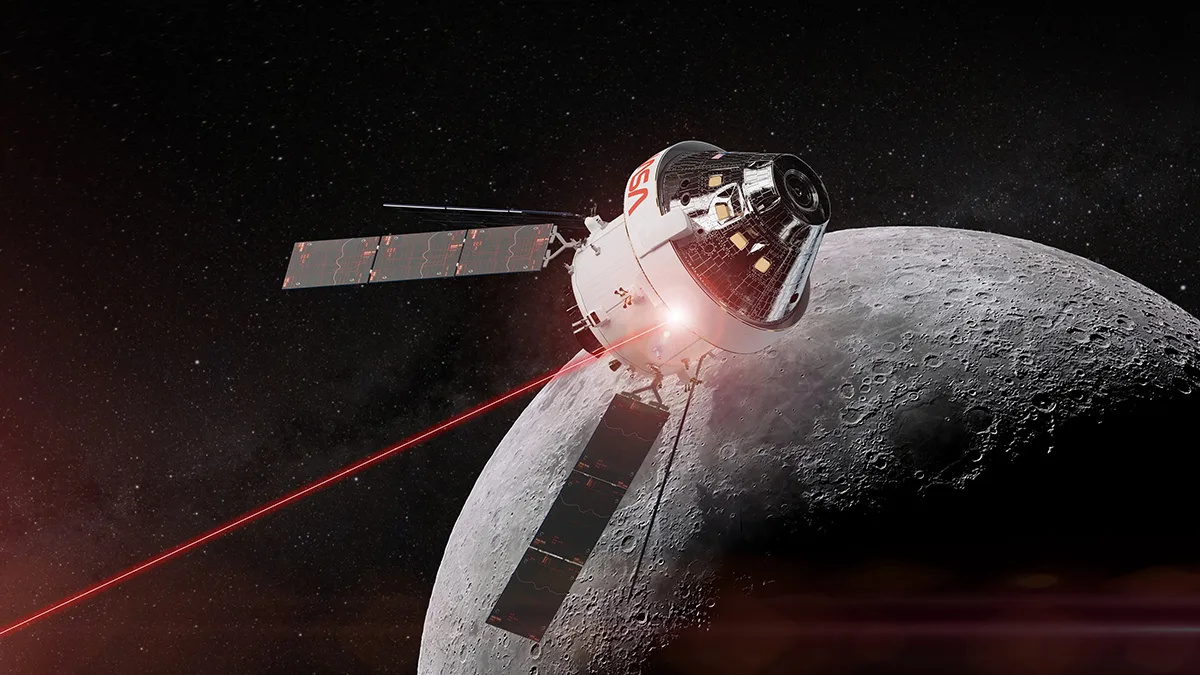
Your home broadband just got outclassed by a spacecraft heading to the Moon. Artemis II’s new Orion Artemis II Optical Communications System (O2O) will beam 4K video back to Earth at 260 megabits per second—faster than many household internet connections and light-years beyond Apollo’s grainy, static-filled transmissions.
While Neil Armstrong’s “one small step” came through crackling S-band radio that delivered low-resolution video, you’ll watch Artemis II’s crew with Netflix-quality clarity as they loop around the lunar far side. This isn’t just another incremental upgrade—it’s the difference between watching a pixelated livestream and experiencing cinematic-quality space exploration.
The secret lies in O2O’s laser-powered communication terminal, which replaces traditional radio waves with focused infrared light beams. This 4-inch telescope system locks onto ground stations in California and New Mexico, encoding mission data into laser pulses that carry exponentially more information than Apollo-era systems.
“At 260 megabits per second, O2O is capable of sending down 4K high-definition video from the Moon,” confirms project manager Steve Horowitz. The crew’s Nikon cameras will capture lunar surface details in vivid color and resolution that would make Apollo astronauts weep with envy.
This isn’t just a technical upgrade—it’s a cultural reset for how you experience space exploration. Instead of squinting at fuzzy black-and-white footage, you’ll see the Moon’s lunar surface in the same sharp detail as your favorite streaming show. The catch? Physics still rules: when Orion passes behind the Moon, that laser connection goes dark for 41 minutes, creating a planned communications blackout that no amount of bandwidth can fix.
Success here opens the floodgates for space content that actually competes with terrestrial entertainment. Future Mars missions could stream rover expeditions and astronaut activities with the production value of a nature documentary. The Moon transforms from a distant, static backdrop into a dynamic destination you can virtually visit—assuming the weather cooperates at those desert ground stations and the laser stays locked on target across 240,000 miles of space.