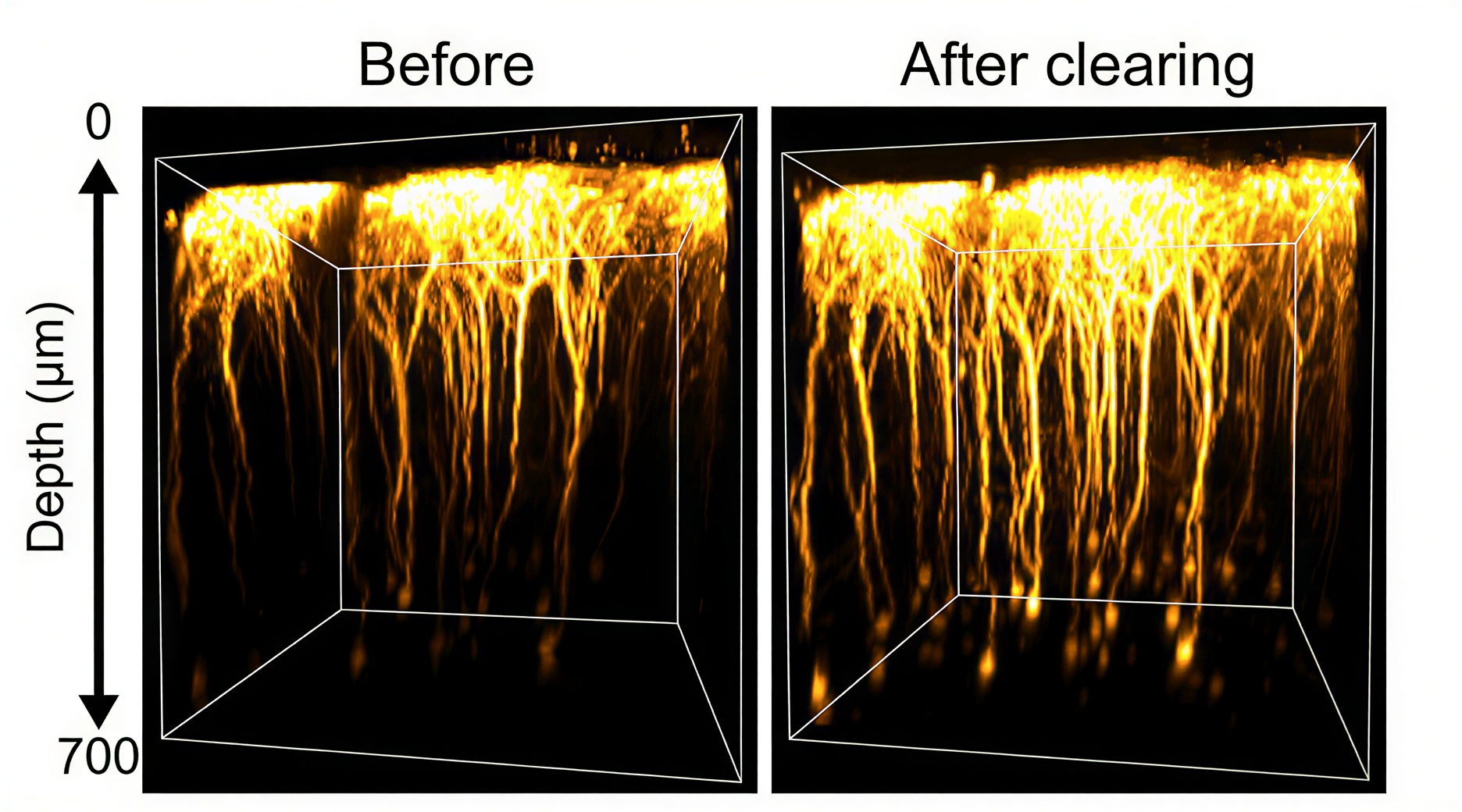
Japanese researchers achieved something that sounds ripped from a cyberpunk novel: making living brain tissue completely see-through without killing it. Your mind isn’t playing tricks—scientists at Kyushu University actually developed a method to render mouse brains transparent while they’re still firing neurons and processing information.
The Breakthrough That Changes Brain Imaging Forever
A blood protein solution creates crystal-clear views of living neural networks in just one hour.
The magic happens through SeeDB-Live, a reagent that uses albumin—the same protein floating in your blood serum right now. By matching the brain’s refractive index to 1.36-1.37, it eliminates light scattering that normally blocks deep tissue views.
The result? Fluorescence signals become three times brighter, revealing layer 5 cortex neurons with stunning clarity. Unlike previous methods that dehydrated or damaged tissue, this process reverses completely when the solution washes out.
From Lab Bench to Drug Discovery Pipeline
Transparent organoids could revolutionize how pharmaceutical companies test brain medications.
Professor Takeshi Imai notes this marks “This is the first time tissue clearing has been achieved [in an organism] without altering its biology,” That distinction matters enormously for drug testing on brain organoids—those lab-grown mini-brains that pharmaceutical companies increasingly rely on.
When you can watch neurons firing in real-time without interference, drug effects become immediately visible. Assistant Professor Shigenori Inagaki confirms “SeeDB-Live can pave the way for deep-tissue live imaging,” potentially accelerating treatments for Alzheimer’s, depression, and neurological disorders.
The Neuralink Connection Nobody’s Talking About
Better brain imaging could fast-track the brain-computer interface currently in development.
While Elon Musk’s Neuralink grabs headlines, this transparency breakthrough addresses challenges that brain-computer interface companies face in understanding neural tissue interactions. Current surgical access requirements limit immediate applications, but the reversible nature opens possibilities for repeated imaging sessions.
Picture debugging your neural implant the same way you troubleshoot a smartphone app—except the code runs on actual neurons.
The research, published March 12, 2026, in Nature Methods, represents more than clever chemistry. It’s a window into living consciousness itself, making the invisible machinery of thought suddenly, brilliantly visible.