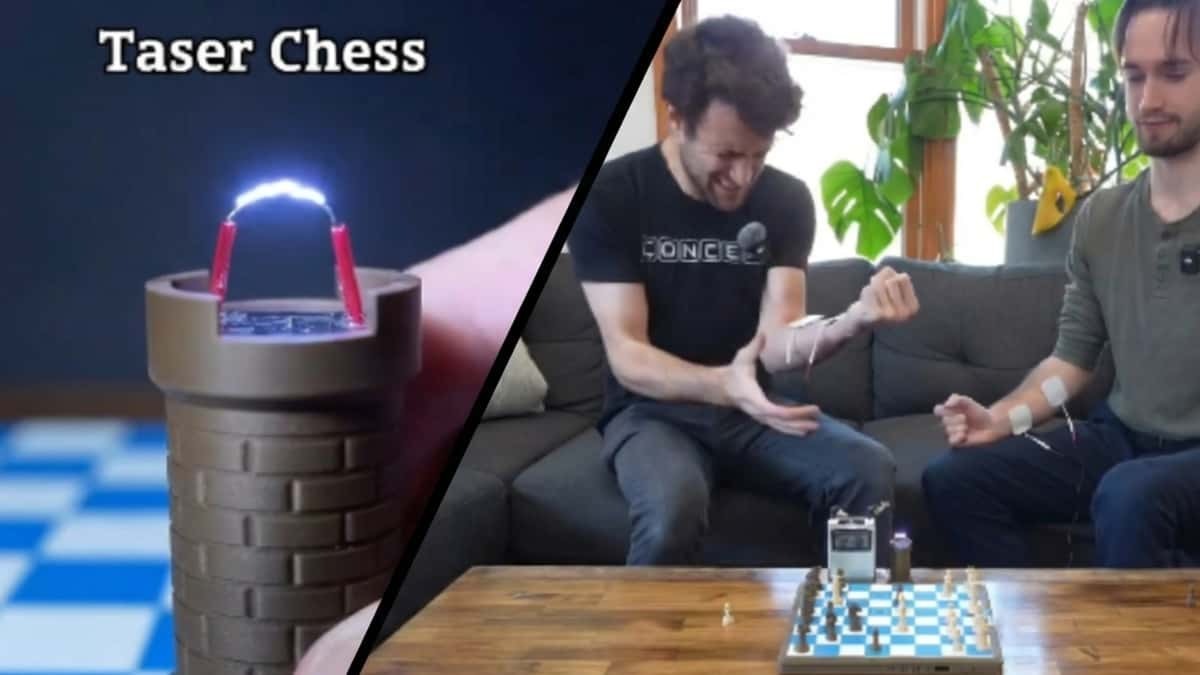
Losing your queen hurts enough without actual voltage, but the Open Chess project takes competitive gaming to electric extremes while democratizing smart board technology.
Competitive chess already punishes mistakes ruthlessly. Now Kevin from Concept Bytes has created a board that makes those punishments physical. His viral “taser chess” mode delivers actual electric shocks when you lose pieces—mild zaps for pawns, stronger jolts for your queen.
Think of it as negative reinforcement for the Netflix generation, where every blunder comes with immediate, memorable consequences. But beyond the viral appeal lies serious open-source innovation challenging expensive commercial alternatives.
Smart Hardware Meets Sadistic Software
The Open Chess board combines legitimate technology with playful punishment systems.
The foundation is legitimate tech hardware. Kevin’s 3D-printable board features 64 magnetic sensors detecting piece movement and 64 RGB LEDs providing visual feedback. An Arduino microcontroller runs open-source firmware that tracks games in real-time.
The custom PCB handles everything from move validation to those infamous shock penalties. You can program different intensities based on piece values or even punish illegal moves with escalating voltage. The Arduino code lives on GitHub for anyone to modify and extend.
DIY Democracy vs Premium Paywalls
This $22 project challenges expensive commercial smart boards costing twenty times more.
Commercial smart chess boards like DGT models cost around $600. Kevin’s approach flips that equation entirely. His PCB costs roughly $22 for five boards through services like JLCPCB.
The 3D-printable components work on standard printers, making the entire system accessible to makers worldwide. It’s open-source hardware meeting maker culture, proving that innovation doesn’t require corporate budgets or closed ecosystems.
Going Viral Through Voltage
Creator Kevin’s shock demonstration videos turned a DIY project into internet sensation.
Kevin’s Instagram and YouTube shorts showing players getting zapped mid-game launched this project into viral territory. The taser mode wasn’t just a gimmick—it demonstrated the board’s programmability in the most attention-grabbing way possible.
His PledgeBox crowdfunding campaign capitalizes on that buzz, offering an accessible entry point for makers who want custom chess experiences without commercial limitations. The maker community has embraced both the serious hardware and humorous shock features.
The Open Chess project represents something bigger than electrified entertainment. It shows how open-source hardware can democratize smart gaming peripherals while adding features no commercial manufacturer would dare include. Sometimes the best innovations come from makers willing to shock themselves—literally—in pursuit of better gameplay.