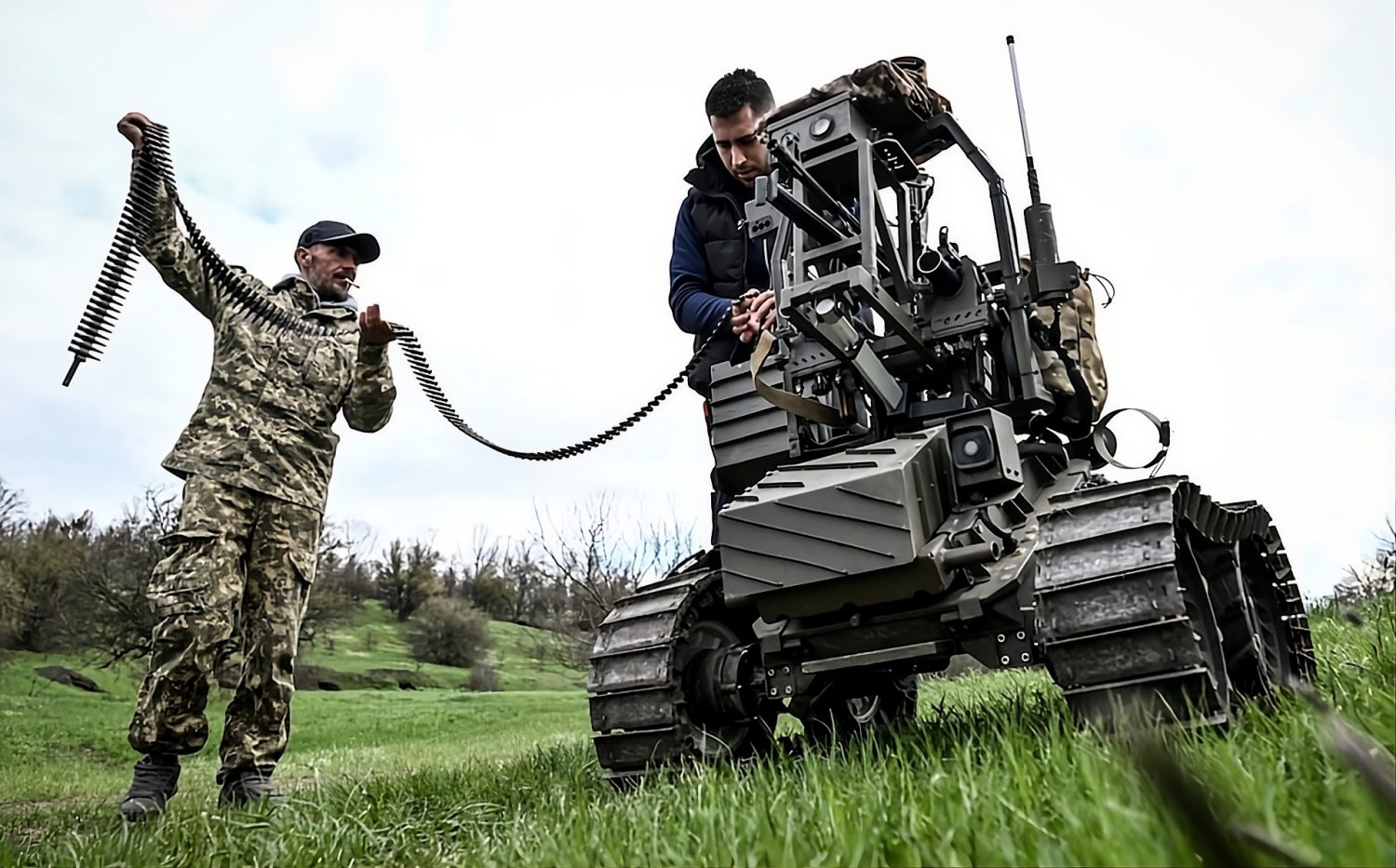
Sometime in the dark over northern Donetsk, a heavy drone crossed the front line carrying not a bomb, but a wheeled robot. According to Ukraine’s 3rd Army Corps, that robot was released more than 10 kilometres behind Russian positions, dropped into occupied territory to do what no Ukrainian soldier was sent to do.
The 3rd Army Corps calls this Operation Vivaldi, and describes it as the first time any military force has used an aerial drone to deploy a combat ground robot behind enemy lines. That claim belongs to the Corps; independent verification is not available.
What Happened on the Ground
The robots, referred to as Hryphons in official 3rd Army Corps accounts and also written as “Gryphons” in some secondary reporting, are remotely operated ground vehicles built to carry explosives toward a target. Available reporting describes them as operator-directed rather than fully autonomous, with trained personnel directing each vehicle and making targeting decisions.
Getting them 10 kilometres behind Russian lines required coordination that looks straightforward only in retrospect. According to The Telegraph, Ukrainian forces ran the operation at night. A drone large enough to carry a ground robot is large enough to be seen and shot.
Electronic warfare units worked to disrupt Russian reconnaissance drones, while artillery and aerial strikes suppressed troops who might otherwise have spotted the carrier aircraft and opened fire. The NC13 strike UGV unit developed and operated the Hryphon platforms, according to the 3rd Army Corps, with support from the Corps’ unmanned aviation units.
The Human Weight of the Operation
Darwin, identified by The Telegraph as commander of the 2nd Mechanized Battalion of the 3rd Army Corps, said the robots “make the war safer for our soldiers.” That sentence carries the whole weight of what the operation was designed to do , a goal that parallels how a robotic knee exoskeleton aims to keep human bodies out of harm’s way in demanding physical environments.
The 3rd Army Corps claims Operation Vivaldi contributed to more than 3,000 Russian personnel losses and the recovery of approximately 48 square miles of territory. Other reporting uses the broader term “casualties,” which typically includes both killed and wounded personnel. Neither figure has been independently confirmed, and both should be understood as Ukrainian military claims.
What is documented is that infantry still moved in after the robotic and artillery strikes. The Hryphons and other systems supported the advance; Ukrainian soldiers then walked that ground and held it.
The Limits of What Machines Can Do
Large carrier drones are vulnerable to air defence and small-arms fire. Communications links can be disrupted by Russian jamming. Electronic warfare, surveillance drones, artillery and ground fire remain serious threats to every part of this chain. Modern strike platforms such as hypersonic missiles face their own distinct vulnerabilities within layered defense systems.
Weather and terrain impose their own constraints. Trained operators are not interchangeable, and the operation required heavy-lift drones, secure command links, electronic warfare support, artillery coordination and infantry readiness to work together under pressure. The sources do not establish that nothing went wrong; they establish that the mission was completed.
None of that diminishes what the 3rd Army Corps reportedly achieved. It clarifies what it actually cost: the logistics, the preparation, the sustained human expertise behind every machine deployed that night.
What Operation Vivaldi signals is not the end of soldiers. It is the expansion of what soldiers now have to learn to coordinate, trust and send forward in their place.
Every remote-controlled strike raises a question no military communique answers cleanly. What does it mean to act at distance, through a screen, with a machine that carries your decision but not your body?