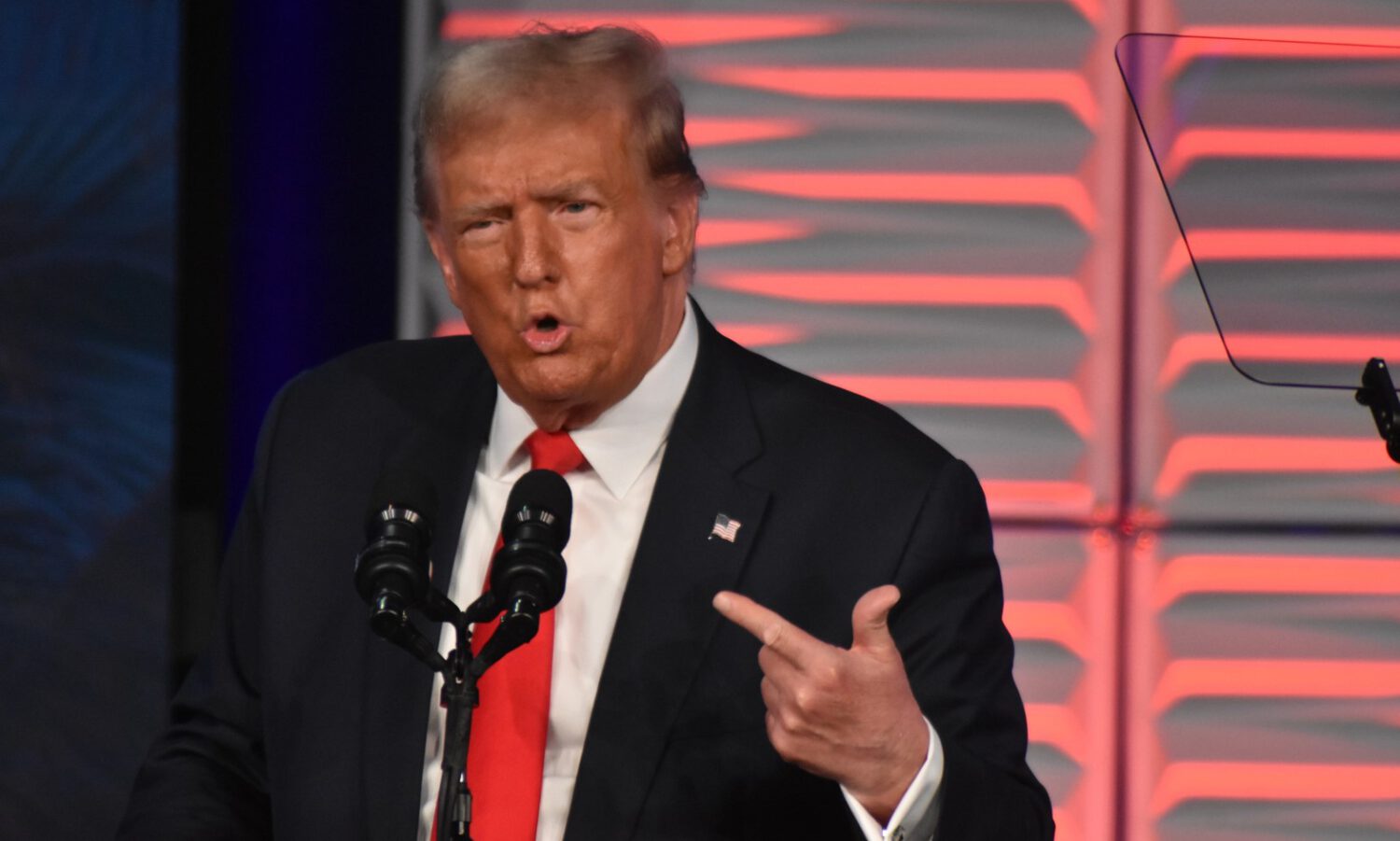
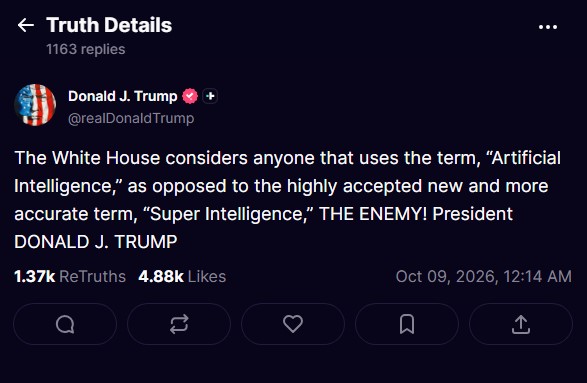
There is now a correct way to say “artificial intelligence,” at least according to the White House, and using the wrong term puts you in hostile territory. President Donald Trump posted on Truth Social that the administration considers continued use of “artificial intelligence” an act of opposition. The post escalates a broader push to rebrand the technology, though the replacement word already carries a specific technical meaning that no current product meets.
What Trump Actually Said
Trump’s Truth Social post turned a terminology preference into a political line in the sand.
Trump’s post, as reported by Arab News, read: “The White House considers anyone that uses the term, ‘Artificial Intelligence,’ as opposed to the highly accepted new and more accurate term, ‘Super Intelligence,’ THE ENEMY!” Available reporting does not identify any formal legal consequence for continuing to say “AI.”
The Word Gap That Matters
“Superintelligence” means something precise to researchers, and current tools do not meet that definition.
In AI research, “superintelligence” describes a hypothetical system that surpasses human cognitive ability across nearly all domains. No existing product has reached that threshold, according to PolitiFact.
Trump’s administration has applied the term as a wholesale replacement for “artificial intelligence,” collapsing that distinction. The underlying software, its data practices, and its capabilities remain unchanged regardless of what officials call it.
The Industry Accord
Major companies joined a voluntary agreement with no stated consequences for non-compliance.
Executives from Google, Anthropic, Meta, OpenAI, xAI, and Nvidia participated in the White House “Accord on Super Intelligence,” per Axios. Some of those same executives continued using “AI” in their own public remarks after signing.
The accord carries no enforcement mechanism, according to Reuters. A YouGov poll cited by Axios found 53% of respondents still prefer “artificial intelligence” as the standard term, against 9% who prefer “super intelligence.”
Trump also announced a “Super Intelligence Force” to coordinate federal engagement with AI companies, led by Director of National Intelligence Jay Clayton, per NPR.
What Changes for You
The practical impact lands on federal agencies, not on the consumer software or research literature you use every day.
Federal agencies are directed by a September 29 executive order to use “super intelligence” in official communications. Government contractors may face pressure to follow in government-facing material, though that outcome is not established by the order itself.
Consumer products, technical documentation, and academic research are likely to continue using “AI.” The more durable concern is public confusion: applying “super intelligence” to today’s tools blurs the line between software that autocompletes your sentences and a hypothetical future system that does not yet exist. That distinction is worth keeping clear.