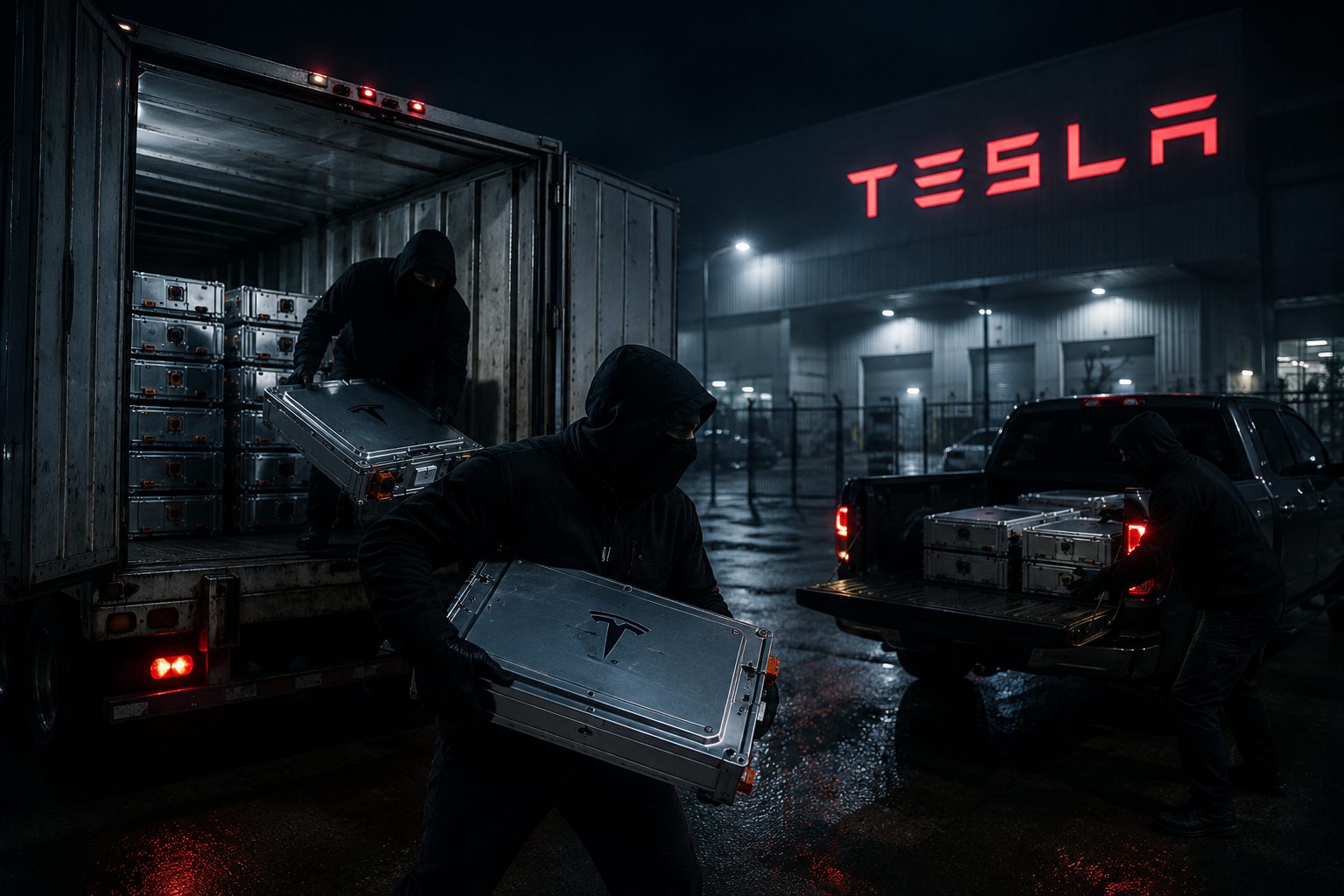
Half a million dollars in Powerwall batteries, loaded on a trailer, handed to a driver with forged credentials, and gone before anyone noticed. That scene played out at least 11 times since December at Tesla’s Nevada Gigafactory, according to Storey County sheriff’s records obtained by Wired. Customers awaiting Powerwall 3 installations may have found an explanation. The company that writes autonomous driving software apparently couldn’t verify a trucker’s credentials at a loading dock.
Fake IDs, Ghost Carriers, and an $18 Million-a-Day Problem
These aren’t smash-and-grab jobs — organized groups exploited Tesla’s own logistics chain from the inside out.
The thieves used forged commercial driver’s licenses, impersonated legitimate carriers, and exploited sloppy vetting by freight brokers. On January 19, a trailer carrying 123 Powerwalls destined for Hayward, California simply never arrived. Sheriff’s reports noted the contracted carrier wasn’t even licensed for interstate operations — a freight broker had handed the job to a phantom. Nationally, US cargo theft doubled between 2022 and 2024, costing an estimated $18 million per day, according to industry data cited by Wired. criminal networks behind these schemes have grown increasingly sophisticated, outpacing traditional law enforcement responses.
- Two trailers carrying $475,000-plus each in Powerwall 3 systems turned up empty 500 miles away in Southern California
- On January 19, 123 Powerwalls vanished after a freight broker unknowingly awarded the load to an unlicensed carrier
- Stolen Powerwalls flagged in Tesla’s system cannot be activated — buyers end up with expensive, useless hardware
“It’s an epidemic right now.” — Detective Sam Hatley, Storey County Sheriff’s Office
Detectives planted a GPS tracker on a recovered trailer, planning to catch thieves returning for it. Then Tesla employees retrieved the trailer themselves and were stopped by deputies — derailing the sting entirely. On January 30, law enforcement arrested three suspects moving a separate police-tracked trailer, recovering roughly $500,000 in stolen product, according to mynews4.com. Trials are scheduled for October.
A Company That Builds the Future Can’t Secure Its Loading Dock
Tesla acknowledged basic protocol failures — but the thefts haven’t stopped entirely.
A Tesla associate manager admitted in sheriff’s reports that early thefts resulted from failure to follow basic security protocols. The company has since tightened gate procedures and begun systematic driver identity verification. Detective Hatley says the measures are “definitely helping,” and “It’s going to take a concerted effort with carriers and brokers and victims and law enforcement.” though thefts continue at a reduced pace. Worth noting: in 2018, Tesla reportedly refused to cooperate with Storey County investigators on factory thefts, with a whistleblower later claiming over $37 million in losses went undisclosed. Relations improved after 2019. Tesla declined to comment for Wired’s story.
Congress passed a bipartisan cargo theft bill now awaiting Senate action. Amazon already deploys AI anomaly detection and daily carrier screening to protect shipments. Tesla, meanwhile, keeps expanding Nevada operations — more battery lines, Semi production, higher-value outbound loads every quarter. The security problem scales with the ambition, and right now the ambition is pulling ahead.