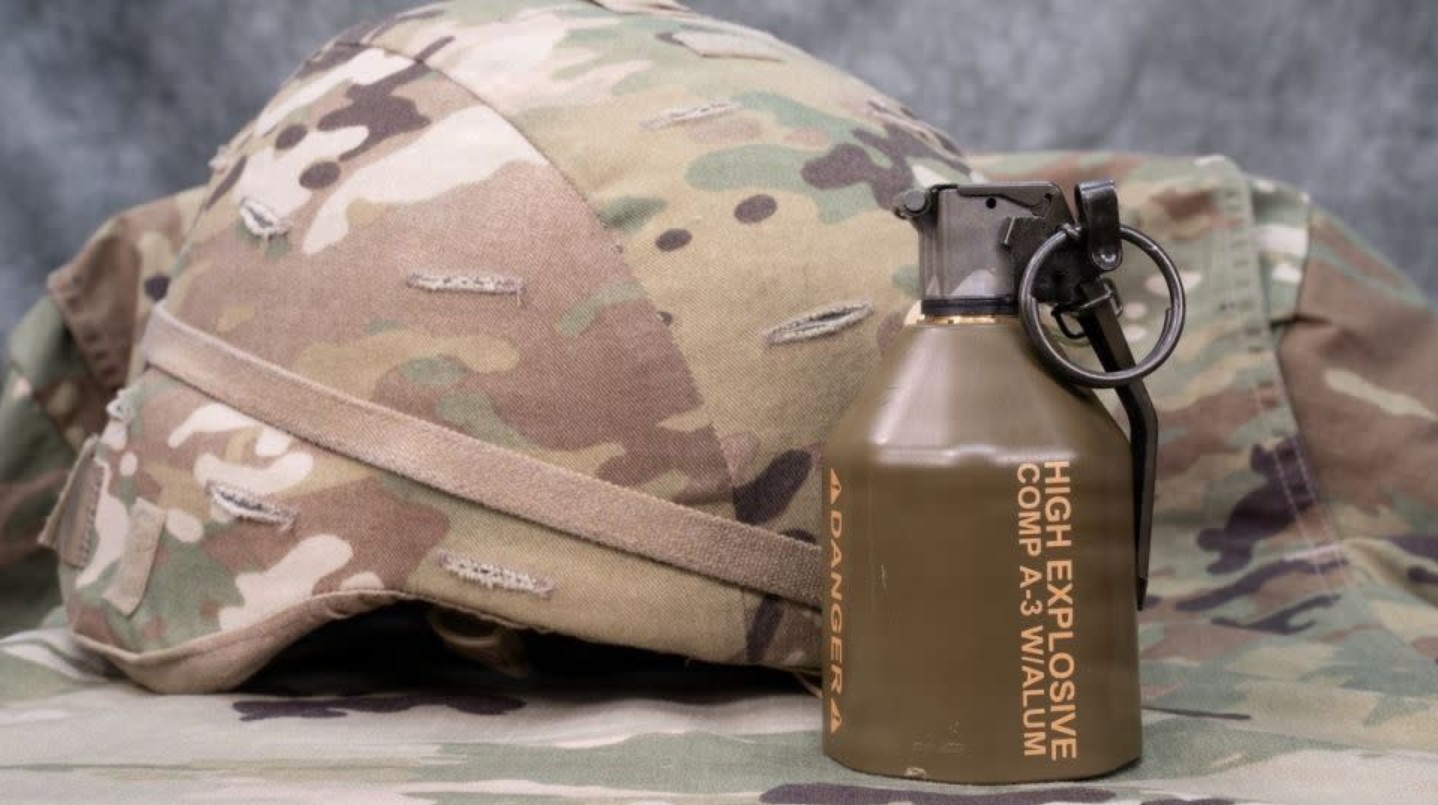
The US Army just approved its first new lethal hand grenade since 1968, and it’s nothing like the baseball-sized fragmentation bombs previous generations used. The M111 Offensive Hand Grenade represents a fundamental shift from metal shrapnel to pure shock wave technology, designed specifically for the urban warfare realities that emerged from Iraq’s street-to-street fighting.
Plastic Body Delivers Invisible Destruction
This palm-sized cylinder uses a plastic body that completely vaporizes on detonation, eliminating the metal fragments that made previous grenades dangerous to friendly forces. Instead, it relies on blast overpressure (BOP)—rapid compression and decompression waves that target human organs directly. The RDX explosive creates shock waves that affect eardrums, lungs, and other soft tissue without producing a single piece of shrapnel. Think of it as weaponized physics rather than weaponized metal.
Urban Combat Demands Smarter Solutions
The M67 fragmentation grenade, unchanged since the Vietnam War, creates deadly flying metal that ricochets unpredictably off walls and penetrates barriers. In urban warfare, that shrapnel becomes as dangerous to American soldiers as to enemies. “A grenade utilizing BOP can clear a room of enemy combatants quickly leaving nowhere to hide while ensuring the safety of friendly forces,” explains Col. Vince Morris, the Picatinny Arsenal project manager who oversaw development.
Familiar Training, Revolutionary Technology
Developed at Picatinny Arsenal by DEVCOM Armaments Center, the M111 shares the same fuze system as the M67, meaning soldiers won’t need new training protocols. This standardization saves costs while giving troops tactical flexibility—fragmentation for open terrain, blast overpressure for enclosed spaces. The Marines are pursuing similar technology with their M21 grenade from Norwegian manufacturer Nammo, signaling a service-wide shift toward specialized urban munitions.
The M111 enters full material release this March, finally replacing the asbestos-laden Mk3A2 that was withdrawn decades ago. After 58 years of relying on Vietnam-era technology, American forces now have purpose-built tools for the wars they’re actually fighting.