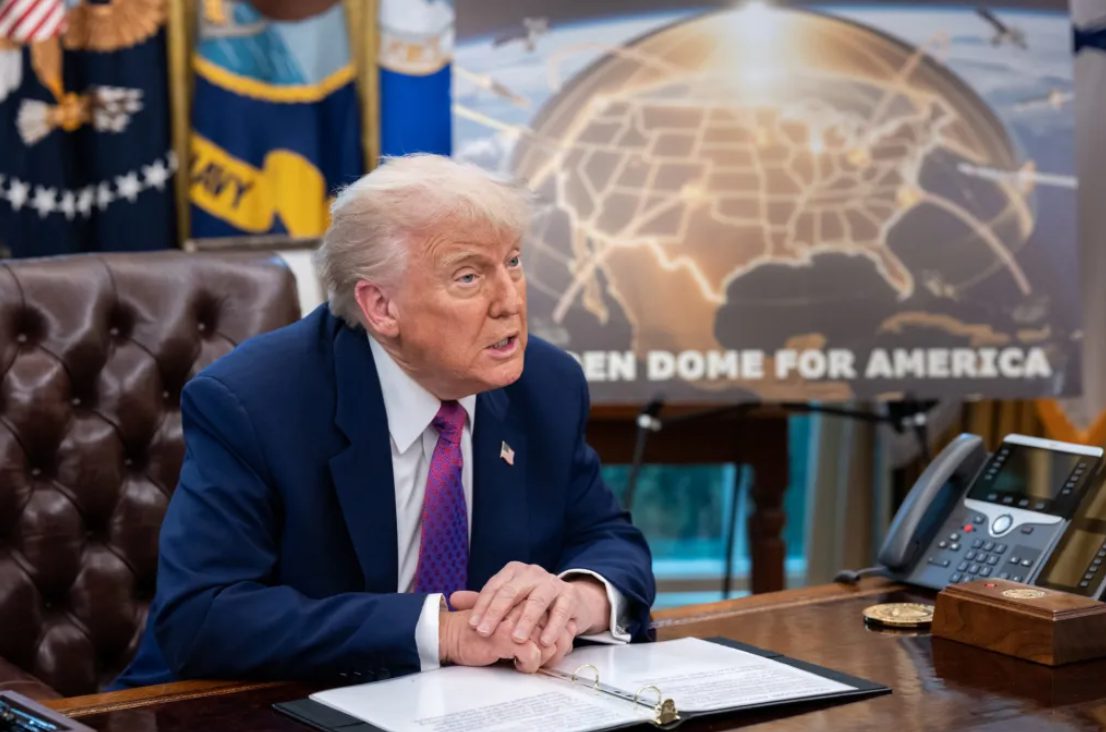
You’re funding the most expensive defense system in human history to handle what amounts to a medium-sized missile salvo. The Congressional Budget Office just dropped a reality check on Trump’s “Golden Dome” missile defense: $1.2 trillion over 20 years, with the bulk of that astronomical sum going toward 7,800 space-based interceptors that can simultaneously engage exactly 10 incoming missiles.
That’s $743 billion for the space layer alone—roughly 60% of the entire program cost. The math gets uglier when you dig deeper.
The Replacement Treadmill That Never Stops
Each satellite costs $22 million but survives only five years in orbit before atmospheric drag destroys it.
Each satellite costs an average $22 million and lives just five years in low Earth orbit before atmospheric drag drags it back to Earth. Simple arithmetic reveals the maintenance nightmare: keeping 7,800 interceptors operational requires launching 30,000 replacement satellites over two decades. That’s launching and replacing an entire constellation every five years, forever.
CBO’s estimate demolishes the Trump administration’s $175-185 billion price tag like a hypersonic missile through tissue paper. The discrepancy suggests either the Pentagon has a radically different system in mind, or someone’s budget math makes Enron’s accounting look conservative. With Congress having approved just $24 billion so far, the funding gap resembles the Grand Canyon.
Launch costs aren’t even the problem—CBO assumes SpaceX’s Starship brings that down to $500 per kilogram. The satellites and their interceptors devour the budget, not the rockets carrying them to orbit.
A Shield That Admits Its Limits
Despite trillion-dollar costs, the system cannot defend against Russian or Chinese nuclear arsenals.
Despite consuming more money than most nations’ entire GDP, this constellation explicitly cannot defend against Russian or Chinese nuclear arsenals. CBO’s model targets “regional adversaries” like North Korea or Iran—countries that might launch 10 ICBMs simultaneously if they’re having their worst day ever.
Think about that strategic calculus. The system that costs more than building 50 aircraft carriers can’t handle a serious superpower exchange, only smaller threats that existing ground-based systems already address. Russia and China could overwhelm Golden Dome by simply building more missiles—a much cheaper proposition than orbital interceptors.
Space Force Chief Gen. Chance Saltzman defends the concept by arguing adversaries have already placed “interceptors in space,” referring to anti-satellite weapons. But deploying 7,800 armed satellites would militarize orbit like never before, potentially triggering the arms race Golden Dome supposedly prevents.
You’re witnessing the Pentagon’s biggest bet since the Manhattan Project: that space-based missile defense justifies costs exceeding the entire Apollo program. The question isn’t whether America can afford this system—it’s whether a trillion-dollar constellation that can’t stop major powers makes strategic sense when you’re paying $74 billion per missile it can actually intercept.