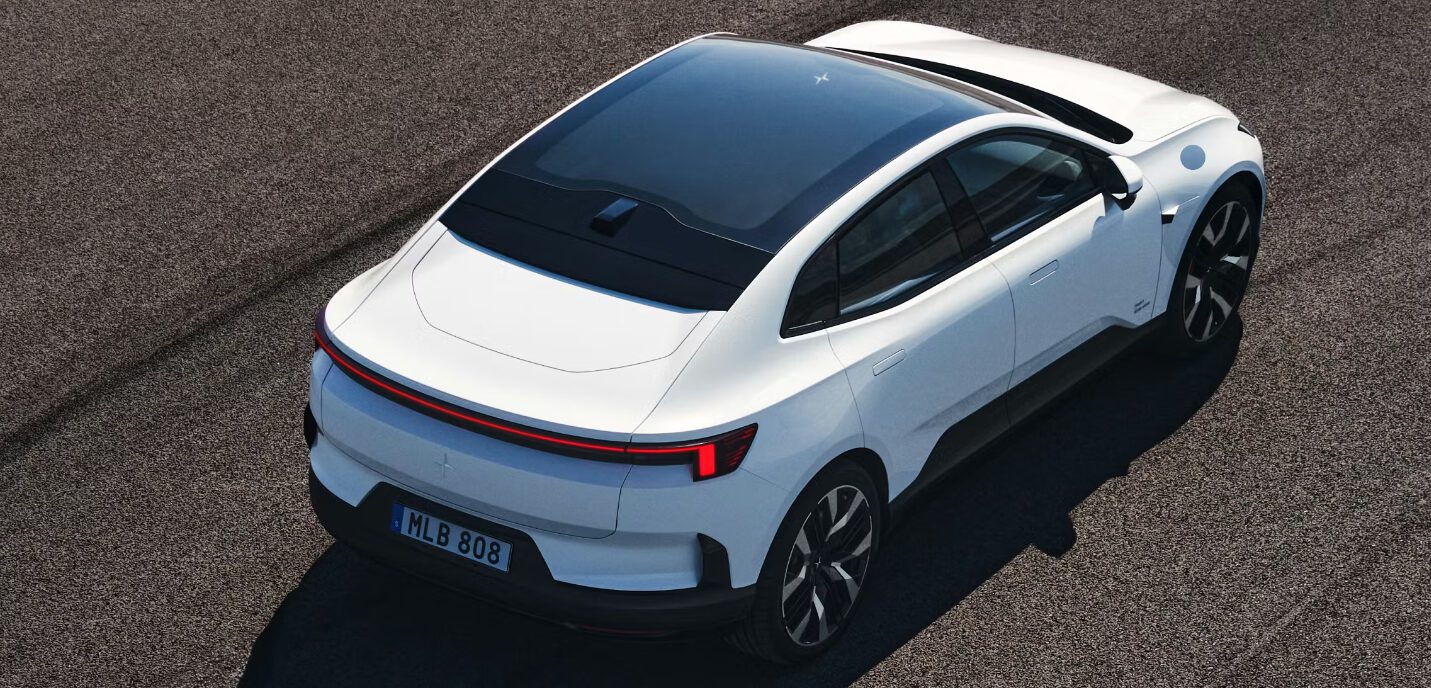
You glance up at your rearview mirror during rush-hour traffic and see nothing. Not because you’re driving badly, but because your $56,400 Polestar 4 doesn’t have a rear window. Instead, a high-definition camera feeds live video to a display where your mirror used to be.
Welcome to Swedish automotive philosophy, where eliminating a car’s rear window somehow counts as progress. The 2026 Polestar 4 is the first mass-market electric vehicle to ditch this century-old feature entirely. But before you dismiss this as Scandinavian design excess, consider what you actually see in your current rearview mirror.
When Mirrors Became Decoration
Most SUV rear windows are already functionally useless, sitting 10 feet away behind two rows of headrests.
Your typical SUV’s rear window sits roughly five feet off the ground, making traffic cones invisible from closer than 35 feet. Those headrests blocking your view? They’ve turned your mirror into automotive theater. You probably rely more on side mirrors and backup cameras already.
Sports cars figured this out decades ago. In the 1976 film “The Gumball Rally,” a Ferrari Daytona driver snaps off his rearview mirror and tosses it aside, declaring, “What’s behind me is not important.” Polestar’s designers reached the same conclusion, just with more Swedish engineering restraint.
The Polestar 4’s rearward-shifted roofline—designed for coupe aesthetics while maintaining rear headroom—would have made a traditional rear window practically useless anyway. Rather than install a decorative glass rectangle, they eliminated it completely.
Camera Never Blinks
The digital replacement system combines HD cameras, ultrasonic sensors, and auto-dimming displays that reportedly judge distances better than traditional mirrors.
Polestar’s solution centers on a roof-mounted HD camera feeding a display shaped like a traditional mirror. The system includes graphical overlays, warning tones, and wide-angle views that extend beyond what glass could provide. Four parking cameras and 12 ultrasonic sensors create a 360-degree awareness bubble around the vehicle.
Early road testers report the imagery feels “convincingly mirror-like” with decent resolution and low-light sensitivity. Auto-dimming algorithms prevent glare while maintaining visibility—something traditional mirrors struggle with during night driving.
The trade-off? Complete dependency on electronics. Camera failure or display malfunction eliminates rear visibility entirely, a scenario impossible with simple glass. Yet this reflects broader automotive reality: modern vehicles already rely heavily on electronic systems for basic functions.
Reality Check
Chinese buyers haven’t rejected the design, suggesting consumer acceptance may be stronger than industry skeptics predicted.
The Polestar 4 launched in China last December without suffering sales disadvantages. Early market signals suggest traditionally minded consumers aren’t fleeing from the no-window design. Performance specs help: 544 horsepower, 3.7-second acceleration, and 255-mile range in the dual-motor variant.
This isn’t automotive revolution—it’s evolution acknowledging what already happened. Modern SUVs had already abandoned functional rear visibility through design choices prioritizing style over sight lines. Polestar simply formalized that abandonment with superior digital alternatives.
The real question isn’t whether you’re ready for a car without rear window. It’s whether you’re still mourning a technology that was already dead.