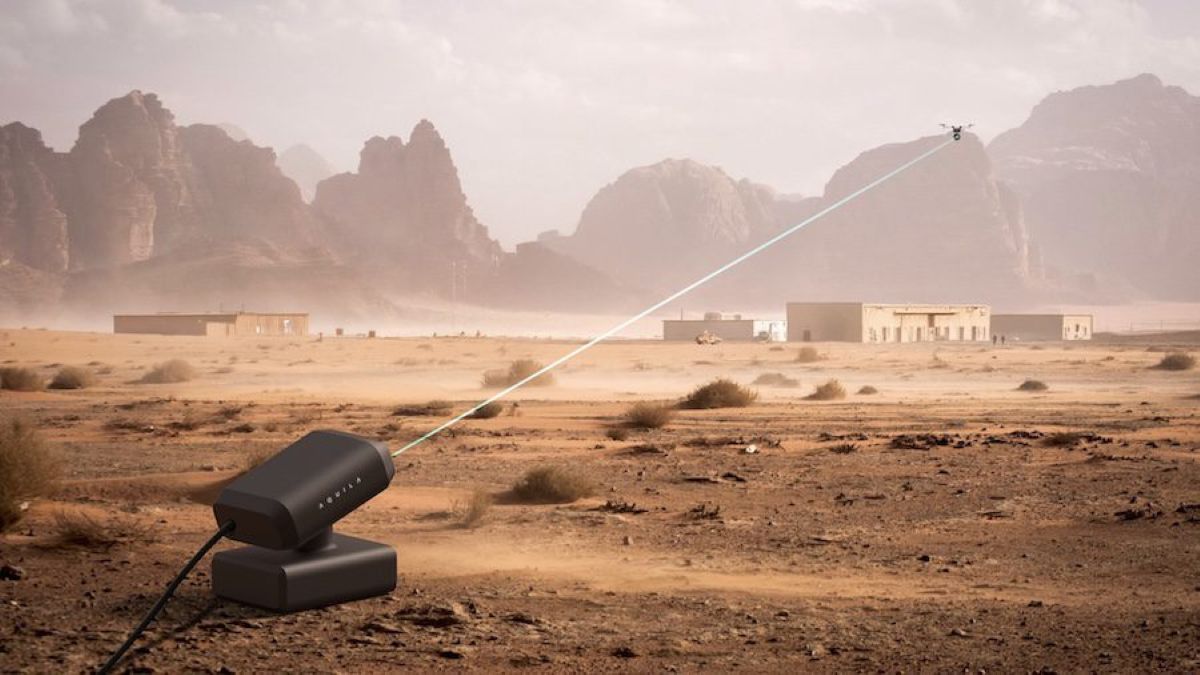
Dead batteries shouldn’t sideline your warehouse robots mid-shift, but Aquila Earth just proved they don’t have to. This Sydney-based startup powered a warehouse robot for 24 hours straight using nothing but a 4-kilowatt laser beam—no charging breaks, no battery swaps, no downtime.
Think of it as a wireless power cable made of light. Aquila’s system converts grid electricity into a focused infrared laser, beams it through the air to a receiver mounted on the robot, then converts that light back into electrical power. The robot traveled roughly 25 kilometers during the test run, operating on laser power with only nominal battery backup.
Safety Meets Science Fiction
The safety angle matters more than the sci-fi factor here. Aquila built automatic shutoffs that kill the beam instantly when unexpected objects—like humans—enter the laser path. CEO Ruby Jones calls this protection “foolproof” from the operator’s perspective, addressing the obvious concern about invisible infrared beams powerful enough to run industrial equipment.
“It’s the most power that has ever been delivered to a dynamic platform,” Jones told Renew Economy. “Nobody else has ever done it with that much power in power beaming, ever.” The company claims two world records:
- Highest total laser power transferred to a moving platform
- Longest continuous duration at this power level
Racing Against Battery Physics
Aquila isn’t alone in this wireless power race. Japanese giants Mitsubishi Heavy Industries and NTT recently transmitted 1 kilowatt over one kilometer, achieving 152 watts of received power at 15% efficiency. PowerLight Technologies has logged 15 years of beaming demonstrations, though typically at lower power levels or shorter durations than Aquila’s warehouse marathon.
The timing aligns with broader warehouse automation trends—facilities increasingly rely on AI-driven robots for inventory management and order fulfillment, but battery limitations still constrain operational efficiency.
Commercial Reality Check
Aquila targets commercial deployment around 2027, with partnerships already sketched out with major drone companies. The economics have shifted dramatically: kilowatt-class lasers that cost $120,000 when the company launched in 2022 now run about $6,000 from Chinese suppliers.
Your warehouse robots could soon operate like they’re plugged into an invisible extension cord, eliminating the battery anxiety that currently forces scheduled downtime. Jones envisions “perpetual” drones and robots that never need to land or dock—they just keep working as long as the laser stays on.