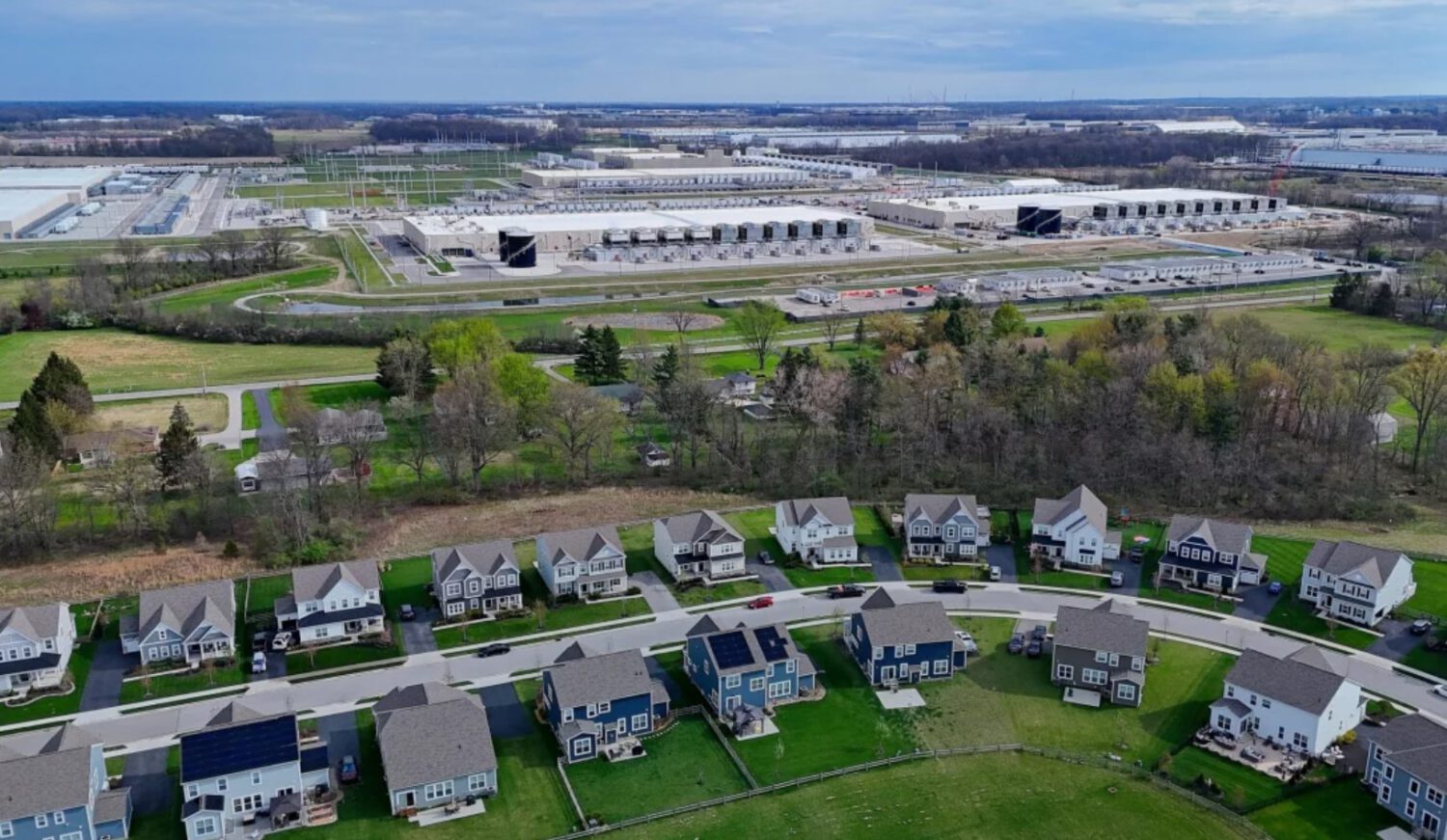
Reuters and NBC exit-poll data, cited in legal and policy coverage from Reuters, found that 76% of voters opposed building a new data center in their community. Ballot measures went against data-center development in 40 of 41 contests, according to the same reporting. Both figures require the underlying poll methodology and election records to be fully verified, and readers should treat them as reported rather than independently confirmed.
That is the political context Span is building around.
An HVAC-Sized Box With 16 Nvidia GPUs
Span’s XFRA node is designed to sit outside a home and plug into underused household power capacity.
Span’s answer is XFRA, a distributed data-center node designed to sit outdoors beside a home, connected to its smart electrical panel. Secondary reporting describes each unit as containing 16 Nvidia RTX PRO 6000 Blackwell Server Edition GPUs, AMD processors, liquid cooling, and an integrated battery of roughly 15 to 16 kilowatt-hours; Span has not published a formal specification sheet confirming those details.
Span describes the system as quiet, modular, and self-contained. According to the company, its orchestration software schedules AI-inference workloads around real-time energy availability at each host location, with the smart panel acting, in Span’s own framing, like an air-traffic controller managing household demand alongside the computing load.
What the Homeowner Gets
Span has outlined a set of proposed host benefits, though commercial terms are still being defined.
Span has proposed covering or discounting electricity and internet bills for host households, installing a smart panel, and providing battery backup access during outages. Trade reporting also indicates that the node would stop operating during a utility outage so the battery could prioritize the home, though no official operating specification confirming that rule has been published.
Prospective hosts should treat current descriptions as proposals, not guarantees, until formal contract terms are released.
100 Homes, Two Partners, One 2027 Target
The project remains at pilot scale, with broader availability planned but not yet demonstrated.
Span is testing the concept across roughly 100 new-construction homes, with the company confirming a proof of concept with residential homebuilders. PulteGroup has been identified as the homebuilder partner in reported coverage, though that identification has not been confirmed in an official company announcement. Sunrun, the solar and storage company, has been reported as a partner to supply batteries and integrate them with the XFRA nodes; no primary Sunrun or Span release was available to confirm the full scope of that arrangement.
Current tests are reported to be running in Texas and Northern California, though Span’s official materials confirm U.S. testing without specifying locations. Broader availability is planned for 2027, a target that originates with Span and has not been independently verified.
Grid Displacement, Not Grid Relief
Span’s grid argument has drawn a pointed counterpoint from an independent infrastructure researcher.
Span argues that smart-panel controls can tap spare household capacity with the aim of reducing or delaying the need for new transformers or substations. Andy Lawrence, identified in secondary reporting as a research executive at the Uptime Institute, offered a counterpoint: moving the equipment changes its location, not the amount of power required, and broader grid investment remains necessary. That statement has not been located in a primary Uptime Institute publication and should be read as a reported paraphrase rather than a direct quotation.
Whether many individually manageable nodes could collectively stress neighborhood transformers, feeders, or substations is an open engineering question. The answer would depend on deployment density, utility coordination, and local load growth. Those answers do not yet exist.
Unresolved Contract and Security Questions
The practical questions facing a prospective host homeowner go well beyond the hardware itself.
A prospective host would reasonably want to know who owns the equipment and what happens to the contract when the house sells. Responsibility for maintenance, particularly if the liquid-cooling system fails, has not been publicly addressed by Span.
Physical security for an enclosure holding significant computing hardware is also unresolved in the available reporting. Span markets the unit as quiet, but no independent noise or heat measurements across varied climates were identified in the sources reviewed. These remain contract and regulatory questions, not established outcomes.
Distributed Infrastructure, Distributed Accountability
The deeper policy question is whether spreading the data-center footprint across private properties reduces its impact or simply disperses oversight.
A conventional data center tends to concentrate permitting scrutiny, security obligations, and public accountability in one place. XFRA would spread those across private properties, one installation at a time.
That may make deployment politically easier than a single rezoning battle, but it also creates an infrastructure layer whose cumulative neighborhood effects may be harder for regulators and nonparticipating residents to track or challenge. Whether XFRA makes AI data centers less visible or simply less accountable is the question that regulators, utilities, and future homebuyers will need to answer before Span’s 2027 target arrives.