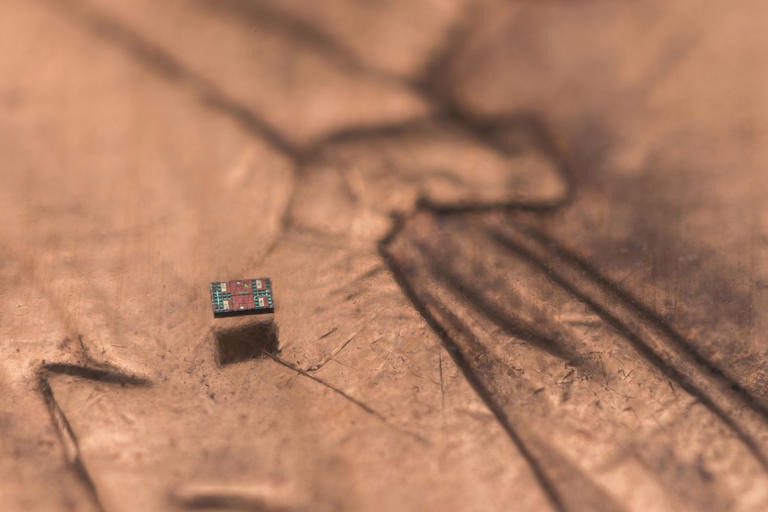
Researchers just cracked a four-decade engineering puzzle that’s been taunting scientists since the 1980s. The University of Michigan and University of Pennsylvania teams built a robot smaller than a grain of salt that can sense, think, and act independently—something that sounds ripped from a Marvel movie but lives in a very real lab.
These breakthrough machines don’t just miniaturize existing technology. The microscopic machine packs a 55-nanometer computer, temperature sensors accurate to 0.3 degrees Celsius, and tiny motors that propel it through liquid using platinum electrodes. Solar cells power the whole operation while a glass-like coating protects the delicate innards. “This is the first tiny robot to sense, think and act,” says lead researcher Marc Miskin, and the specs back up that bold claim.
Your future doctor’s visits might look radically different thanks to this breakthrough. These micro-robots could:
- Navigate your bloodstream to deliver drugs precisely where needed
- Repair damaged nerves
- Monitor cell health in real-time
The timeline isn’t sci-fi distant either—researchers predict practical medical applications within 10 years. David Blaauw from the University of Michigan sees “real uses” emerging as the technology matures beyond its current lab-only status.
Current limitations keep these robots lab-bound for now. They need biocompatibility upgrades and must adapt from their current freshwater environment to work in saltwater or on land. But accessibility isn’t the issue—high school students successfully operated these machines using a $10 microscope, proving the technology doesn’t require million-dollar lab setups.
Next-generation swarms could transform surgery itself. Getting multiple robots to communicate and coordinate represents the next major breakthrough, creating networks that could revolutionize medical procedures. Johns Hopkins’ David Gracias envisions robots replacing surgeons entirely within 100 years, though that timeline might sound optimistic to anyone who’s watched medical device approval processes.
Achievement bridges sci-fi fantasies with tangible engineering reality. When something 100 times smaller than MIT’s 1989 “Squirt” robot can outperform its ancestor while running on solar power, the impossible starts feeling inevitable. You’re witnessing the moment when microscopic intelligence stopped being theoretical and started being practical.