Factory floor logic typically favors hiring the fastest workers. Chinese manufacturers are doing the opposite. Companies like BYD and Foxconn are deploying humanoid robots that achieve only 30 to 50 percent of human productivity—and they’re accelerating orders anyway.
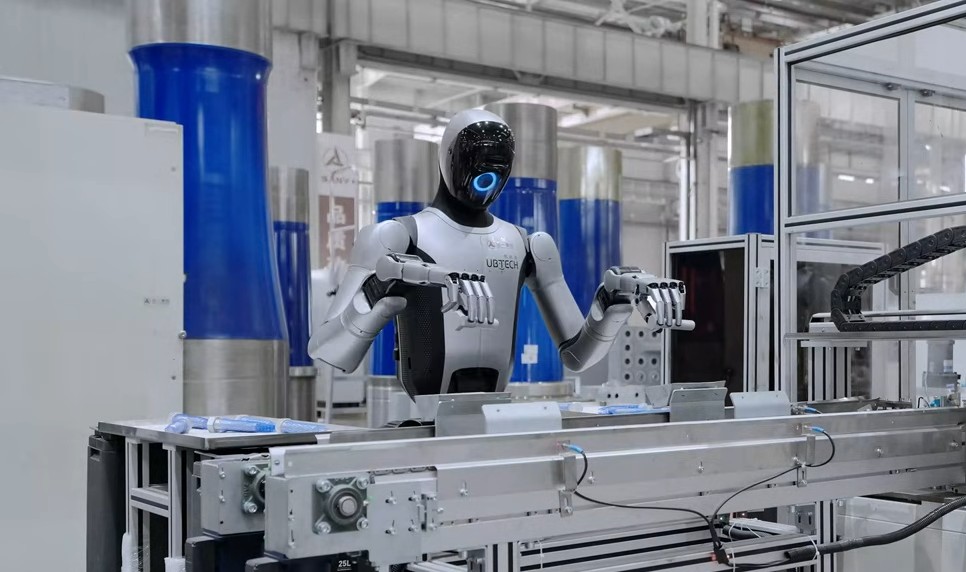
UBTECH’s Walker S2 represents this counterintuitive strategy. Standing 5.7 feet tall with 52 degrees of freedom, the robotic handles repetitive tasks like moving parts between stations and stacking boxes. But here’s the catch: it needs battery swaps every 2-3 hours and requires manual appendage changes for different tasks. That’s not exactly the seamless automation dream.
The Arms Race Logic
First-mover advantage trumps current efficiency in China’s automation strategy.
Michael Tam, UBTECH’s chief brand officer, cuts straight to the competitive reality: “You can imagine if Tesla has the advantage of deploying their own human robots into the manufacturing line, that means maybe BYD, they are staying behind.” This isn’t about today’s productivity metrics—it’s about tomorrow’s manufacturing dominance.
The Walker S2’s key advantage isn’t speed; it’s flexibility. Unlike traditional robotic arms bolted to assembly lines, humanoids walk between workstations and theoretically handle multiple production functions. Think of it as buying one Swiss Army knife instead of a dozen specialized tools—less efficient per task, but more adaptable when production needs shift.
Reality Check on the Timeline
Industry experts split on whether ambitious efficiency targets are achievable.
Kelvin Lau of Daiwa Capital Markets calls UBTECH’s goal of reaching 80 percent human efficiency by 2027 “ambitious but not unrealistic.” His reasoning? Robots don’t need breaks or holidays, so 80 percent efficiency could actually outpace human output over time.
But Marco Wang from Interact Analysis in Shanghai sees current deployments as “limited to state-funded pilot projects” with “commercial viability still some distance away.” Meanwhile, UBTECH plans to scale from roughly 500 units delivered in 2025 to 10,000 in 2026—a 20-fold increase that will test whether factory floors can handle humanoid integration at scale.
The bet isn’t on perfect robots today. It’s on learning faster than competitors while the technology matures. In China’s manufacturing arms race, being first often matters more than being flawless.