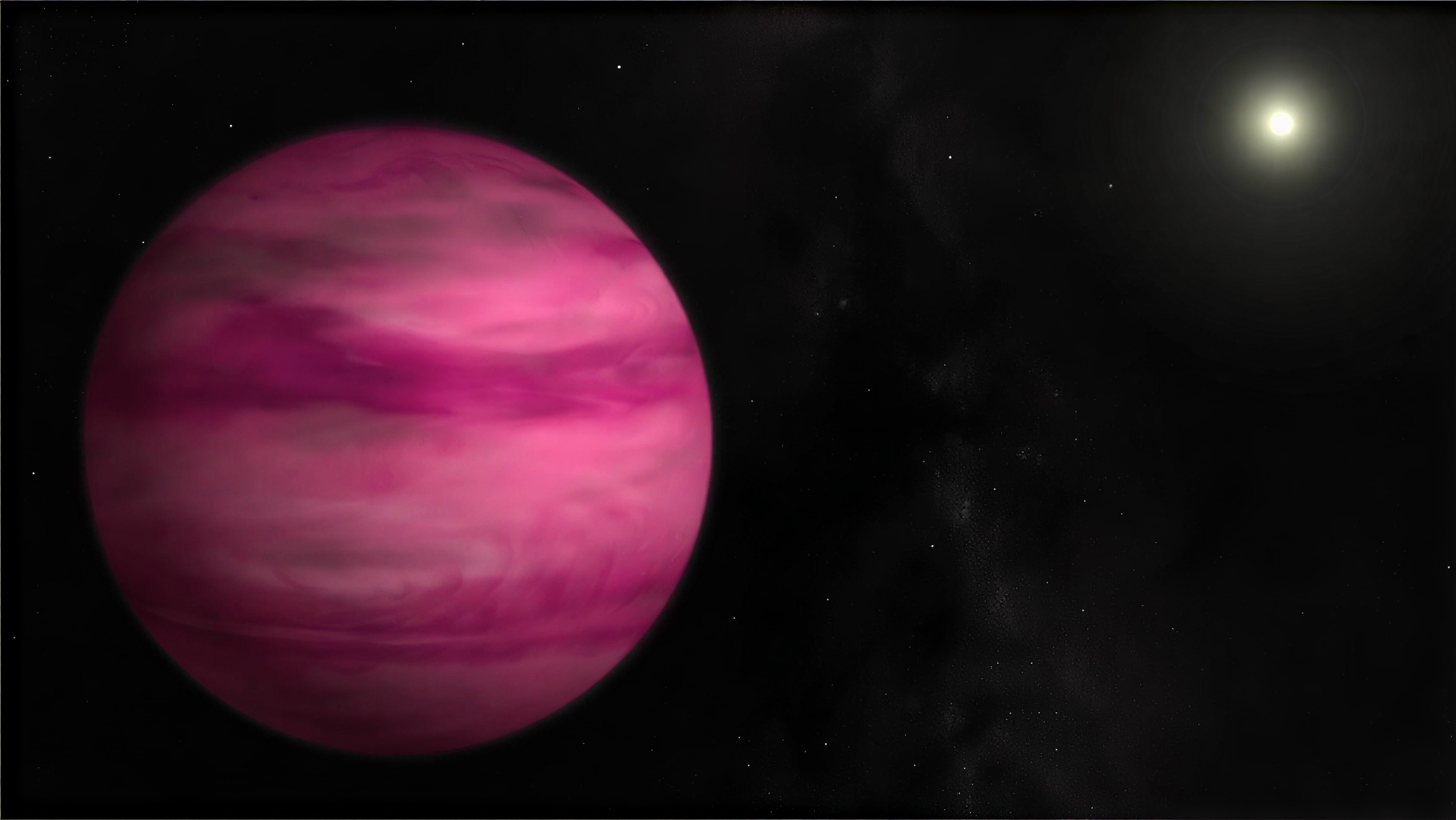
For over a decade, the best observatories on Earth pointed at GJ 504 b and came up empty. Discovered in 2013 orbiting a Sun-like star 57 light-years away, the so-called Pink Planet runs at roughly 550°F — hot enough to bake bread, but brutally faint by exoplanet standards. Most directly imaged worlds blaze between 1,000 and 2,000°F. This one barely whispered. Ground-based teams burned entire nights trying to extract a usable spectrum and failed. Lead researcher Aneesh Baburaj of Northwestern University put it plainly: earlier efforts “could not see the object.” JWST pulled a high-quality chemical reading in about two hours, according to Northwestern University.
Salt Clouds Nobody Expected
The atmosphere’s chemistry only made sense once researchers added clouds of potassium chloride and zinc sulfide to their models.
That spectrum revealed water vapor, methane, carbon dioxide, and ammonia — a rich cocktail, but not the headline. When the team modeled the atmosphere without clouds, the chemical abundances were physically nonsensical. Only after introducing deep clouds of potassium chloride and zinc sulfide — literal salt clouds — did the numbers snap into place. Those clouds mute spectral signatures from deeper layers, reshaping what instruments actually detect. Theorists had predicted such clouds for over 15 years. This marks some of the first direct confirmation, according to the study published in The Astronomical Journal.
Salt clouds weren’t an exotic theoretical footnote. They were the only explanation that made the data work.
Giant Planet or Failed Star? Still Unclear.
At roughly 25 times Jupiter’s mass, GJ 504 b occupies the taxonomic no-man’s-land between planet and brown dwarf.
GJ 504 b weighs in around 25 Jupiter masses — well past the 13-Jupiter-mass threshold where deuterium fusion can ignite, the rough dividing line between giant planets and brown dwarfs. Yet JWST found its atmosphere loaded with heavy elements like carbon and oxygen, mirroring Jupiter and Saturn. That enrichment pattern fits core accretion, a planet-style birth process. The team cautions, though, that brown-dwarf formation pathways could produce similar chemical signatures, so the origin remains unresolved.
“It was not like anything we have analyzed before.” — Aneesh Baburaj, Northwestern University
A Window Into Colder, Quieter Worlds
The techniques behind this discovery could eventually help characterize smaller, potentially habitable exoplanets.
Before JWST, cold giants like GJ 504 b were effectively locked rooms — no key, no entry. This result fills a critical temperature gap between scorching young exoplanets and the cooler gas giants in your own solar system. The imaging and spectral-extraction methods refined here point directly toward studying even fainter, cooler targets. Researchers plan to apply the same approach to other cold planetary-mass companions, building the comparative sample needed to test formation theories at scale. If salt clouds appear consistently across similar objects, current models of where and how giant planetary cores grow may need serious rethinking. What started as a whimsical nickname now opens a direct chemical window into how massive worlds are born — and JWST has barely begun pulling the curtain back.