South African radio telescope array detects extraordinary hydroxyl gigamaser using advanced data processing pipelines. This cosmic laser beam shoots across 8 billion light-years of space with unprecedented intensity. The MeerKAT radio telescope array in South Africa just detected the most distant and luminous hydroxyl gigamaser ever found—a natural space laser so powerful it earned “gigamaser” status.
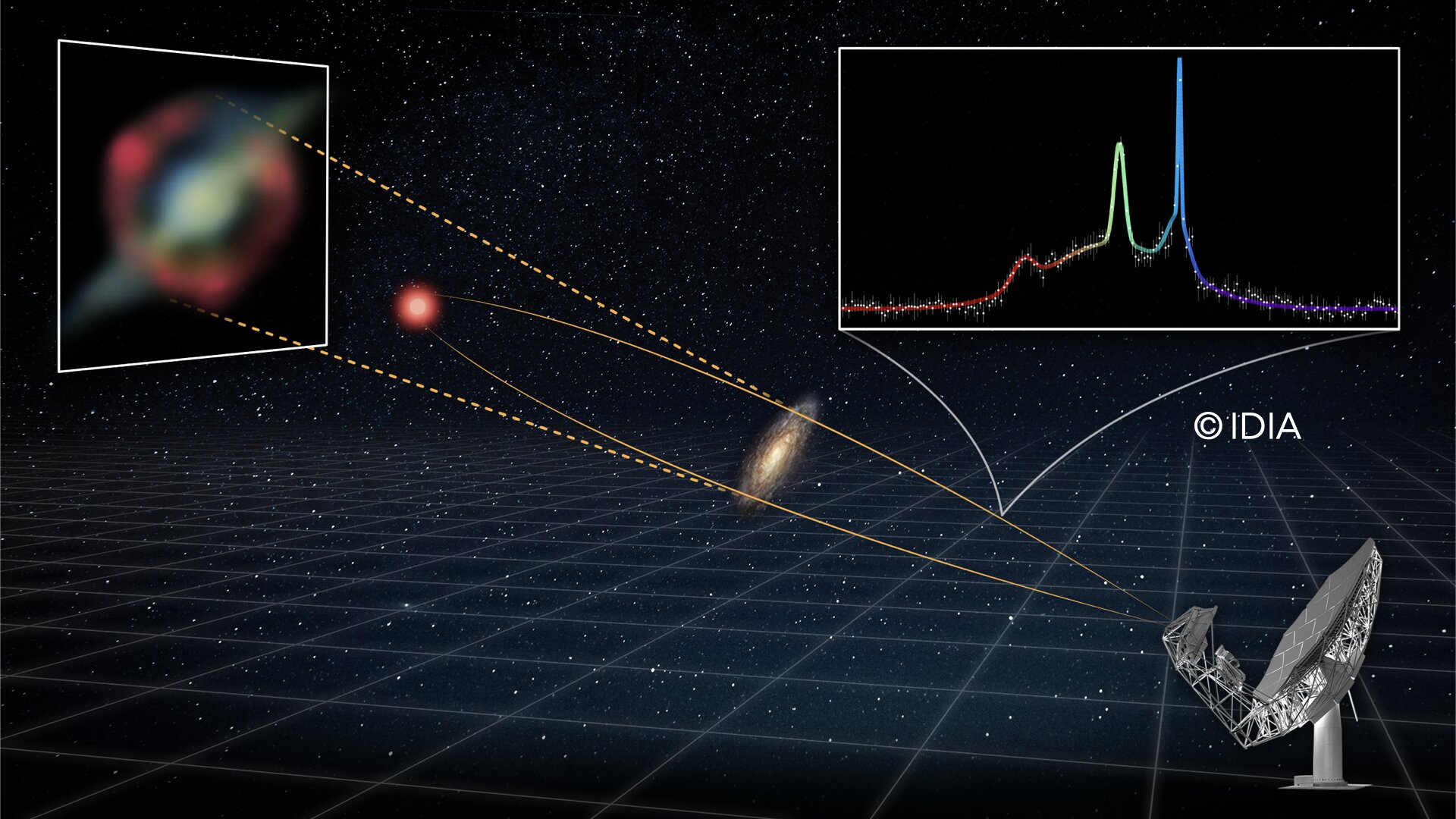
Dr. Thato Manamela from the University of Pretoria called the discovery “truly extraordinary,” explaining how gravitational lensing acts like “a water droplet on a windowpane” to amplify the signal. Your typical laser pointer has nothing on this cosmic beast.
High-Tech Hunt Required Massive Data Crunching
Discovery demanded 62 antennas working together to process terabytes of astronomical information.
Finding this space laser wasn’t luck—it required serious computational muscle. MeerKAT’s 62 antennas spent 4.7 hours collecting radio waves at 544-1088 MHz frequencies, generating terabytes of data that needed advanced processing algorithms to decode.
The system, designated HATLAS J142935.3–002836, emerges from a violent galaxy merger with stellar mass exceeding 130 billion suns and star formation rates around 400 solar masses per year. Think of Netflix’s data processing challenges, but for cosmic signals traveling since the universe was less than half its current age.
Gravitational Lensing Creates Natural Magnifying Glass
Foreground galaxy bends spacetime to amplify the distant merger’s radio emissions into detectable signals.
The discovery relies on cosmic luck meeting cutting-edge technology. A foreground galaxy at redshift z=0.218 acts as a gravitational lens, bending spacetime to create an almost-complete Einstein ring that amplifies the gigamaser’s signal.
Without this natural magnification, even MeerKAT‘s sensitivity couldn’t detect hydroxyl molecules radiating from the merging galaxies. The lensed system reveals tidal tails stretching tens of thousands of light-years—cosmic wreckage from two galaxies destroying each other in slow motion.
SKA Telescope Will Hunt Thousands More Systems
Future surveys aim to discover hundreds of similar cosmic lasers to map early universe evolution.
This discovery previews what’s coming when the Square Kilometre Array comes online. MeerKAT serves as SKA’s technological testing ground, proving that systematic surveys can find these rare systems hiding in plain sight.
The data processing breakthroughs needed for terabyte-scale radio astronomy directly benefit consumer tech sectors requiring massive parallel computing. You’re witnessing South African engineering leadership in global astronomy—technology that transforms cosmic whispers into scientific gold.