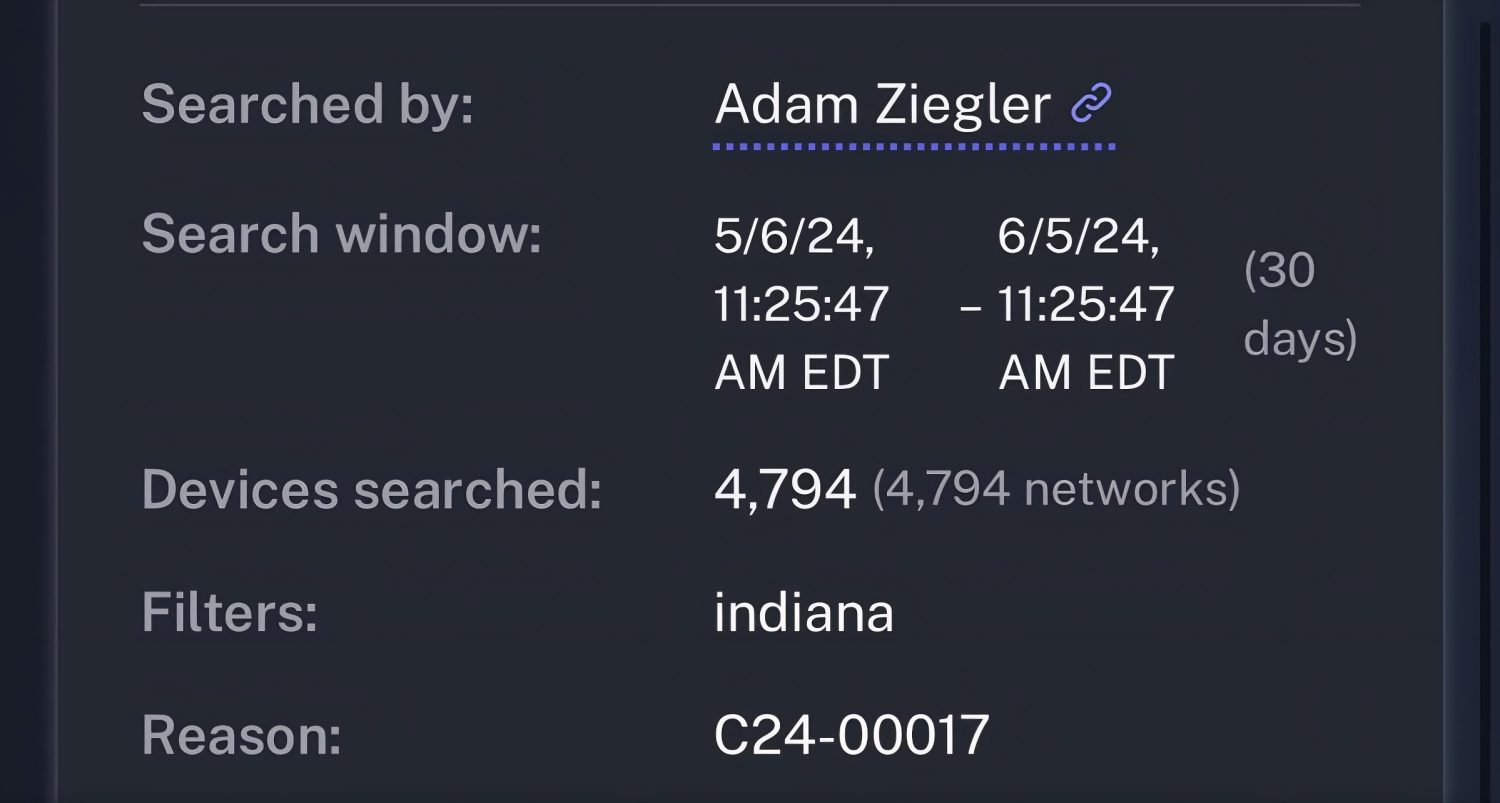
Your plate shows up on HaveIBeenFlocked.com. In many records: the agency name, the operator, the timestamp. And where the reason should be — the field that’s supposed to tell you why someone pulled your location history — there’s a vague abbreviation, a blank, or, in some cases, a numeric placeholder. No codebook attached. No explanation offered. That’s not an oversight. It’s a pattern.
HaveIBeenFlocked.com aggregates Flock Safety audit logs obtained via public records requests, letting anyone search their own plate to see if an operator actively queried the database. Not just whether a camera photographed your car — whether someone chose to look you up. The “reason” field was supposed to tell you why. Increasingly, it tells you nothing.
From “Fishing Violation” to Sanitized Codes
Reason fields have quietly evolved from readable free text into something far more useful to police — and far less useful to you.
Before January 2026, free-text reason fields produced entries that were absurd but at least readable: “fishing violation,” “stranger danger,” “Suspicious Auto (bullet holes).” Chaotic, yes — but you could see the shape of what was happening. Then Flock introduced dropdown menus. Reasons collapsed into sanitized phrases like “Traffic Infraction – Criminal Justice Purpose,” per Texas Department of Public Safety logs. San Jose’s Flock problem illustrates how vague abbreviations and internal codes are the logical extension of that trend: internal tracking preserved, public accountability diminished.
Here’s what the audit log can — and can’t — tell you now:
- Agency name, operator, and timestamp: visible in many records, though some logs — particularly those released via Flock’s own transparency portal — are more heavily redacted.
- The reason field: increasingly an abbreviation like “inv” or “sus,” or simply blank.
- Blank fields, per HaveIBeenFlocked’s own documentation, “typically indicate the agency chose not to include this information in public records.”
- These same logs previously exposed ICE coordination, a search tied to a woman who had an abortion, and officers using the system to stalk people — which is precisely why readable reasons have become inconvenient.
- HaveIBeenFlocked’s Reason Search tool, built to surface patterns like “protest” or “journalist” searches, becomes far less useful when reasons are opaque codes or stripped entirely.
The Strategy Is Documented
This isn’t agencies being cautious — internal guidance shows it’s a deliberate effort to limit what public records reveal.
Internal guidance obtained via public records instructs officers to be “as vague as permissible” about why they use Flock — specifically to limit what aggregator sites can surface from those records. That’s not bureaucratic caution. It’s a documented effort to degrade the one field that separates a routine traffic check from something worth a phone call to a lawyer.
As an analysis of Flock logs via footnote4a.org put it: “The logs tell a story that is perhaps even more disturbing: police will examine your long-term location history for any reason or no reason at all.”
What You Can Actually Do
A strategic FOIA request can turn opacity into a documented paper trail.
If your plate appears with a vague reason or a blank field, a public records request is your next move — but file it strategically. Ask the agency for the full audit log and any policy document or codebook mapping abbreviated or coded reasons to specific investigative categories. Agencies are generally required to respond, and while they can still apply redactions, forcing them to produce that documentation makes the opacity visible and on the record.
The shift from “fishing violation” to a meaningless abbreviation isn’t a technical upgrade. It’s a transparency downgrade — one designed so that tools built to hold police accountable can show you that you were secretly tracking users, but never why. That asymmetry is the whole point.