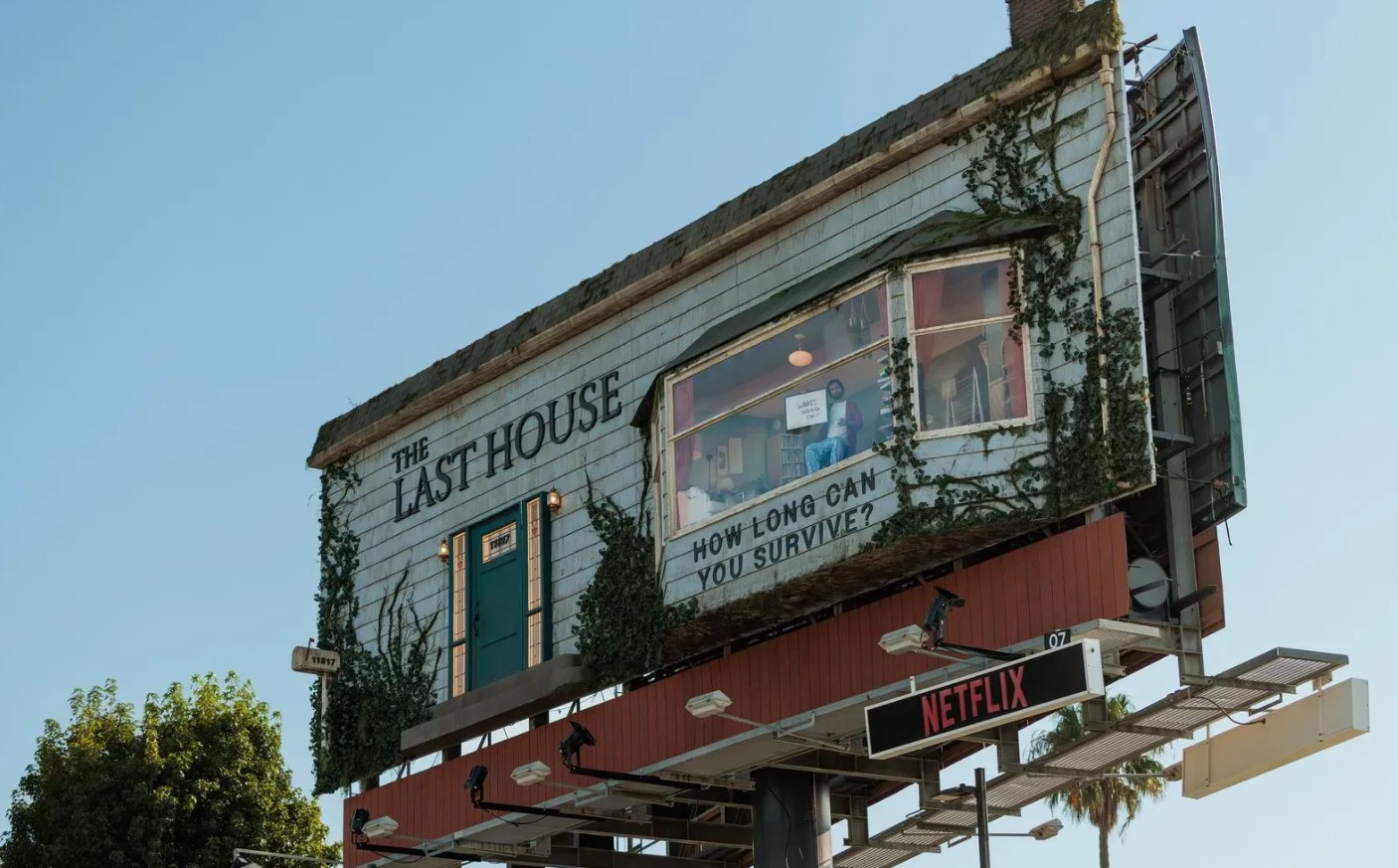
You’re driving west on Sunset Boulevard, somewhere near Selma Avenue, and you glance up at what looks like a house facade bolted to a billboard. Door, chimney, ivy creeping up the side, a window. Someone is inside. They’re holding a whiteboard, scrawling messages to commuters below. This is not a fever dream.
Netflix installed a real performer inside a furnished billboard installation to promote The Last House, a sci-fi horror film about a family of four suddenly sealed inside their home with no way out. The streamer posted a video on X with the caption “There’s a guy inside.” That’s the whole pitch. One sentence doing the work of a two-minute trailer.
The tagline visible from street level reads: “How long can you survive.”
- The billboard sits at Sunset Boulevard and Selma Avenue in Los Angeles
- The performer communicates with passersby through a whiteboard
- The film stars Greta Lee and Wagner Moura, directed by Louis Leterrier
- In The Last House, a family of four is suddenly sealed inside their home, forced to survive with dwindling resources against a mysterious threat
- Greta Lee noted the production consulted actual survivalists for authenticity
When the Ad Becomes the Movie
This isn’t a billboard advertising isolation — it is isolation, staged thirty feet above rush-hour traffic.
The stunt lands like a Black Mirror episode that escaped into the real world. Rather than explaining the film’s premise through conventional marketing, Netflix built the premise and stuck someone inside it. The whiteboard communication — limited, visible, slightly desperate — mirrors the psychological strain the film’s characters face under confinement. Every passing car becomes an unwitting audience member.
That connection runs deeper than spectacle. In the film, parents Jason and Ann try to maintain normalcy while hiding the severity of their situation from their children as resources dwindle. The performer up on that billboard is doing something eerily similar: projecting calm while literally trapped in a box, watched by thousands of strangers. The survivalist consultants Greta Lee mentioned suggest the production took its confinement premise seriously enough to ground it in something real — which makes the stunt less of a decoration and more of a proof of concept. Readers drawn to themes of confinement and vulnerability may find home security a natural next consideration.
A Stunt That Earns Its Attention
Committing fully to a strange idea turns out to be a more effective pitch than explaining it.
The installation works because it refuses to over-explain itself. Netflix posted one video, wrote one caption, and let the image do the arguing. That kind of restraint is rarer in marketing than it should be. If The Last House brings the same nerve to its 98-minute runtime that this billboard brings to a single street level corner of Sunset Boulevard, it arrives as one of the more committed genre entries of the streaming season — and one worth clearing a Friday night for.