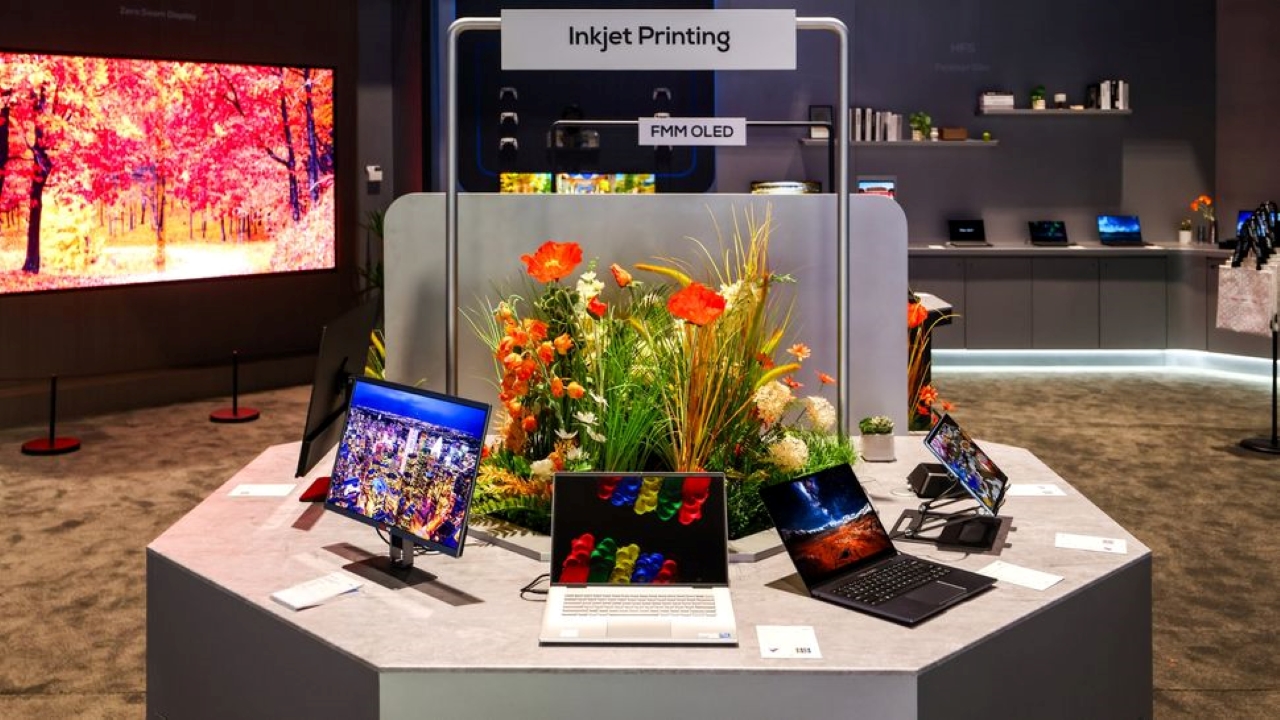
Most OLED screens exist because someone heated organic materials in a vacuum and blasted them through a fine metal mask onto glass. Think frosting a cake through a stencil — precise, but wasteful and expensive to scale. TCL CSOT just threw out the stencil. Its inkjet-printed (IJP) OLED process uses precision inkjet printers to deposit OLED “inks” directly onto the substrate, droplet by droplet, exactly where needed. No masks. No vacuum evaporation. And now, for the first time, that process lives inside a laptop: the Lenovo Legion R9000P 2025 Ultimate Edition, according to Tom’s Hardware.
The panel specs read like a highlight reel:
- 16-inch, 2560×1600 (WQXGA), 16:10 aspect ratio
- 240 Hz refresh rate, ~0.08 ms response time
- ~1100 nits peak HDR brightness, 100% DCI-P3 coverage
- Real RGB stripe subpixel layout — sharp text, not the fuzzy compromise some OLED patterns deliver
Underneath sits up to an AMD Ryzen 9 9955HX and Nvidia RTX 5080 laptop GPU. Early video reviews praise the contrast and HDR punch compared to previous IPS-equipped Legion generations.
What This Means When the Price Tag Still Says $3,000
The cost savings story is real, but it has not reached the price tag yet.
TCL CSOT claims inkjet printing cuts manufacturing costs by 20%, doubles material efficiency, and shortens development cycles by 30%. Those are the manufacturer’s own figures — not independently verified — but even skeptical observers acknowledge the physics make sense. Depositing ink only where needed generates far less waste than vapor-blasting through masks. Yet the R9000P starts at roughly 21,999 yuan in China (north of $3,000 for top configurations), and global availability remains unconfirmed. Right now, you’re paying flagship prices for first-generation bragging rights, and the manufacturing savings haven’t translated into a friendlier price tag.

That changes when production scales. TCL CSOT’s 5.5-gen IJP line has been running since 2024, and an 8.6-gen plant is under construction targeting monitors, TVs, and smartphones. A consumer-grade 27-inch 4K IJP OLED monitor panel is reportedly headed for mass production by July 2026 — MSI’s Pro Max OLED 271UPJW12 appears to match that spec profile, according to Tom’s Hardware. No independent long-term burn-in or lifespan data exists yet for these panels. TCL CSOT claims improved pixel stability, but claims and years of real-world use are different conversations entirely.
The R9000P matters less as a laptop and more as a proof-of-concept. When IJP OLED hits desktop monitors at scale next year, the pricing pressure on conventional OLED panels becomes very real — and that’s when your wallet actually notices.