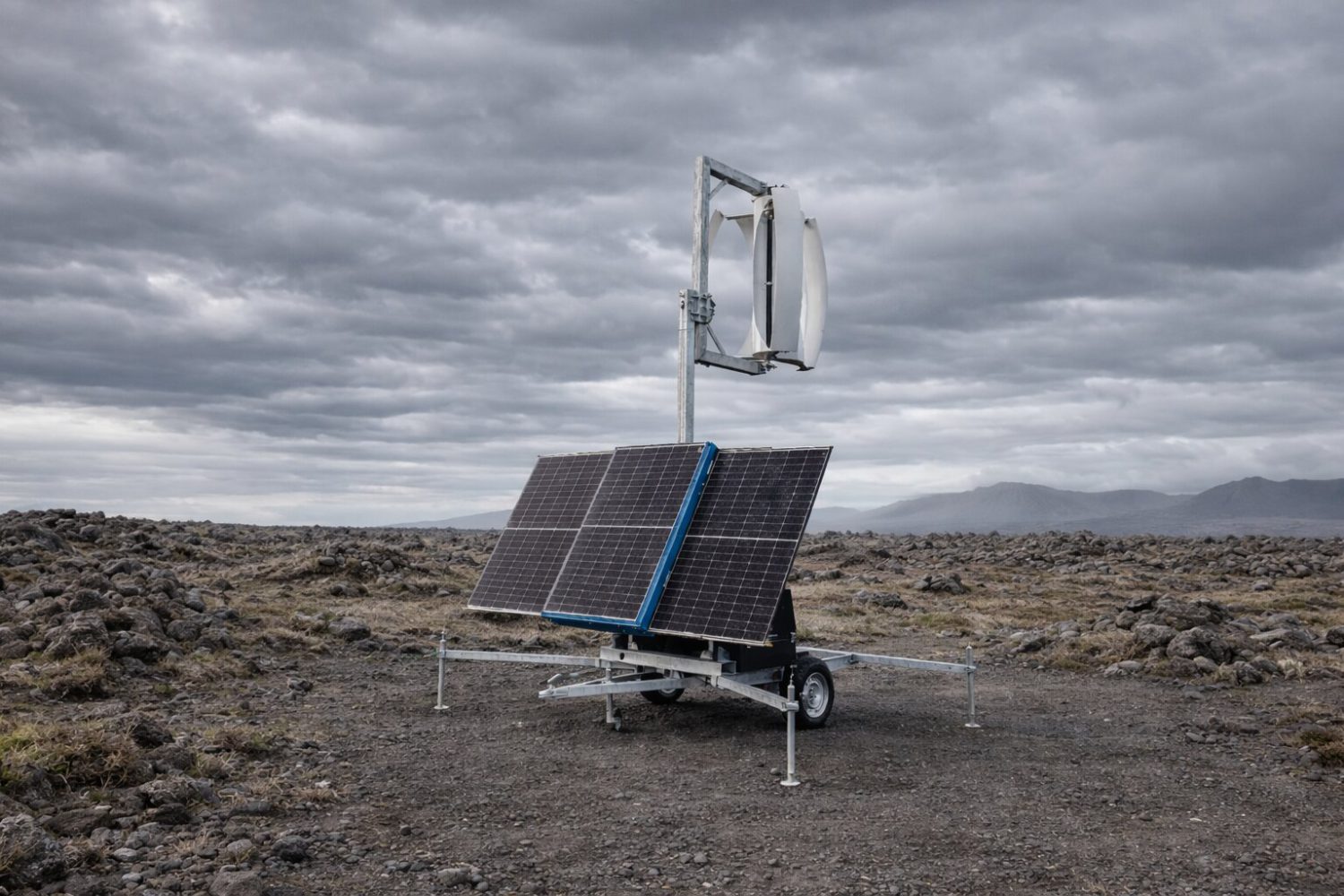
The moment a hurricane makes landfall, your solar panels stop earning their keep. The grid goes dark. Batteries drain. That’s exactly the scenario Icelandic mechanical engineer Sæþór Ásgeirsson designed against when he founded IceWind in 2012. Iceland doesn’t offer gentle test conditions — it demands answers. The result is a line of vertical-axis wind turbines (VAWTs) built to keep generating precisely when conditions are worst.
How the Design Actually Works
Forget the windmill on the hill — IceWind’s turbines don’t care which direction the wind blows.
Standard horizontal-axis turbines — the three-bladed giants you see on hillsides — need to face the wind directly. VAWTs spin on a vertical axis and catch energy from any direction, no tracking mechanism required. IceWind’s dual blade design combines lift and drag types, meaning the turbines start generating at a gentle 2.5 m/s breeze and keep running well into conditions that test conventional equipment. The industrial RW600 survives winds up to 167 mph — Category 5 hurricane territory.
The specs worth knowing:
- Freya residential model: 160W at 10 m/s wind speed; cut-in speed 2.5 m/s
- CW-1000: rated 1,000W at 10 m/s, designed as an off-grid primary or grid-backup source
- RW600: survives winds up to 167 mph (75 m/s); operates down to –45°C on request
- Noise output: under 30 dB — quieter than a library
- Residential height: ~1.6 meters; no complex foundation required
For off-grid homeowners, the pitch is straightforward. Solar is great until it’s 2 a.m. during a nor’easter. IceWind’s residential models pair with solar, batteries, or diesel generators — covering the hours and weather events that photovoltaic systems simply can’t address. Prospective buyers should note that the Freya’s 160W output is supplemental power, not a utility replacement. The CW-1000’s 1,000W rating is more viable as a primary source, contingent on consistent wind at your specific site.
The RW600 targets a different problem entirely. Telecom towers in Greenland and other Arctic deployments — places where a maintenance visit carries enormous logistical cost — need power systems that work without babysitting. IceWind mounts these on existing tower structures using screw-pile ground frames, no concrete pour required.
Built to Be Left Alone
Marine-grade stainless steel and aerospace aluminum aren’t marketing language — they’re the answer to “what happens when no one can get there to fix it.”
Sealed generator housings block dust, ice, and water. Carbon fiber and aerospace-grade aluminum handle fatigue across a claimed 20–25 year lifespan. That near-zero maintenance promise remains contingent on site conditions, but for remote deployments, even near-zero beats the alternative dramatically.
At $3,200–$4,500 for residential models, this is infrastructure spending, not impulse buying. The more useful question isn’t whether IceWind’s engineering is credible — independent coverage and verified datasheets suggest it is. It’s whether your location delivers consistent wind to justify the investment. For anyone living where the grid is the fragile option, that calculus shifts considerably.