The search giant’s latest wearable ditches notifications for recovery insights, undercutting premium competitors by hundreds of dollars.
Expensive fitness trackers shouldn’t gatekeep your health data, yet Whoop’s $199-per-year subscription model does exactly that. Google just changed the game with the Fitbit Air—a screenless tracker that delivers premium recovery insights for $99 upfront, no mandatory subscription required.
The device launches May 26 after Steph Curry’s April teaser, positioning itself directly against Whoop and Oura Ring in the screenless wearable space. You get comprehensive health monitoring without the distraction of notifications buzzing on your wrist every few minutes.
Built for Comfort, Not Convenience
At 5.2 grams, this tracker disappears on your wrist while monitoring everything that matters.
The Fitbit Air weighs less than a nickel without its band, making it 25% smaller than the already-compact Fitbit Luxe. You’ll forget you’re wearing it—which is precisely the point for 24/7 health tracking.
Three interchangeable bands handle different scenarios:
- Recycled Performance Loop for workouts
- Waterproof Active Band for swimming (50-meter resistance)
- Elevated Modern Band for professional settings
Seven-day battery life means charging becomes a weekly ritual, not a daily anxiety.
Emergency power? Five minutes of charging delivers a full day of tracking.
The screenless design eliminates the modern smartwatch trap where fitness tracking becomes secondary to managing notifications. Your health metrics live in the Google Health app, accessed when you choose rather than constantly demanding attention.
AI-Powered Recovery Without the Premium Price Tag
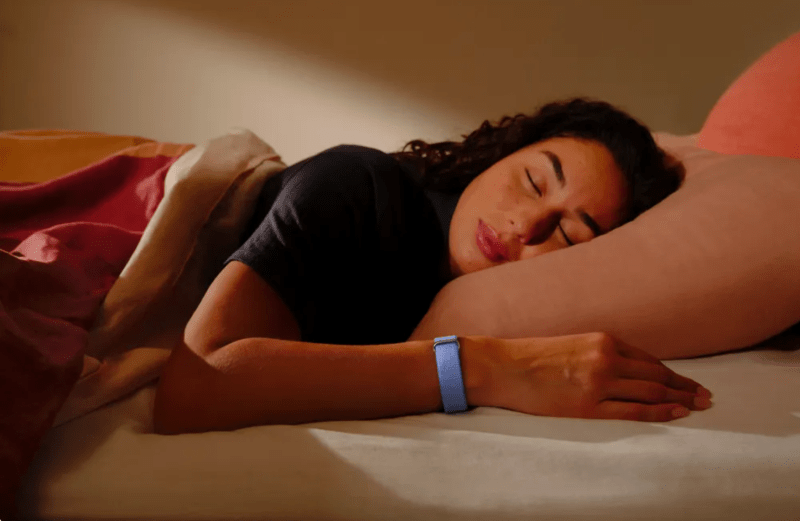
Gemini analyzes your meal photos and sleep patterns to deliver personalized coaching that rivals Whoop’s software.
Heart rate variability, AFib detection, sleep staging, and recovery metrics form the core tracking suite. The interesting part? Google Health Coach uses Gemini AI to analyze not just your biometrics, but photos of your meals, creating holistic wellness guidance that goes beyond “walk more steps.”
The free Google Health tier covers basic tracking and sleep data. Google Health Premium ($99 annually) unlocks the AI coaching, custom workout plans, and detailed recovery analytics. Compare that to Whoop’s mandatory subscriptions starting at $199 per year—suddenly, Google’s approach looks refreshingly reasonable.
Recovery culture has exploded among weekend warriors and serious athletes alike. The Fitbit Air makes those insights accessible without requiring a second mortgage or annual subscription commitment.
Your existing Pixel Watch pairs seamlessly for a dual-device strategy: smartwatch during the day, discrete tracker for sleep and focused workouts. Google finally understands that different activities demand different wearables.
The Fitbit Air challenges the notion that premium health tracking requires premium pricing. Whether Google’s AI coaching matches Whoop’s proven software remains to be seen, but at this price point, you can afford to find out.