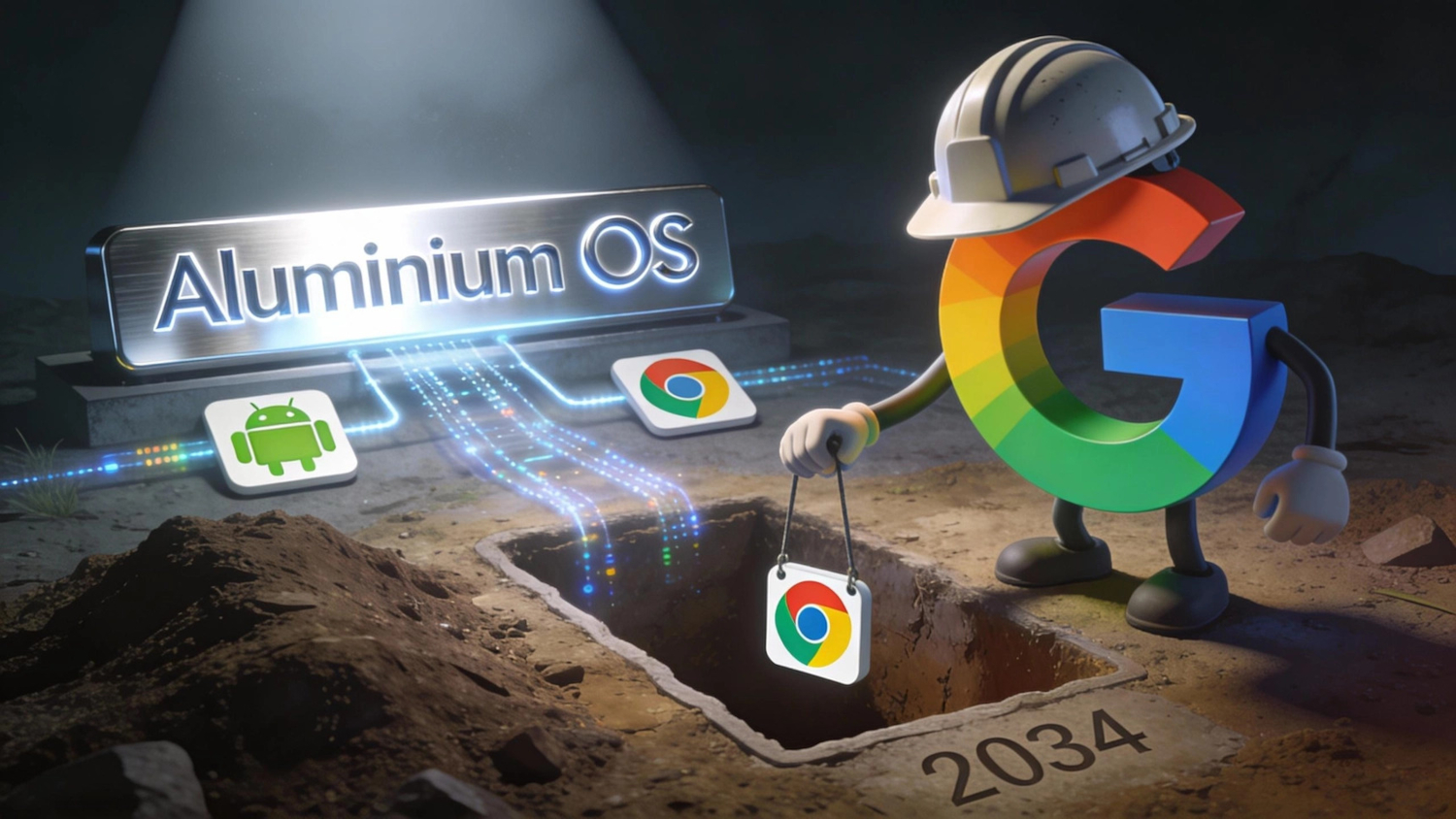
Your Chromebook is not about to become a paperweight. Google has formally confirmed that ChromeOS devices will continue receiving regular updates and security patches through mid-2034. That date previously surfaced in U.S. antitrust court records before Google addressed it publicly.
How much runway your specific device has depends on its individual support lifecycle, not the 2034 headline. Google’s automatic-update policy assigns each Chromebook a 10-year support window tied to the device, not to a universal platform cutoff. A Chromebook that reaches its published Auto Update Expiration date before 2034 will ordinarily stop receiving security patches under the standard lifecycle at that point.
Googlebook OS is not a ChromeOS software update. It is a distinct Android-based laptop platform that Google is positioning as a successor experience to ChromeOS. Google says many of its newest Chromebook devices will be eligible to migrate to Googlebook OS, according to the company’s support documentation.
Googlebooks are scheduled to reach U.S. stores on October 4, 2026. International availability follows one day later, on October 5, covering Canada, the United Kingdom, Ireland, France, Germany, and Australia.
Google has not yet published a list of eligible models or explained how the migration will work.
That gap matters for anyone making purchasing decisions now. Google has not yet disclosed a migration method, whether over-the-air, factory reset, or service-assisted. The company has also not announced pricing or terms for Googlebook Enterprise or Education licenses, and it has not yet explained whether existing Chrome Education or Chrome Enterprise upgrade licenses will carry over to Googlebook. Chromebooks purchased in 2021 or earlier are among the devices most likely to face eligibility questions, since Google’s focus is on its newest models.
School districts and enterprise IT departments face an additional complication worth flagging on every procurement spreadsheet. Google’s enterprise roadmap places broader commercial management capabilities for Googlebook in the second half of 2027. Organizations that attempt to manage Googlebook as a fleet device before those controls exist will encounter significant operational limitations and unsupported configurations.
Googlebook devices carry a 10-year update commitment, according to Google, but the clock starts from the platform and CPU launch date. A laptop built on an older processor may carry fewer than 10 years of remaining support at the point of retail purchase, per reporting from Tom’s Hardware on Google’s explained policy.
Your immediate action is straightforward: check your device’s published Auto Update Expiration date rather than anchoring on the 2034 figure. For schools, businesses, and families considering new hardware, the practical guidance is to wait until Google publishes the full model eligibility list, licensing terms, and the complete Googlebook management roadmap before restructuring any fleet or budget around the new platform. Those evaluating supercharge your productivity tools alongside a platform transition may also find value in exploring AI-powered workflow options in the interim.