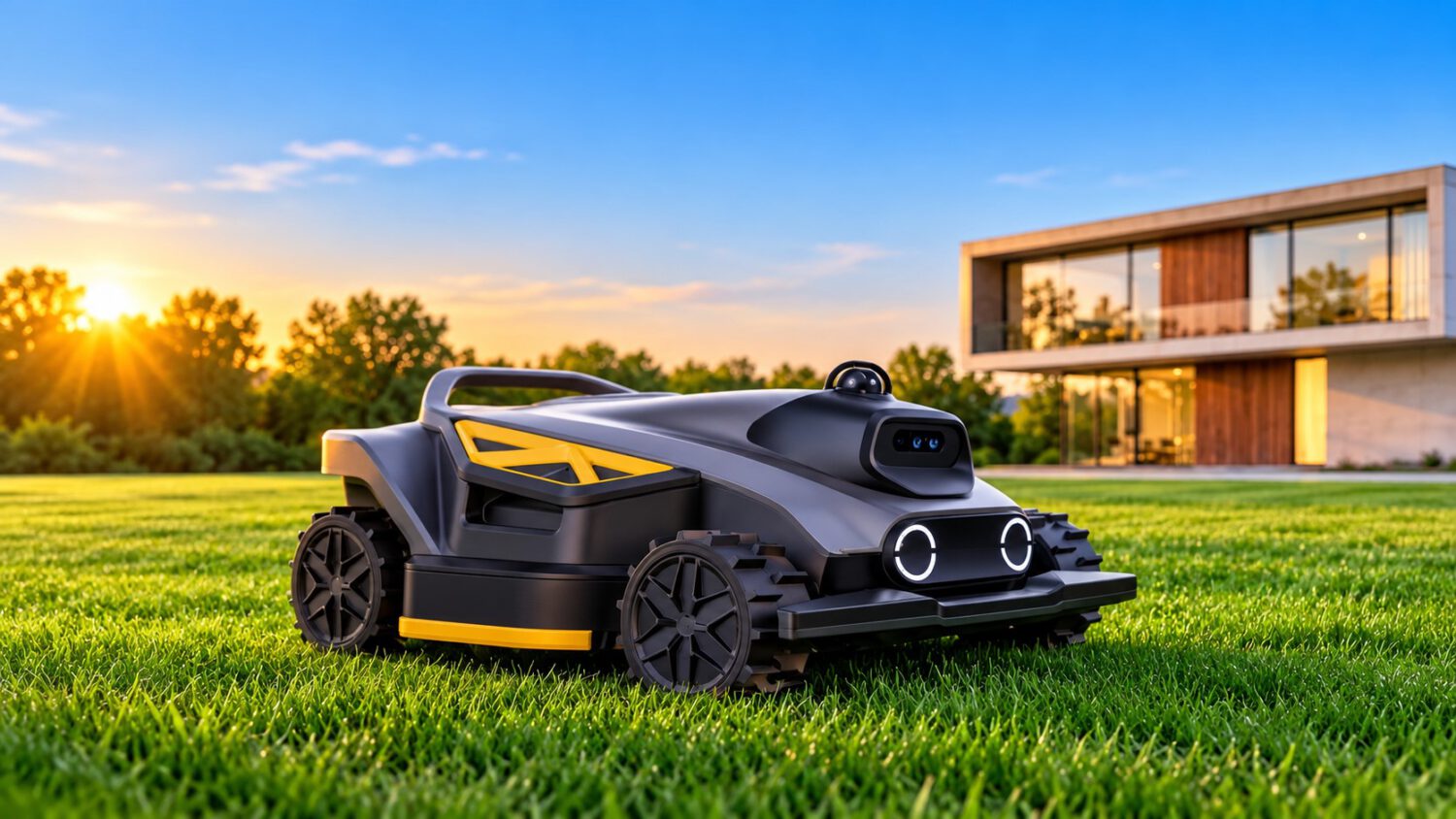
Blade sharpness is a routine maintenance issue that robot-mower owners often neglect, and Pudu Robotics is building its first consumer product around solving it.
Dull blades tend to tear grass rather than slice it cleanly, potentially leaving ragged brown tips. Pudu Robotics is betting that fixing this neglected maintenance step is worth building a whole product around. The Tomo S Series, the company’s first consumer offering after years of developing commercial service robots, automates blade sharpening inside the charging dock.
How SharpLoop Actually Works
At the charging dock, the Tomo’s rotary blades sharpen against a stone edge at a 24-degree angle, according to secondary reporting from BGR.
The process triggers automatically around every 30 hours of mowing, and owners can also initiate it manually through the companion app. Blades are made from 65Mn corrosion-resistant steel. Pudu describes the operating cycle as mow, return, sharpen, repeat.
This system defers blade replacement; it does not eliminate it. Sharpening removes small amounts of metal each cycle, so blades will eventually wear past usefulness. Pudu has not disclosed how many sharpening cycles each blade can withstand or what replacements will cost. How the system performs across multiple seasons is also unverified.
Navigation and Terrain
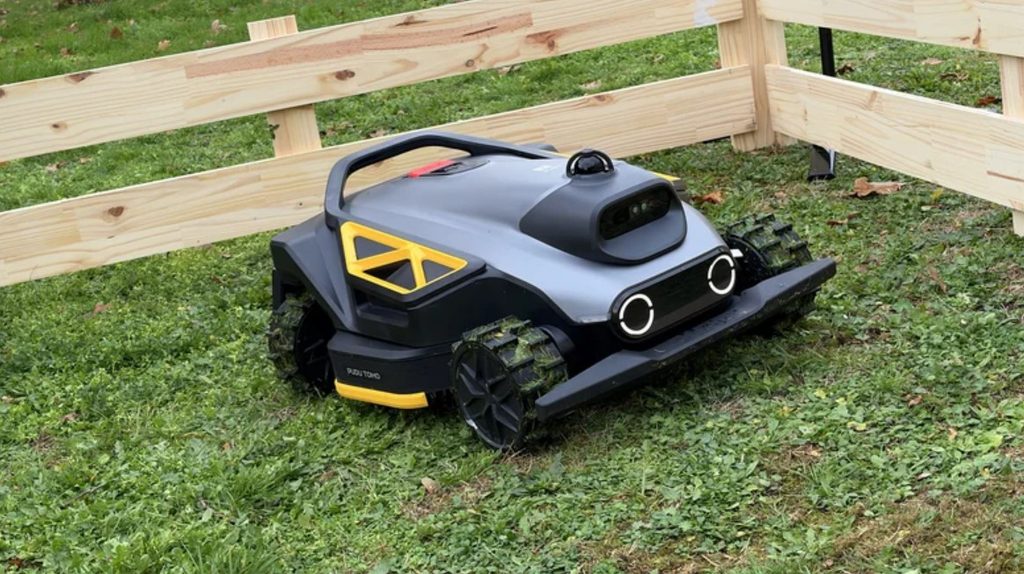
The Tomo maps its lawn autonomously and handles challenging terrain, though its steepest-slope rating is a claimed specification that independent testing has not yet confirmed.
The mower requires no boundary wire and no manually created map, building its route on the first run. It uses 360-degree LiDAR, AI vision, and network RTK positioning that Pudu claims delivers centimeter-level accuracy without a separate base station. Four independent hub motors give it a slope rating of up to 45 degrees and obstacle clearance of up to 2.4 inches, per secondary reporting.
Rear-wheel steering lets it turn in place rather than reversing repeatedly across turf. The mower also follows the perimeter when returning to its dock. Real-world performance on wet or uneven grades will require independent testing to confirm.
Three Models, One Key Unknown
The Tomo S Series spans three models by lawn size, but pricing for all of them remains unannounced.
The entry-level S115 targets lawns up to 1,500 square meters with 115 minutes of runtime and up to 15 mowing zones. The S130 covers up to 3,000 square meters with 140 minutes of runtime and 30 zones. The flagship S150 handles up to 5,000 square meters and runs up to 210 minutes on its 15 Ah battery. It reaches blade speeds of 6,000 RPM and supports 50 zones.
All three models include SharpLoop self-sharpening, IPX7 waterproofing, built-in 4G connectivity, and both lift and perimeter alarms. Two 636-watt motors and an aerodynamic deck are featured across the lineup. Pudu cites a rear-discharge clipping channel as a clog-reduction measure, particularly in damp conditions.
What to Watch Before 2027
Sales are not expected until early spring 2027, leaving pricing, real-world performance, and blade longevity as open questions.
Pricing and regional availability remain unannounced as of this writing, which makes direct comparisons to competing robot-mower brands premature. No independent long-term test data was identified in the available research. Performance in persistently wet grass, under dense tree cover, and on lawns with irregular boundaries has not been verified outside Pudu’s own claims.
SharpLoop is a meaningfully differentiated feature in a category where blade maintenance is a recurring friction point. Independent testing in 2027 will determine whether it performs as described outside a controlled demonstration environment.