Electric bike manufacturers love quoting their maximum range, but a bike promising 80 miles can deliver considerably less once you start climbing hills or using more motor assistance. That’s why independent testing matters. It tells you what these machines can actually do, rather than what they’re capable of under ideal conditions.
We’ve tested and picked seven electric bikes covering everything from affordable everyday transportation to performance cycling and luxury cargo hauling. Each has been tested either by our team or by experienced reviewers, with real-world results that help explain where your money goes and which bikes are worth considering.
This content may contain affiliate links. If you wish to support us and use these links to buy something, we may earn a commission.
1. ENGWE E26 3.0 Dual Motor

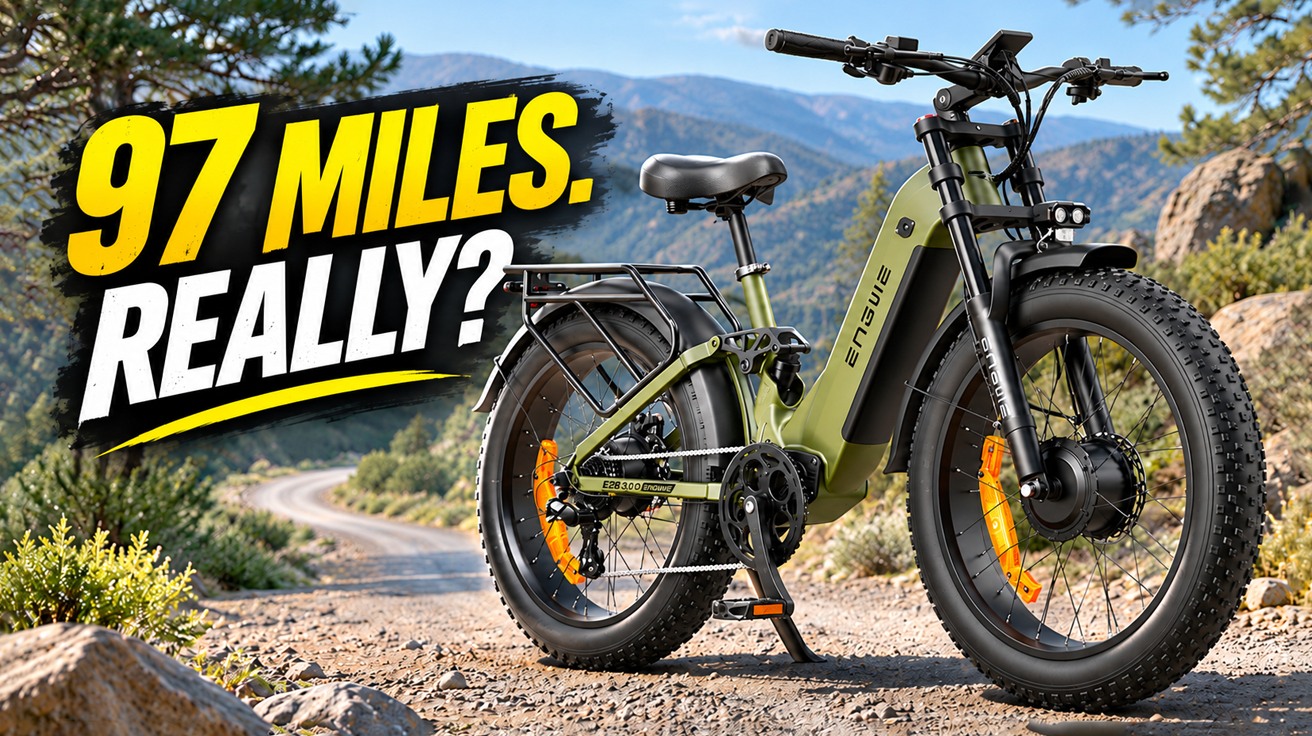
The ENGWE E26 3.0 Dual Motor has two motors, a large 960Wh battery, and four-inch-wide fat tires, but its range is what surprised us. In our own testing, we recorded 97 miles of range and a top speed of 19.9 mph (you can digitally remove the limiter). Assembly was straightforward and we came away impressed with how the bike handled trails around Big Bear, California. That’s encouraging for a bike designed to venture well beyond paved roads.
The two hub motors produce a claimed 2,000 watts of combined peak power and 160 Nm of torque, giving the E26 3.0 additional pulling power when the terrain gets steep. In ALL Electric’s independent review, a roughly 200-pound rider couldn’t climb a steep gravel section using only the rear motor. Switching on both motors allowed him to restart from a standstill and complete the climb without pedaling.
That extra traction and power make sense for riders tackling gravel roads, hilly terrain, or trails where a conventional commuter might struggle. Full suspension helps absorb bumps, although the bike’s claimed 85.9-pound weight makes it considerably less convenient to lift or transport. ENGWE also advertises higher maximum speeds than we recorded, with figures that exceed conventional U.S. e-bike class limits. Check local riding restrictions before taking it onto public roads or shared trails.
2. Ride1Up Vorsa

The Ride1Up Vorsa costs around $1,700 and promises 30–60 miles of range, which makes its independent test results particularly interesting. Electric Bike Report managed 92.42 miles in its lowest assistance setting and 42.56 miles at maximum power. Both results exceeded the manufacturer’s expectations, although they were recorded using the bike’s torque-sensing mode, which adjusts assistance according to how hard you’re pedaling.
The Vorsa also has a 750W rear motor delivering a claimed 95 Nm of torque, considerably more than many conventional commuter e-bikes. In Electric Bike Report’s hill test, it climbed the test course in 1 minute and 19 seconds using only the throttle, then completed it in 1 minute and 4 seconds with pedal assistance. At the time, that was the publication’s quickest pedal-assisted result for a commuter-style e-bike.
There’s practical versatility here, too. Its reinforced rear rack supports 150 pounds, expandable to 180 pounds with an accessory, making it useful for groceries or additional cargo. The suspension fork and wider tires also help on rough pavement and packed dirt. At around 70 pounds, it’s not particularly portable, but the combination of strong climbing performance, substantial carrying capacity, and impressive tested range makes it appealing for riders who want one bike to handle several jobs.
3. Riese & Müller Load5 75 Rohloff

Spending over $10,000 on an electric bike sounds difficult to justify until you look at the Riese & Müller Load5 75 Rohloff. It’s designed to carry children, groceries, and other substantial loads in a large compartment ahead of the rider. A Bosch Cargo Line motor handles propulsion, while full suspension and a Rohloff 14-speed internal gear system make those heavier journeys easier to manage.
German cycling publication Radelbande tested the Load5 75 Rohloff for six weeks, covering nearly 350 kilometers. The bike earned 5/5 for ride handling and 38/50 overall, with the reviewer particularly impressed by how comfortably it handled despite measuring over 2.6 meters long. Cobblestones and uneven paths barely disturbed the suspension, while the motor and gearing made steep climbs manageable. The review was conducted with a manufacturer-loaned bike and a sponsored video, although Radelbande states its editorial assessment remained independent.
The internal gearing also reduces exposure to the dirt and damage that conventional derailleur systems face, although Radelbande found its automatic shifting occasionally struggled in stop-and-go traffic. The review awarded just 2/5 for value, and suspension maintenance adds another consideration. Still, for families replacing school runs, grocery trips, and other short car journeys, the Load5 75 offers carrying capacity and comfort that ordinary electric bikes can’t easily match.
4. Lectric XP Lite 2.0

A budget electric bike doesn’t need to be particularly powerful to be useful. The Lectric XP Lite 2.0 takes a simpler approach, pairing a 300W rear motor with a lightweight folding frame and single-speed drivetrain. Standard-battery versions have sold for around $800, and despite the modest price, Lectric included hydraulic disc brakes with 180mm rotors, equipment you don’t always find on entry-level models.
Those brakes performed particularly well in Electric Bike Report’s testing. The XP Lite 2.0 stopped in an average of 20 feet 1 inch, compared with 22 feet 7 inches for the original model’s mechanical brakes. Range was respectable, too. The standard 374Wh battery lasted 37.2 miles at minimum assistance and 19.62 miles at maximum assistance, with both tests continuing until the battery was depleted.
That’s enough for plenty of short commutes and everyday errands without paying for a much larger battery. Electric Bike Report also measured the bike at 47.5 pounds, making it easier to manage than many full-size e-bikes. The trade-offs are a rigid frame, no suspension, and limited gearing that makes pedaling less useful at higher speeds. Lectric has since introduced the XP Lite3, so these results apply specifically to the tested XP Lite 2.0.
5. Specialized Turbo Creo 2 Comp

Some electric bikes deliver enough assistance that pedaling becomes almost optional. The Specialized Turbo Creo 2 Comp is designed for people who still want the exercise and responsiveness of a performance bicycle, with a little help when the road gets difficult. Its carbon frame, drop handlebars, and lightweight motor system keep it closer to a conventional road or gravel bike than the heavier utility models on this list.
In an extended Ars Technica review, Eric Bangeman averaged 20.1 mph over a 17.3-mile ride using maximum motor assistance. Battery charge fell from 100% to 26%, showing how quickly sustained high-power riding can consume energy. More importantly, he found the motor integrated naturally with his pedaling and that the bike remained enjoyable even with assistance switched off, something not every heavy e-bike manages particularly well.
Specialized also uses its Future Shock system to reduce impacts reaching the handlebars, helping maintain comfort on rough pavement and gravel without a conventional suspension fork. Bangeman praised the bike’s handling but found the original saddle uncomfortable and experienced some hand numbness on longer rides. His evaluation covered an earlier Comp configuration, so current builds may have different components. It’s an expensive option, but one that makes sense for cyclists who want to extend their rides rather than replace the effort entirely.
6. Aventon Level 4 REC
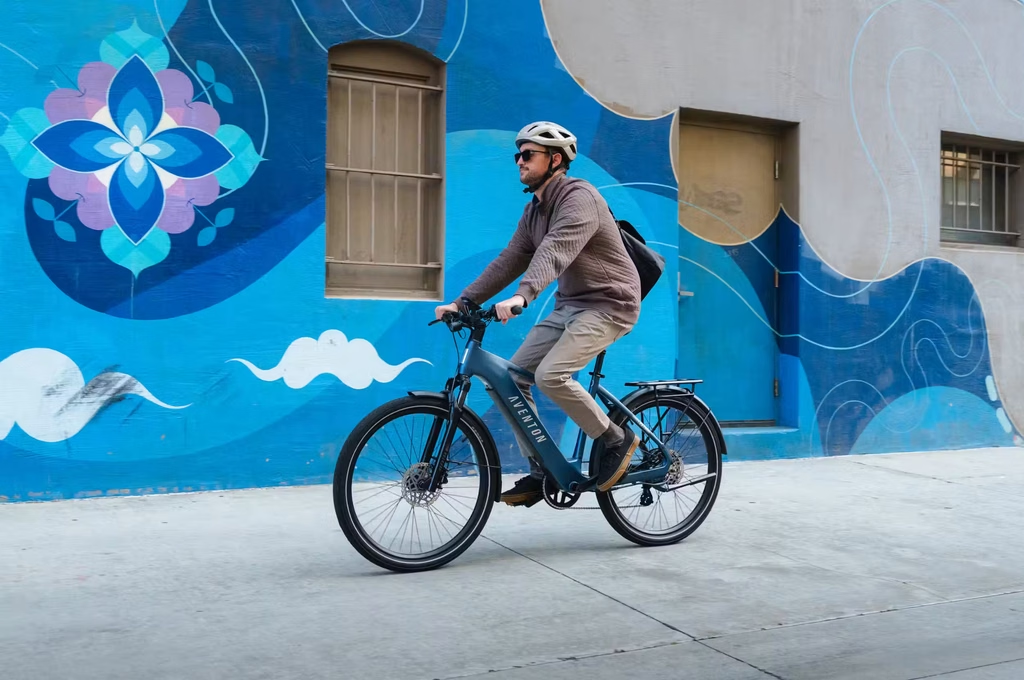
A commuter e-bike needs enough range that charging doesn’t become another daily chore. The Aventon Level 4 REC, priced around $2,000, goes considerably further than many riders will need between charges. In Electric Bike Report’s testing, it covered 97 miles in Eco mode and 43.8 miles in Turbo. Those results used torque-sensing assistance and a 20 mph speed limit, so riding faster will affect endurance.
Another testing team reached a similarly positive conclusion. OutdoorGearLab awarded the Level 4 REC 85/100 overall, ranking it third among 19 tested bikes and naming it the Best Everyday eBike. Its separate throttle-only range test returned 33.4 miles over a route with nearly 1,700 feet of climbing. That’s substantially less than Electric Bike Report’s Eco result, but the different riding conditions explain why both measurements are useful.
The Level 4 REC also includes a 750W motor, hydraulic disc brakes, suspension fork, integrated lighting, and connected security features. Electric Bike Report recorded an average stopping distance of 20 feet 2 inches, reinforcing its credentials for busy streets. It weighs roughly 70 pounds, however, and certain connected features can involve ongoing costs. For riders commuting regularly, the combination of measured endurance, effective braking, and everyday equipment helps justify the price.
7. Brompton Electric C Line e-Motiq

The Brompton Electric C Line e-Motiq costs around $4,700, considerably more than most folding electric bikes. What you’re paying for is a compact folding design that makes combining cycling with trains, offices, and apartment living much easier. Its battery detaches in a front-mounted bag, while the rear-hub motor provides assistance through a four-speed drivetrain. Once folded, the bike occupies a fraction of the space needed by a conventional commuter.
In an August 2026 eBikes International review, Alison Stewart covered 75 kilometers, or approximately 46.6 miles, during her evaluation. She rode on paved routes, gravel sections, and hills, praising how naturally the motor responded and how comfortably the bike handled with assistance switched off. That distance represents the total riding completed during the review, rather than a single-charge range test. Brompton separately claims up to 56 miles per charge.
The small wheels and compact frame aren’t intended for aggressive off-road riding, and the price is difficult to justify if you have plenty of storage space. But the C Line’s appeal is as much about where you can take it as how far you can ride. For someone who cycles to a station, boards a train, and finishes the journey on two wheels, having a capable electric bike that folds into a compact package changes what’s practical.