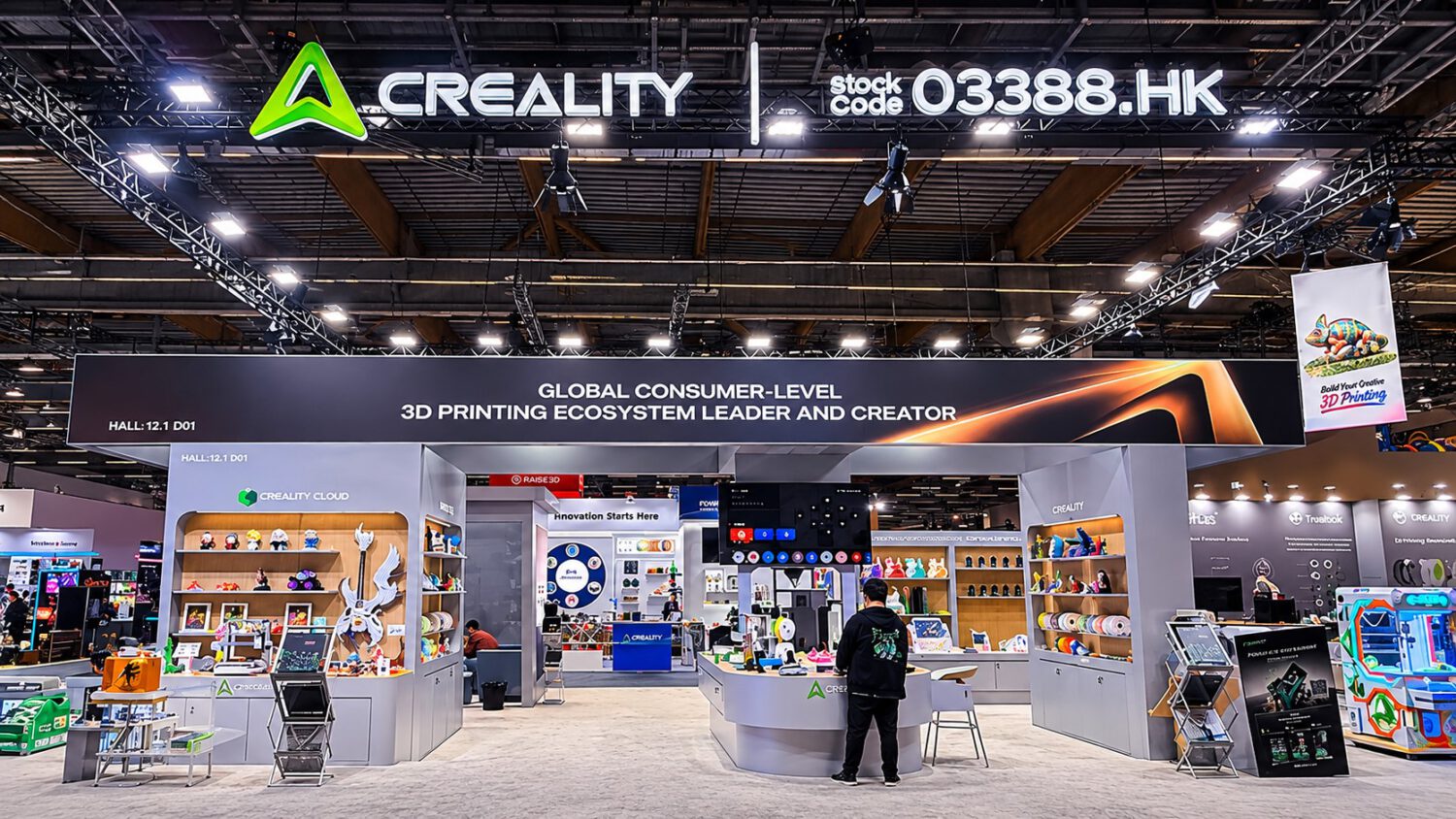
One scanner has never covered every workflow. At Formnext 2026 in Frankfurt, Creality presented three devices built for distinctly different users, from industrial reverse engineers to classroom educators.
The Flagship: Raptor Pro Max
Creality’s highest-output handheld targets automotive and large-part capture workflows.
Raptor Pro Max launched globally on November 19, 2026, making it the only device in the showcase with a confirmed worldwide release date. The scanner combines 42 cross blue laser lines, seven parallel blue laser lines, and NIR structured light, reaching a capture rate of up to 1.26 million points per second in its 42-line mode.
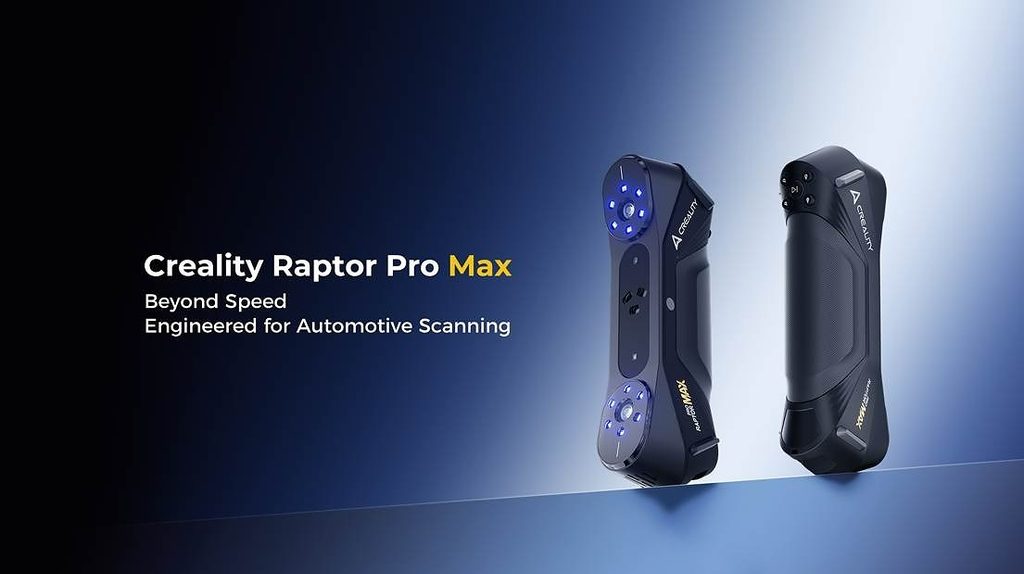
Creality states blue-laser accuracy of up to 0.02 mm and a volumetric accuracy of 0.02 mm plus 0.08 mm per meter. The 42-line single-capture area extends to 480 by 330 mm at a 550 mm working distance.
According to Creality, the expanded capture area can increase scanning efficiency by approximately 91%, expand single-capture coverage by up to 40%, and cut scanning time by up to 40%. In applicable workflows, Creality also states that marker requirements can drop by up to 25%.
These are manufacturer-reported figures; no independent verification was available at the time of publication.
Stated use cases include automotive customization, reverse engineering, dimensional inspection, and large-part capture. The scanner weighs 400 g, supports wireless operation via the Scan Bridge accessory, and works within a software ecosystem that includes Creality Scan, Creality Inspect, and Creality Print.
The On-Site Professional: Sermoon P1S
A built-in touchscreen lets this scanner process and export models without a connected computer.
A built-in 6-inch high-definition touchscreen sets the Sermoon P1S apart, allowing users to scan, post-process, and export models without a continuously connected PC. The device is positioned for professionals who cannot work from a fixed workstation.
The hybrid system combines 34 cross blue laser lines, seven parallel blue laser lines, one additional blue laser line, and NIR structured light. Creality states accuracy of up to 0.02 mm and describes capability for deep holes, grooves, and complex internal cavities. No third-party performance assessment was available to corroborate those claims.
The Portable Creative Tool: Creality Pika
At 260 grams with a removable battery, Pika is built for makers and educators who move.
At 260 g with a removable battery and Wi-Fi 6 connectivity, the Pika is the lightest device in the lineup. Portability here supports mobile capture; full workflow independence will depend on the specific processing and export steps a user requires.
The company states capture speeds of up to 110 frames per second and accuracy of up to 0.03 mm. These figures are manufacturer claims and have not been verified by independent testing.
Pika targets makers, collectible-figure creators, small design studios, and educators. AI-assisted post-processing tools include hole filling, human-figure completion, and retexturing, with output suitable for 3D printing and other creative applications.
The Geomagic Partnership
A new software alliance could extend Creality’s reach into professional engineering workflows.
Creality and Geomagic announced a global strategic partnership intended to connect Creality’s scanning hardware with Geomagic’s professional reverse-engineering and inspection software. The announcement was reported in connection with Formnext, though no joint press release or official Geomagic statement was available to independently confirm the partnership at the time of publication.

Commercial terms, specific supported Geomagic products, integration timeline, and regional availability have not been disclosed. The partnership’s practical impact on buyer workflows will become clearer once Creality and Geomagic release further details.