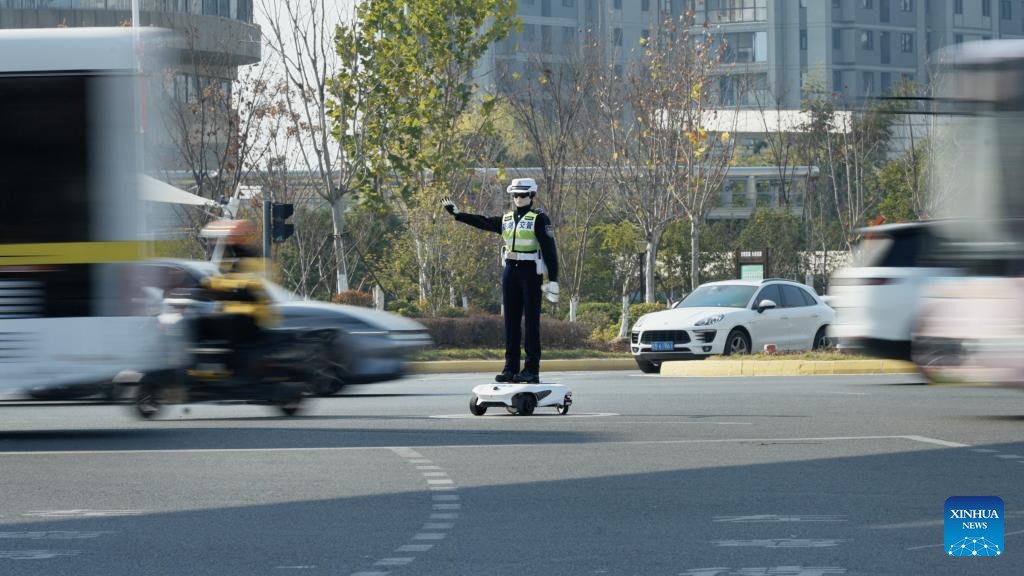
Picture walking up to what looks like a traffic officer from across the street, only to realize you’re face-to-face with China’s latest cyberpunk reality. The “Intelligent Police Unit R001” deployed in Wuhu City this January marks a turning point where humanoid robots transition from factory floors to public intersections—and your daily commute just got a sci-fi upgrade.
Beyond the Novelty: Real Traffic Management Power
These aren’t publicity stunts dressed in reflective gear—they’re solving real municipal problems.
AiMOGA Robotics designed the R001 to handle the grunt work human officers dread. The robot integrates with Wuhu’s traffic signal system, synchronizing gestures while high-definition cameras and AI algorithms detect violations in real-time. It operates 24/7, issuing voice warnings to cyclists riding in motor lanes and monitoring illegal parking.
Traffic officer Jiang Zihao calls it “a new colleague capable of assisting us effectively,” according to People’s Daily. The robot handles repetitive tasks during peak hours and brutal weather conditions, freeing human officers for complex situations requiring judgment calls.
The Bigger Picture: China’s Robotics Explosion
Municipal deployments are becoming systematic rather than experimental.
Wuhu represents just one data point in a massive deployment pattern:
- Chengdu launched robot patrol teams last June
- Hangzhou added AI traffic units in December
- Shenzhen deployed humanoid patrols during holidays
This isn’t experimental—it’s systematic scaling.
AiMOGA delivered roughly 300 humanoids and 1,000 quadruped robots in 2025 alone, operating across 30+ countries. The company’s general manager Zhang Guibing explains the strategy: “Only by bringing products into real-life scenarios can we achieve rapid iteration,” according to Plataforma Media.
These deployments demonstrate how robotics technology can enhance workplace safety across various sectors.
Market Forces: The $57 Billion Question
Infrastructure investments are already flowing into municipal budgets nationwide.
China’s State Council projects the embodied intelligence market will hit 400 billion yuan ($57.1 billion) by 2030, exceeding 1 trillion yuan by 2035. Those aren’t aspirational numbers—they’re infrastructure investments already flowing into municipal budgets.
You’re witnessing the consumer robotics playbook unfold in reverse. Instead of starting in homes, humanoid AI is proving itself in high-stakes public deployment, building the operational data and public acceptance that will eventually reach your doorstep. The R001’s celebrity status—with pedestrians lining up for selfies—suggests the cultural barrier between humans and working robots is dissolving faster than industry experts predicted.