The original EOS R8 was a capable full-frame camera with one glaring omission: no in-body image stabilization. Canon has answered that complaint directly with the EOS R8 Mark II, announced September 15, 2026, priced at $1,899 body-only and set to ship in late October 2026. If you’re weighing this against other options, our guide to the best cameras covers full-frame alternatives at every price point.
Canon positioned IBIS as the defining upgrade and the central motivation for the Mark II’s development.
What Changed From the Original R8
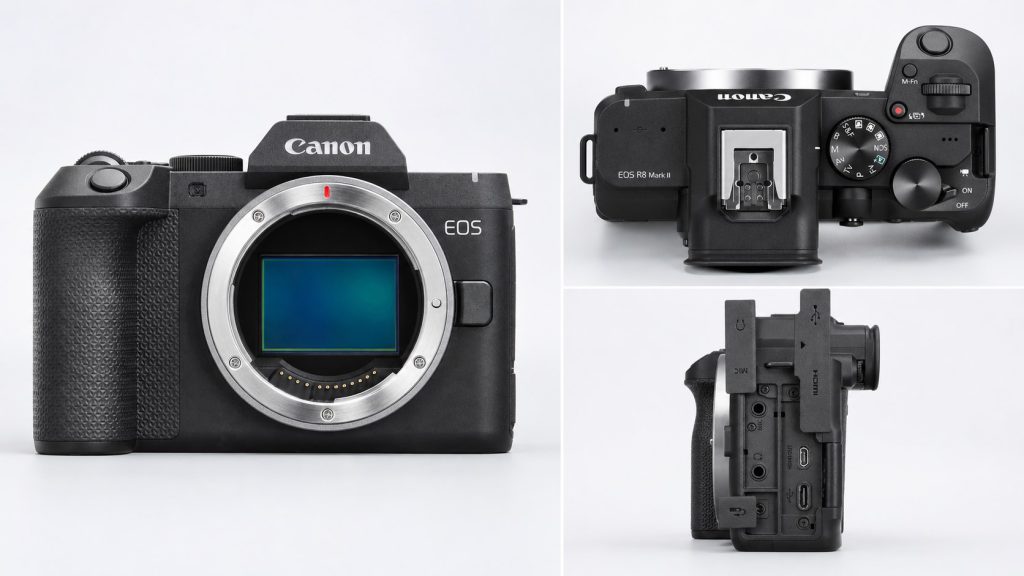
Canon rebuilt the R8 from the outside in, adding stabilization, smarter controls, and faster connectivity without growing the body.
The Mark II weighs 546 g with battery and card, making it, according to Canon U.S.A., the lightest EOS camera body to feature IBIS. The redesigned exterior is more angular than the original R8, though Canon’s familiar EOS silhouette with a viewfinder hump remains intact.
Reviewers flagged the addition of an AF joystick as one of the most meaningful ergonomic upgrades. It gives you direct control over focus point selection without navigating menus.
Canon also deepened the buffer and upgraded wireless connectivity to Wi-Fi 6. Both are useful for burst shooters and on-location file transfers.
What stayed the same: the 24.2-megapixel full-frame CMOS sensor and Dual Pixel CMOS AF II from the original R8 carry over unchanged.
Key Specs at a Glance
- 24.2MP full-frame CMOS sensor with Dual Pixel CMOS AF II and Register People Priority subject tracking
- 5-axis IBIS rated up to 7.5 stops of coordinated shake correction (Canon U.S.A.)
- Oversampled 4K video up to 60p from full-frame readout
- Electronic shutter burst up to 40 fps with pre-continuous shooting
- Wi-Fi 6 connectivity
Accessories and Pricing
Three accessories launch alongside the body, expanding the R8 Mark II’s creative range without adding significant bulk.
The EG-E2 Extension Grip ($99.99, late October) improves handling when you mount larger RF lenses. The Speedlite EL-5 Ver.2 (approximately $379, late October) is an updated hot-shoe flash with tighter integration into Canon’s latest bodies.
Canon is also announcing a Dual Pixel 3D Converter. It reportedly uses Dual Pixel sensor data to enable depth-based processing and creative effects, though specific workflow details remain unclear and are expected in later Canon documentation.
Body-only pricing sits at $1,899. The kit with the RF24-50mm F4.5-6.3 IS STM lens is $2,099, with both configurations expected to be available in late October 2026.
What to Watch in Full Reviews
The sensor carries over from the original R8, so the real tests are IBIS performance and video reliability under sustained use.
The core imaging pipeline is the same as the first-generation R8, meaning image quality improvements will be incremental rather than substantial. Rolling-shutter behavior at 40 fps, overheating limits during extended 4K recording, and long-term build durability all remain untested by independent reviewers.
The R8 Mark II targets enthusiast photographers and hybrid creators who want full-frame performance and genuine stabilization in a compact, travel-ready body. Late October 2026 is when you find out whether Canon delivered on that promise.