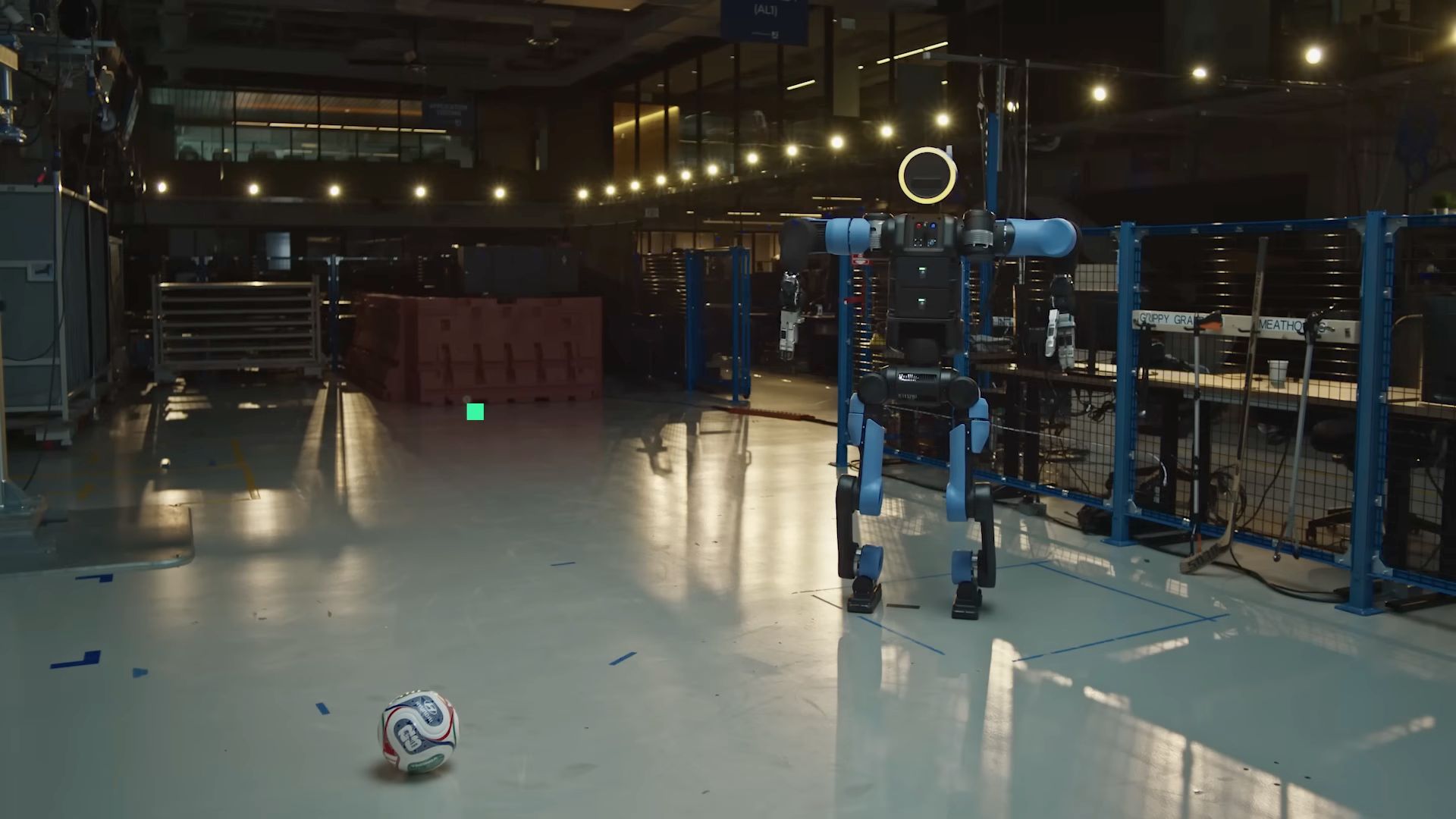
A robot standing in front of a massive screen, absorbing decades of World Cup magic like it’s cramming for the most important final exam ever? That’s exactly what Boston Dynamics’ Atlas humanoid is doing in Hyundai’s new “School of Football” video, where the robot watches iconic match footage and then attempts to recreate the movements it just observed.
This isn’t just clever marketing theater ahead of the 2026 World Cup. Atlas demonstrates genuine technical prowess by shifting its weight smoothly, guiding a soccer ball across the floor with controlled contact rather than just kicking it away, and running through rapid stepping drills that test balance and timing. The robot even mimics emotional gestures from the footage—raising its arms in celebration after completing a drill or dropping to one knee like an injured player.
Simulation Training Meets Sports Psychology
Millions of GPU hours create the foundation for human-like athletic movements and reactions.
Behind these fluid soccer moves lies a sophisticated training pipeline that runs millions of simulated practice hours on GPUs. Atlas relies heavily on proprioception—internal sensing of joint positions, loads, and balance—rather than vision alone, allowing real-time adjustments when dealing with shifting objects or unstable surfaces.
The robot’s training starts from reference trajectories that could come from animation or human demonstrations, then reinforcement learning rewards Atlas for maintaining grip, balance, and control while external disturbances are introduced. This “Sim-to-Real Gap“ process helps bridge the gap between perfect virtual environments and the messy physics of the real world.
This soccer demonstration follows Atlas’s recent heavy-lifting showcase, where the robot carried a 99-pound mini-fridge while maintaining balance. Together, these demos position Atlas as what Boston Dynamics calls a “general-purpose tool for physical work” rather than just an acrobatic showpiece.
World Cup Stage Set for Robot Debut
Hyundai hints at bringing Atlas and Spot robots to the 2026 tournament for unprecedented public visibility.
Hyundai frames this soccer training as Atlas’s first encounter with football, building anticipation for the company’s involvement in the 2026 World Cup co-hosted by the U.S., Canada, and Mexico. While specific plans remain unclear, Hyundai has hinted that both Atlas and Spot could make appearances at the tournament.
If that happens, it would represent one of the most visible public deployments of advanced humanoid robots at a global sporting event. The cultural significance goes beyond technical achievement—seeing robots celebrate goals and show “injury” reactions reinforces how these machines are crossing from purely industrial tools into performers in shared cultural experiences.
The real breakthrough isn’t that Atlas can kick a ball, but that robots are learning complex physical skills through data-driven approaches similar to how AI learned language. Sports provide an intuitive benchmark for agility and coordination that translates directly to warehouse work, construction tasks, and any job requiring human-like movement in unpredictable environments.