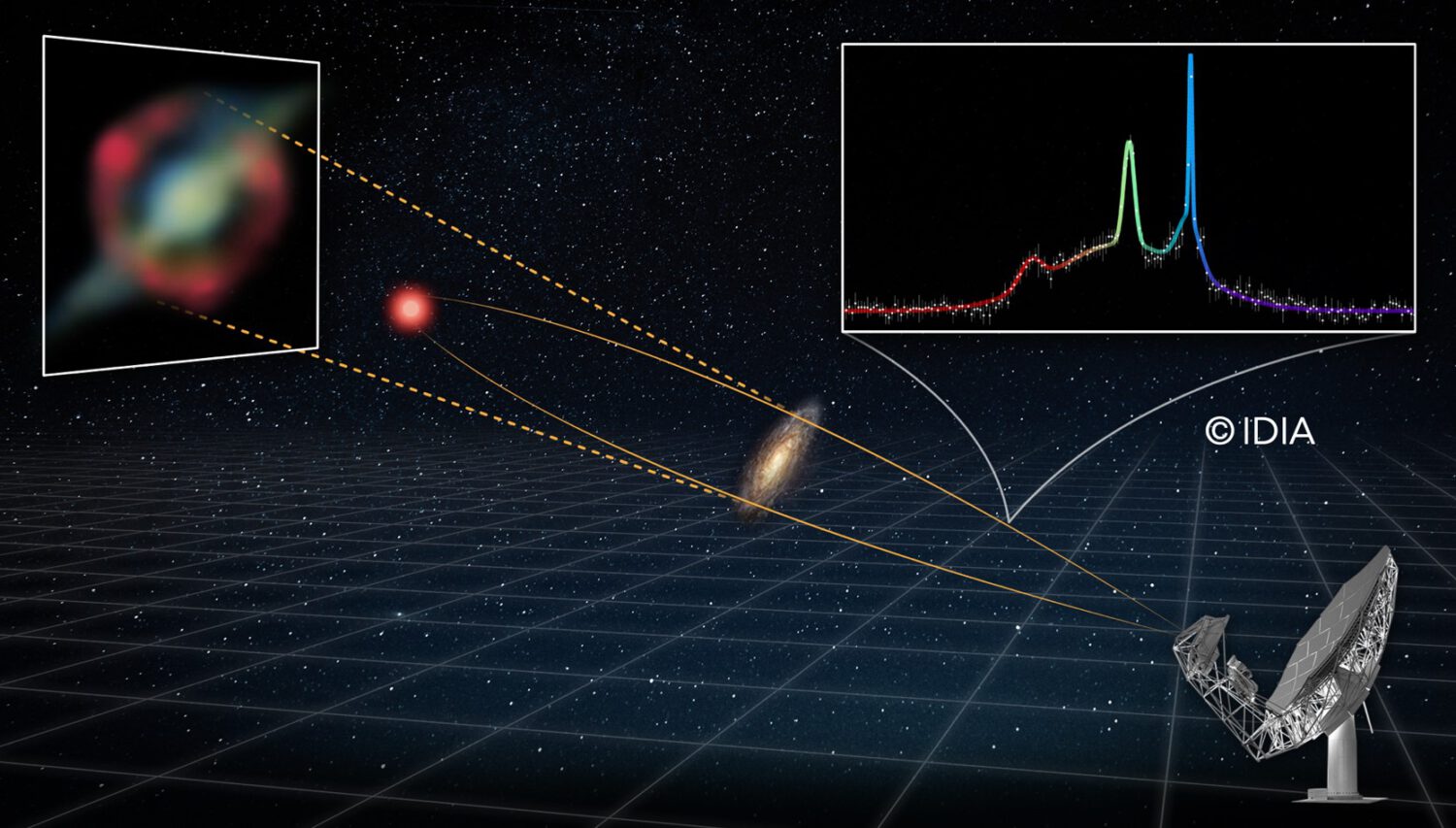
South Africa’s MeerKAT radio telescope has detected the most distant hydroxyl megamaser ever recorded, picking up a signal from a galaxy merger observed from an epoch more than 8 billion years ago. The source registered a signal-to-noise ratio exceeding 150 in just 4.7 hours of observation, setting a new distance record and demonstrating MeerKAT’s potential for detecting rare, high-redshift radio phenomena.
What You’re Actually Looking At
The term “space laser” sells headlines, but the object is something stranger and more interesting than science fiction.
When two gas-rich galaxies collide, their dense molecular clouds compress and intense infrared radiation floods the system. That energy drives hydroxyl molecules, each made of one oxygen atom and one hydrogen atom, to emit amplified real-world laser-equivalent radio waves near the 18-centimeter wavelength.
That process is the radio-wave equivalent of a laser, naturally occurring, no aliens required. Researchers describe this particular source, catalogued as HATLAS J142935.3–002836, as a “gigamaser,” an informal term reflecting that its apparent luminosity is roughly a billion times greater than masers found inside the Milky Way.
It sits at redshift z=1.027. That means the radio waves left their source more than 8 billion years ago, well before Earth formed.
Getting that signal to MeerKAT required an assist from the universe itself. A foreground galaxy sits between the source and Earth, and its gravity bends and magnifies the radio waves. Thato Manamela, a postdoctoral researcher at the University of Pretoria and SARAO-funded researcher, described it to Anadolu Agency this way: “This galaxy acts as a lens, the way a water droplet on a window pane would, because its mass curves the local space-time. So we have a radio laser passing through a cosmic telescope before being detected by the powerful MeerKAT radio telescope.”
That gravitational magnification is estimated at roughly 8 to 10 times, depending on wavelength, though the figure is model-dependent and varies across different parts of the emission.
Why Astronomers Care
This detection offers a rare window into how galaxies grew, collided, and formed stars when the universe was less than half its current age.
Megamaser emission lines reveal how gas moves inside a merging system, including its density and temperature. That data maps star-formation conditions from an era when the universe was approximately half its current age, much as airborne sensing has illuminated a lost civilization hidden beneath forest canopies.
There is a more dramatic possibility embedded in the data. Merging galaxy systems like this one may contain pairs of supermassive black holes spiraling toward each other, and those systems are among the predicted sources of low-frequency gravitational waves. Megamasers could help astronomers identify and locate them, though this specific source has not been shown to contain a confirmed black-hole binary.
Manamela noted, according to Space.com, that gravitational magnification “makes the emission easier to detect and allows us to study a system that would otherwise be too faint to observe.” The detection also illustrates MeerKAT’s potential for surveying high-redshift hydroxyl megamasers, and points toward what the Square Kilometre Array, a next-generation radio observatory currently under development, could find at even greater distances.
One thing this signal is not: a threat. The radio waves traveled across intergalactic space from a natural astrophysical process, and what MeerKAT captured reflects how the source appeared billions of years ago, not its present-day state.
The research has been accepted for publication in Monthly Notices of the Royal Astronomical Society: Letters and is available as an arXiv preprint. Follow-up observations could map the maser’s velocity structure, refine the lens model, and improve estimates of the system’s intrinsic luminosity once the gravitational magnification is fully accounted for. That work could clarify just how extreme this object actually is.