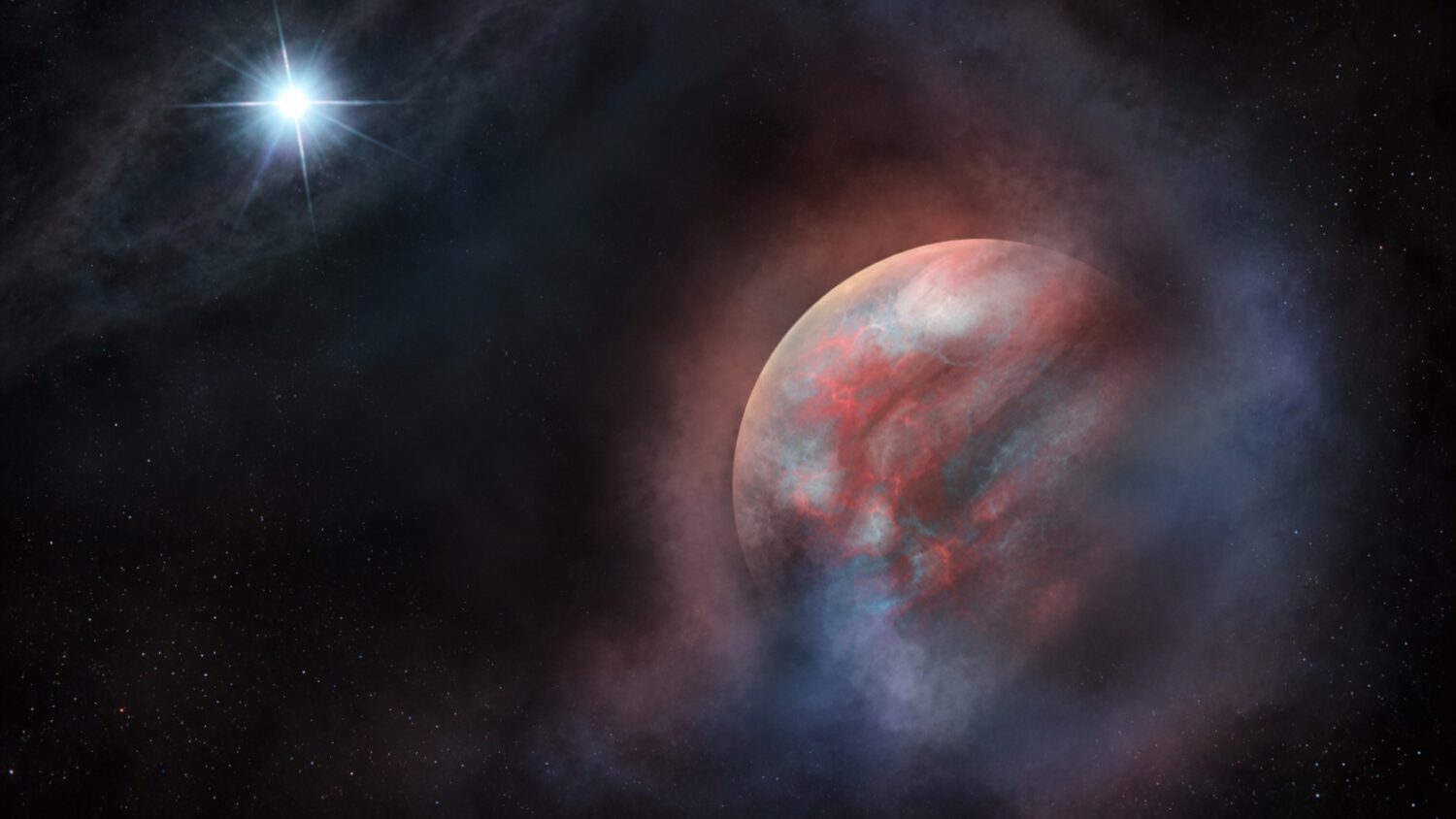
Astronomers have reported evidence for what may be the first planet built from the remains of its own dying star. Published October 5, 2026, in Nature Astronomy, the University of Warwick-led study describes a candidate Jupiter-sized world orbiting the white dwarf HS 0209+0832 every 4.4 Earth days. The object has not been confirmed through multiple detection methods and should be treated as a candidate, not a settled fact.
How Astronomers Found It
Two independent lines of evidence, a repeating brightness signal and an unusual chemical signature, point toward the same unusual conclusion.
A repeating dip in the white dwarf’s brightness on a 4.4-day cycle, consistent with a closely orbiting planet, provided the first clue. That signal alone would not be enough.
Spectroscopic observations revealed something stranger: the white dwarf’s atmosphere contains zinc, copper, and niobium at concentrations far above normal, with niobium reported at roughly 1,000 times the solar abundance. That chemical fingerprint points to the s-process. This nuclear reaction happens deep inside aging stars during the red-giant phase, and the specific enrichment pattern it produces is not associated with planets formed at a star’s birth.
The leading interpretation is that the white dwarf is accreting, or gradually consuming, material stripped from the nearby gas giant’s atmosphere by intense radiation. That stripped material carries the unusual chemical signature onto the stellar remnant, where astronomers can read it as a record of the planet’s composition.
A Star That Made Its Own Planet
The proposed formation pathway depends on a rare set of conditions that researchers say explains why such worlds are expected to be extraordinarily uncommon.
White dwarfs are what Sun-like stars become after exhausting their nuclear fuel. The star expands into a red giant, expels its outer layers, and leaves behind a dense, cooling core.
In most systems, that expelled material disperses into space. Researchers propose that HS 0209+0832 may have had a companion star. That companion’s gravity could have pulled the ejected material into orbit, allowing a disk to form and eventually coalesce into a new planet.
Boris Gänsicke of the University of Warwick described the significance: “What’s remarkable about the planet around HS 0209+0832 is that this isn’t a planet from somewhere else, or a survivor from the system’s birth; it looks like it was built from the very material its own star cast off as it died.”
“Second-generation planets are worlds that form out of the material a star casts off as it dies. They’re incredibly rare, and finding one around a white dwarf was completely unexpected.” , Jamie Williams, University of Warwick
What Happens Next
The candidate’s extremely close orbit means it may be slowly consumed by the same stellar remnant that researchers believe created it.
The candidate orbits at roughly 6 million kilometers, about 4% of the Earth-Sun distance. At that range, the white dwarf’s radiation is continuously stripping the planet’s atmosphere, and the gas giant may eventually be substantially reduced or destroyed entirely.
If confirmed, the system would offer a rare opportunity to study a planet being chemically altered by the remnant of the star that may have formed it. German Scientists working on frontier biology have similarly demonstrated that unexpected physical milestones can reshape scientific understanding. Researchers suggest the combination of heavy-element atmospheric pollution and short-period brightness variations could serve as a search template for similar systems elsewhere.
The Sun’s Distant Future
The HS 0209+0832 system does not predict a second-generation planet around our future Sun, but it does show the formation pathway is physically possible.
In roughly 6 billion years, the Sun you see today will exhaust its fuel and expand into a red giant. It will ultimately collapse into a white dwarf, potentially engulfing Earth in the process.
What this system demonstrates is that planet formation from stellar-ejected material is physically plausible under certain conditions. The candidate still requires confirmation through additional observations, but the chemical evidence already changes how scientists think about what a lost civilization of worlds might look like around a dead star , and what that dead star can leave behind.