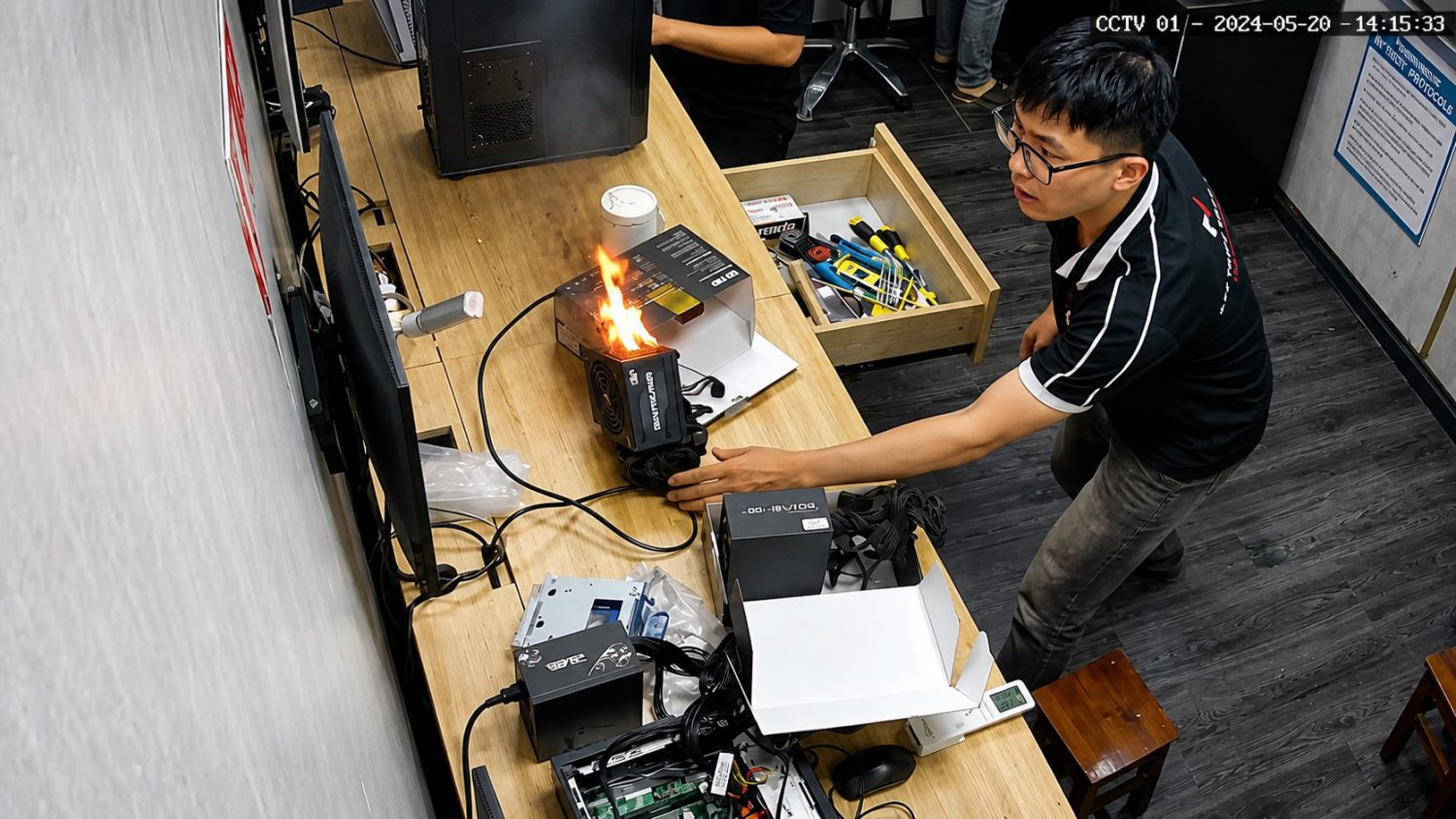
Brand new, straight from the box. The technician sets it on the workbench, connects a standard AC cable, and reaches toward the casing — routine stuff. Then: a loud bang, a flash, sparks, open flame, and thick smoke filling the room. Hot debris scatters across the table. The tech yanks his hands back and kills the power. The VSP Megamax VS750D — a $40 budget PSU with a legitimate Cybenetics Silver certification — just exploded on first contact with mains power. If you’ve run into other computer problems like this, you’re not alone.
What the CCTV Footage Shows — and What the Specs Won’t Tell You
The incident is documented, the specs are verified, and the gap between the two is the whole story.
The verified facts, based on video evidence and reporting from Tom’s Hardware and GameGPU:
- The VS750D is a 750 W ATX unit sold in Vietnam for roughly 800,000–1,100,000 VND (US$30–40), featuring DC-to-DC conversion, Active PFC, and OCP/OPP/SCP/OVP protections via IC GR8329
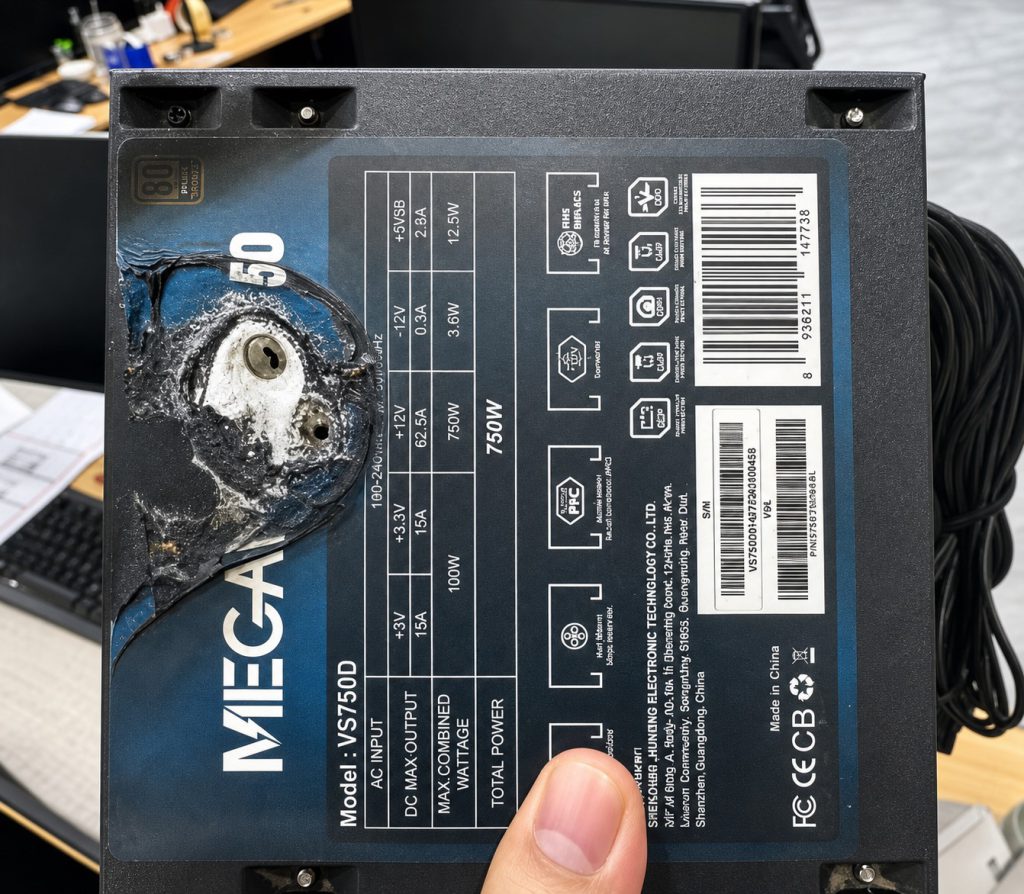
- Post-incident inspection revealed severe damage to the primary high-voltage section — the internal arc burned through the metal top cover and factory spec sticker
- Analysts suggest the likely cause was a bridge rectifier or MOSFET failure in the switching stage, creating a catastrophic internal short at the moment of energizing — this remains a hypothesis, not a confirmed root cause
- Cybenetics independently tested the unit in early 2026, confirming efficiency and listed protections, making this failure appear highly atypical for a certified unit
- No recall has been reported; current evidence points to one defective unit, not a proven systemic design flaw
Here’s the uncomfortable part. Those protection circuits — OCP, OVP, all of it — are downstream safeguards. According to Tom’s Hardware, a primary-side failure at first power-on can happen so fast and so violently that no downstream protection has time to respond. The spec sheet promises protection after the PSU is already running. It cannot save you from a defective component that fails before the system ever stabilizes.
The Bench Test That Saved Everything Downstream
One correct habit — powering the PSU in isolation before connecting anything — is what kept this from becoming a much more expensive story.
The technician’s isolated bench test is exactly the right procedure. According to GameGPU’s coverage, had this unit been installed inside a full system with a GPU and motherboard already attached, the damage would have extended catastrophically beyond the PSU itself. That single habit prevented what could have been a very expensive afternoon.
The broader takeaway lands here. The VS750D sits at Tier E on at least one widely-referenced PSU tier list, despite its certifications and reasonable efficiency numbers. Vietnamese tech communities have openly flagged the unit as controversial. Think of budget PSUs like algorithmic fashion drops — the listing checks every box, but quality control is still a dice roll inside that steel chassis, and occasionally the result is a very bad pull.
Certifications and charger risks are filters, not guarantees — especially below $50. Bench-test before you build. When a $40 PSU is the only buffer between mains power and a $400 GPU, the risk calculus rarely favors the budget option — and you may be paying too much in downstream risk for what looks like a bargain.