Your kitchen Echo is always listening for its wake word, and it occasionally gets that wrong. Northeastern University researchers David Choffnes and Daniel Dubois confirmed this is not paranoia. They played 120 hours of television audio at smart speakers and recorded dozens of false activations. A team at the University of Chicago decided a mute button you have to trust is not good enough, and built one you control entirely.
How It Works
The bracelet exploits a physical quirk in commodity microphones to corrupt recorded speech without touching any device.
The Bracelet of Silence is a wrist-worn cuff that emits ultrasonic signals at around 25 kHz, a frequency above human hearing but well within the sensitivity range of commodity microphones. The mechanism relies on a property called nonlinearity: when a microphone receives a strong ultrasonic signal, it bleeds that noise into the audible range, turning recorded speech into unintelligible static. The effect is equivalent to injecting white noise directly into the microphone’s circuitry, without any physical contact with the device.
The prototype uses 24 transducers arranged in two rings of 12, providing omnidirectional coverage with minimal blind spots. Natural wrist movement shifts the signal angle as you talk, which the researchers found actually improves jamming performance compared to a fixed array. In a documented demonstration, activating the bracelet during a live phone call reduced the audio on the other end to pure static.
The effective radius is roughly three feet, enough to cover a conversation at close range but not an entire room.
Who Built It and Why
The project emerged from adversarial privacy research at UChicago, grounded in the premise that individuals may need to protect themselves at the body level.
Ben Zhao, Heather Zheng, and Pedro Lopes at UChicago’s SAND Lab and Human Computer Integration Lab developed the device. Their framing is direct: in a home dense with IoT sensors, you may need to assume every nearby device is compromised and protect yourself at the level of your own body. The married professors, Zhao and Zheng, reportedly debated whether to keep an Alexa in their own home before building a surveillance app that renders the question moot.
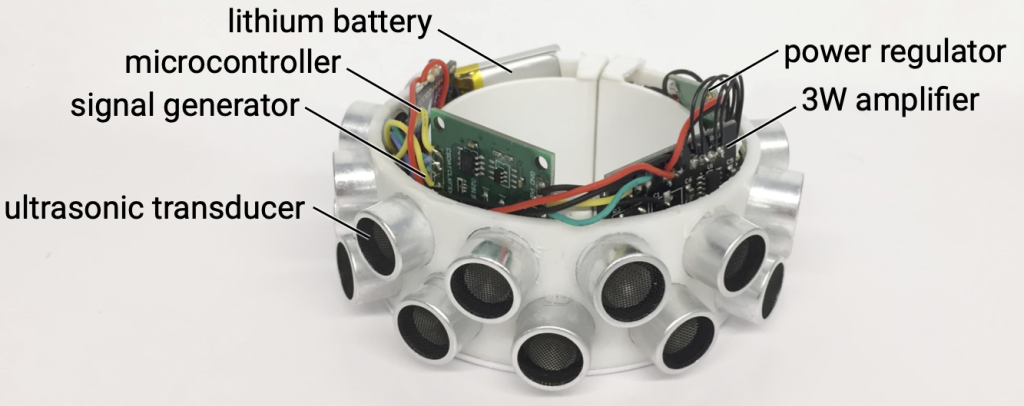
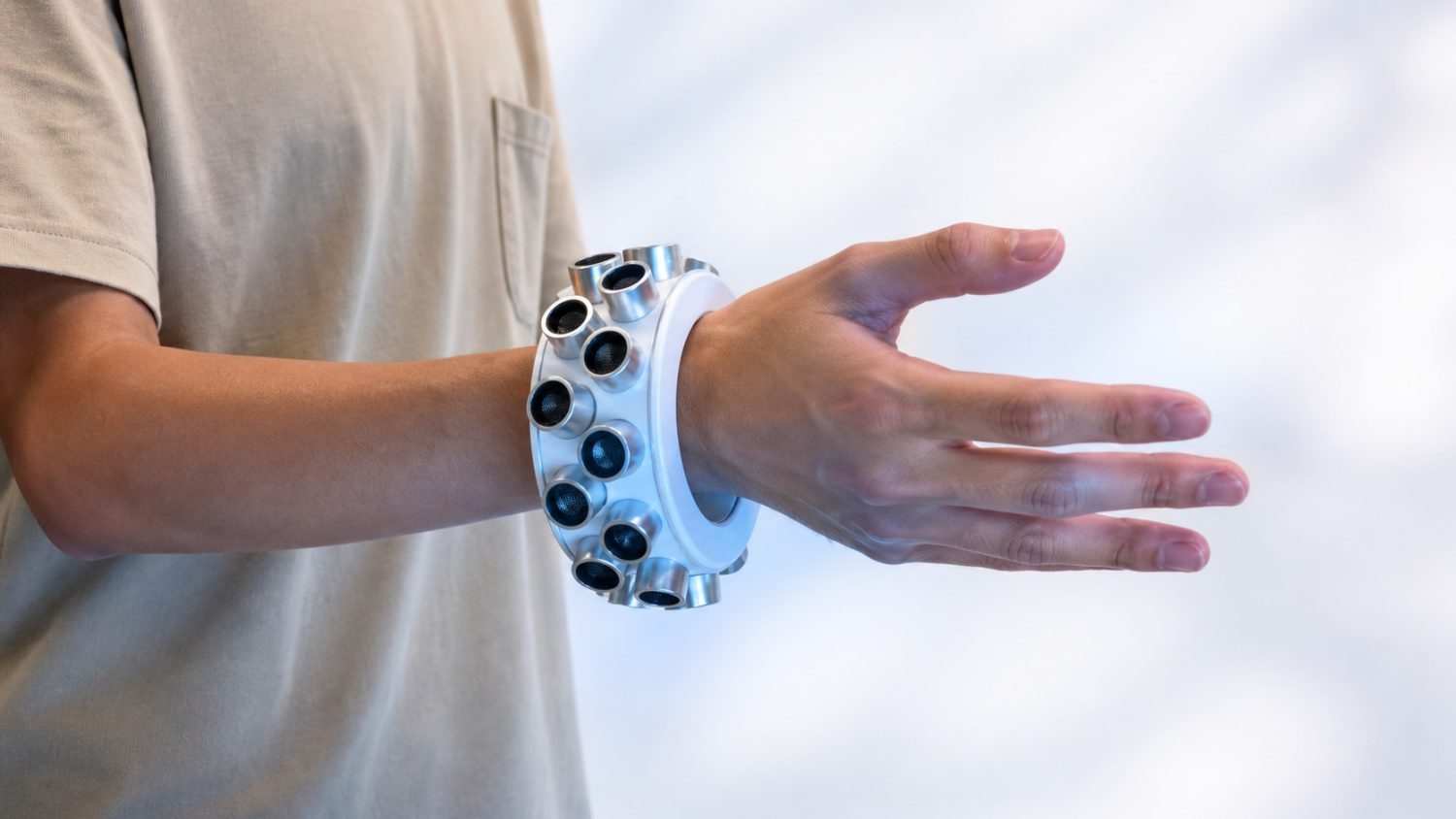
The bracelet looks deliberately confrontational: a bulky white cuff with protruding spiky transducers, an intentional “anti-smartwatch” aesthetic that signals resistance rather than integration. The researchers estimate the parts cost around $20 to manufacture, and the device remains a prototype with no commercial launch date, though investor interest has been reported.
Woodrow Hartzog, law and computer science professor at Northeastern University, offers a pointed counterargument: “It creates an arms race, and consumers will lose in that race. Any of these things is a half-measure or a stopgap. There will always be a way around it.” His critique carries weight. Surveillance systems could adapt by filtering ultrasonic noise or switching to alternative sensors. That would gradually erode the bracelet’s effectiveness and push users toward a cycle of upgrades.
Context and Limits
The bracelet sits within a wider ecosystem of privacy-armor products, each addressing a different surveillance modality.
Google hardware chief Rick Osterloh has publicly stated that homeowners should disclose the presence of smart speakers to guests, a concession that itself acknowledges the etiquette and consent problem is real. Project Alias addresses the same concern differently: it sits on top of a smart speaker and feeds it noise until a local wake word is spoken. Alexagate mounts on Echo devices and jams their microphones with ultrasound, though it stays fixed to one speaker rather than following the user.
Scott Urban, designer of Reflectacles privacy eyewear, frames the broader demand plainly: “New technologies are continually eroding our privacy and anonymity. People are looking for an opt-out, which is what I’m trying to provide.” His infrared-blocking lenses target facial recognition cameras, addressing visual surveillance the way the bracelet addresses audio.
The bracelet’s limits deserve equal clarity. Its three-foot radius leaves the rest of the room exposed, and ultrasonic emissions may be audible as a high-pitched tone to young people and animals. It also does nothing to erase audio already captured before activation.
At roughly $20 in parts, hardware-level, vendor-independent privacy tools are within reach of consumer hands if the design matures. But as Hartzog’s critique makes clear, a bracelet cannot replace enforceable data-protection policy. It can only buy you a few feet of silence while you wait for one.