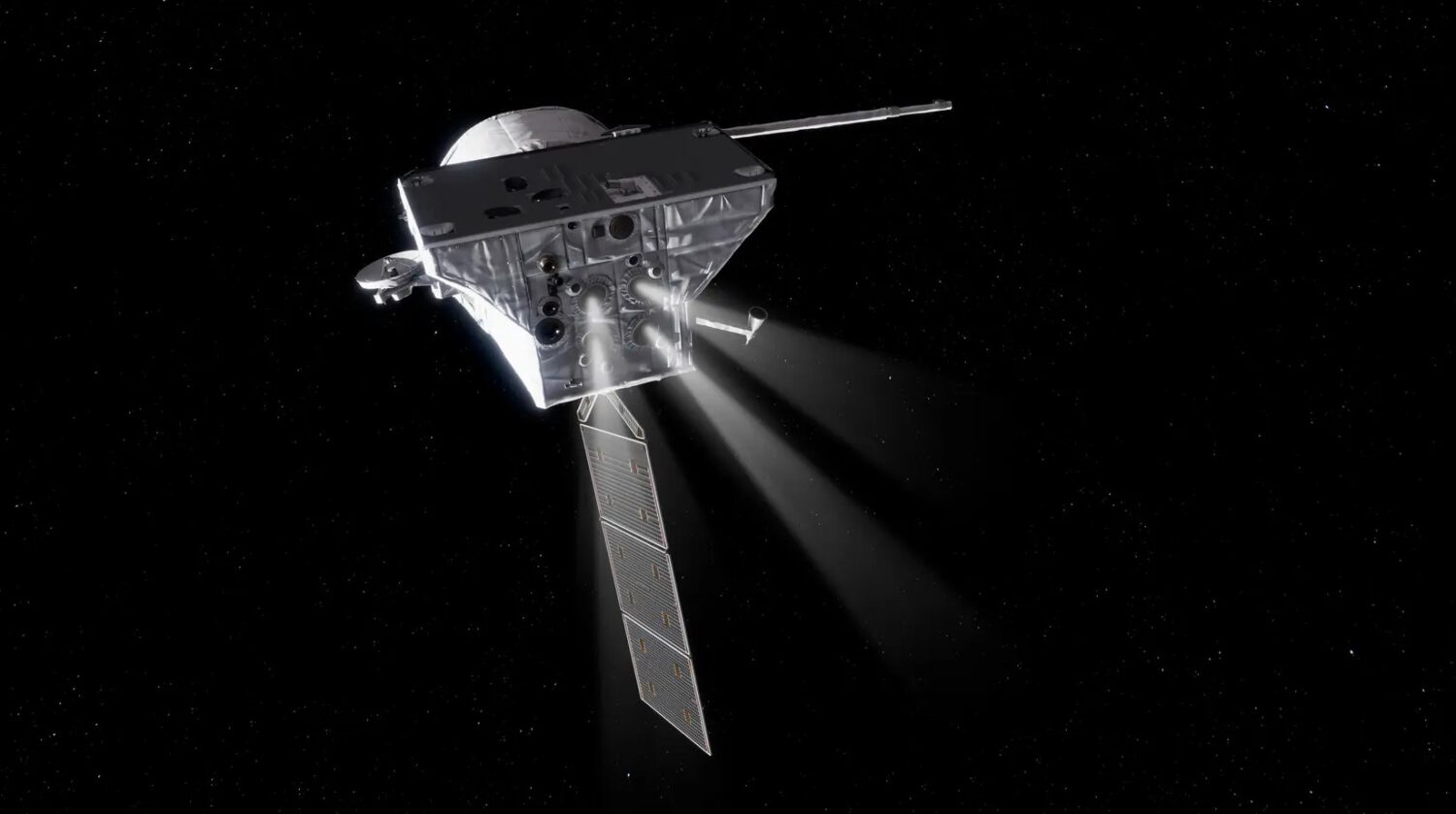
The Federal Communications Commission authorized SpaceX to deploy up to 1 million orbital compute modules under a proposed constellation called Starmind, describing the decision as the first U.S. authorization for a data-center constellation.
That authorization is conditional. The FCC made no finding that orbital data centers are technically or economically viable, and the commission’s order preserves that distinction.
Carr’s Case for Computing in Orbit
FCC Chairman Brendan Carr tied the approval directly to U.S. AI competitiveness, not just satellite communications.
Carr announced the approval on X, arguing that Starmind and competing constellations, powered by solar energy, would extend U.S. leadership in advanced AI and space infrastructure. His framing connects the decision to American economic competitiveness rather than conventional communications policy, echoing broader debates about AI data centers and national infrastructure priorities.
What the FCC Actually Approved
The authorization grants spectrum access for backup and emergency links, not clearance to deploy computing hardware.
The authorization covers radiofrequency links for backup and emergency telemetry, tracking, and command. Those backup links operate on an 18.8–19.3 GHz downlink and a 28.6–29.1 GHz uplink, supplementing optical inter-satellite links that would carry primary traffic between modules.
Higher Orbits Require More Paperwork
Deployment above 600 kilometers is blocked until SpaceX submits an additional orbital-debris mitigation filing.
SpaceX cannot deploy satellites above 600 kilometers until it files an additional orbital-debris mitigation plan. The planned altitude range for the constellation runs from approximately 500 to 1,002 kilometers.
A Long Road to a Million
Reported deployment milestones stretch from a single test satellite in 2033 to the full constellation by 2040, though those figures await independent confirmation.
Deployment milestones cited in FCC filing materials, as summarized by Sawyer Merritt on X, call for one operational satellite by 2033 and 100,000 by 2035. The full constellation of 1 million is projected by 2040, with 500,000 units targeted by 2038. Those figures have not been independently verified against the final commission order and should be treated as preliminary until confirmed.
SpaceX May Not Be the Only Player
The FCC is reviewing orbital data-center applications from other companies, suggesting this authorization could establish a broader regulatory category.
The FCC is reviewing orbital data-center proposals from additional companies. This authorization may define a new regulatory category rather than carve out a privilege for a single operator.
The Political Backdrop
SpaceX’s owner has a prominent public role in federal technology policy, though no causal link between that role and this authorization can be established from available reporting.
SpaceX is owned by Elon Musk. His reported involvement with the Trump administration’s Department of Government Efficiency has drawn scrutiny in contexts where federal agencies interact with his companies, but that role has not been independently verified against primary sources for this article.
What the Authorization Leaves Unanswered
Regulatory clearance does not resolve the core engineering, environmental, and market questions that will determine whether orbital data centers are practical.
Regulatory permission does not solve thermal management in vacuum, continuous power generation at orbital scale, radiation hardening, or data-transfer latency to ground users. Spectrum coordination with existing operators and long-term debris consequences at a constellation scale far exceeding current Starlink also remain open. Those interested in how advanced AI applications are already reshaping productivity on the ground may find the orbital ambitions here a striking contrast. The American Astronomical Society petitioned against the application, and astronomical-interference concerns are unresolved pending the FCC’s formal treatment of those objections.
Permission Granted, Proof Pending
What the FCC issued is conditional regulatory clearance, not a certification that the concept is commercially or technically sound.
What the FCC issued is regulatory clearance under a set of conditions, not a certification that this idea works. The first real milestone arrives in 2033, when SpaceX is expected to have one operational satellite in orbit.