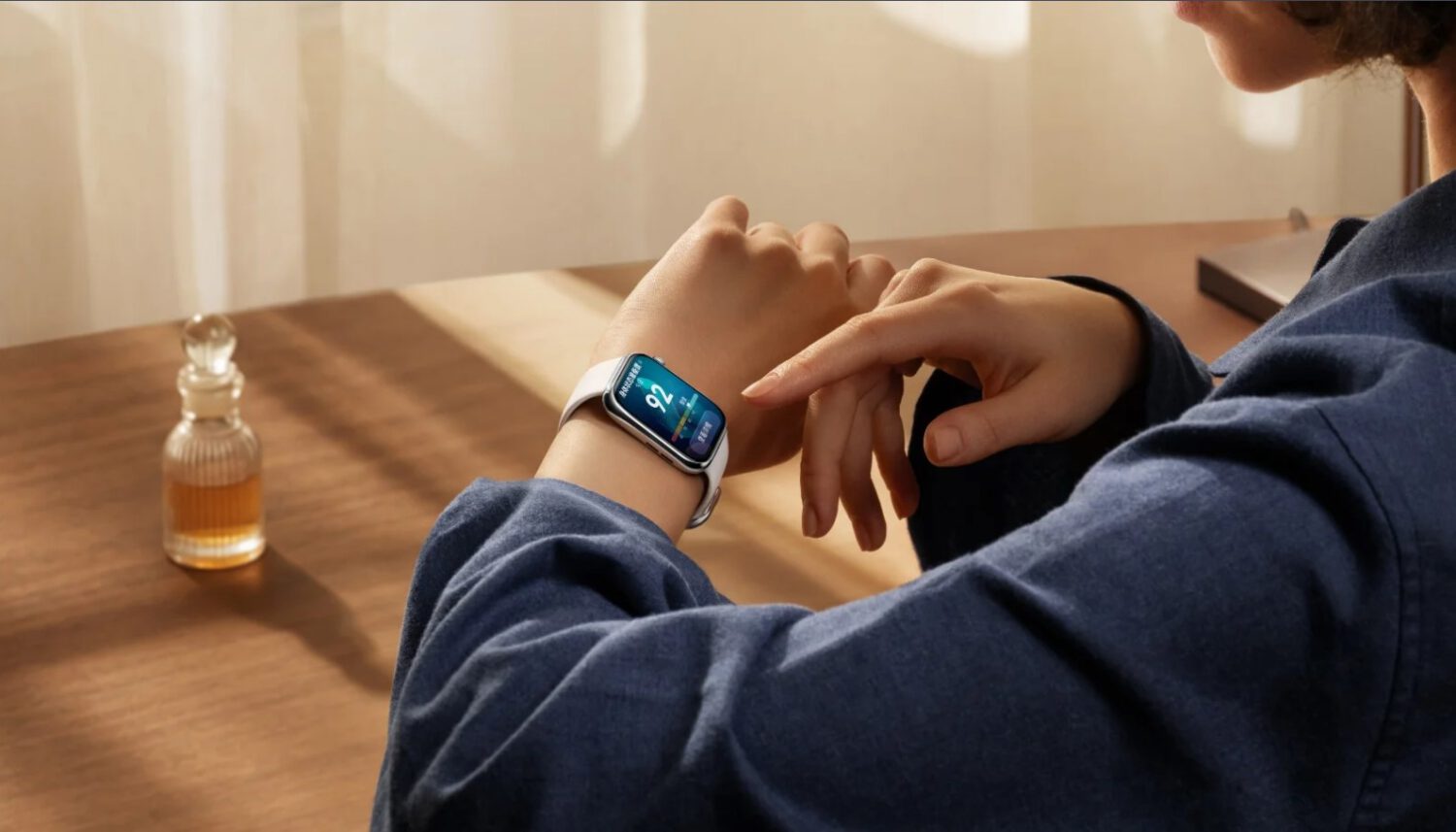
At 6.9 mm thick and 27 grams without a strap, the Watch Air is the slimmest smartwatch Huawei has built to date. Reaching that target required more than a slim casing; it demanded a significant rethink of the internal architecture.
Huawei reorganized the Watch Air’s internals around a stacked motherboard, a miniaturized vibration motor, smaller speakers, and an irregularly shaped silicon-carbon battery. Those changes reflect genuine engineering constraints rather than incremental refinement, because a conventional layout simply could not fit within the available volume.
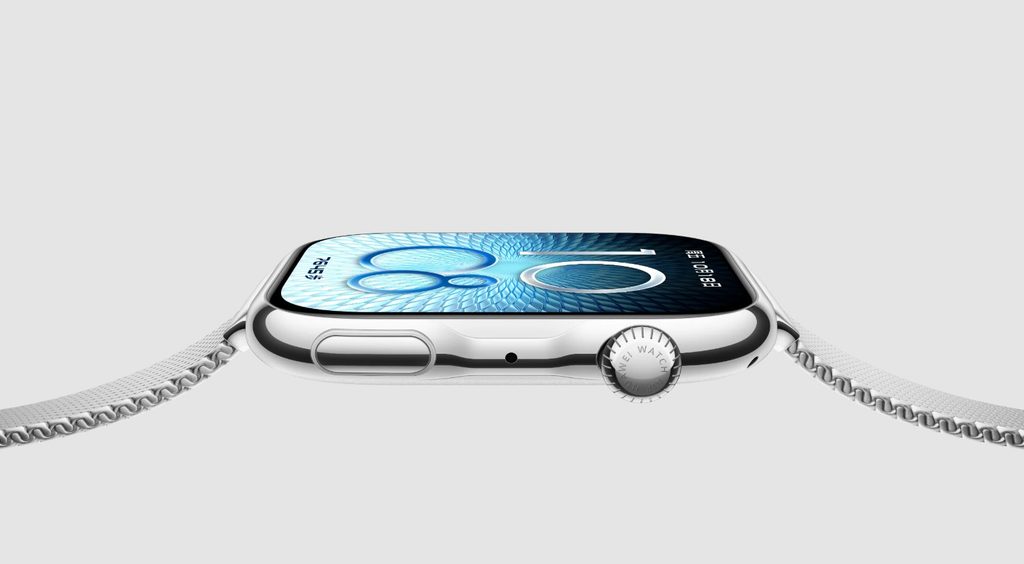
Titanium Shell, Sapphire Glass, Three Finishes
The Watch Air uses premium materials throughout, with an understated aesthetic that prioritizes wearability over visual impact.
The casing uses TC4 titanium and is offered in silver, gold, and black finishes. Sapphire glass protects the display.
The overall design reads as restrained rather than bold, which should suit buyers who want premium materials without a large profile on the wrist.
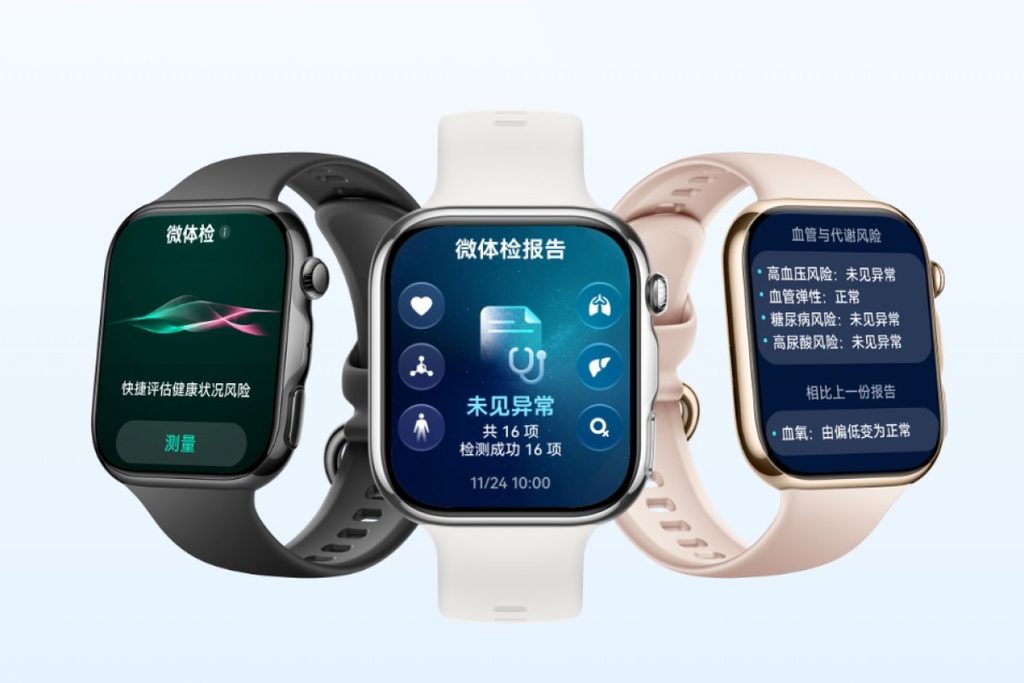
A Bright Screen in a Compressed Frame
The 1.92-inch AMOLED panel delivers a high peak brightness figure despite the watch’s compact dimensions.
The Watch Air features a 1.92-inch LTPO 2.0 AMOLED display with a 480 x 408-pixel resolution, a 60 Hz refresh rate, and a peak brightness of 3,500 nits. Huawei says that brightness level keeps the display readable in direct sunlight.
HarmonyOS 7.0 powers the device, with Bluetooth 6.0, NFC, and dual-band GNSS positioning rounding out the connectivity set.
Health Tracking Comparable to the Watch 6
Huawei reports the Watch Air carries a health sensor suite comparable to what appears in the Watch 6.
Reported health features include heart-rate monitoring, blood-oxygen measurement, skin-temperature tracking, ECG readings, sleep monitoring, and stress tracking. The watch also supports 110 sports modes.
That breadth positions the Watch Air as a capable health wearable rather than a lightweight device that traded sensors for a slimmer profile.
Five Days of Battery, With One Clear Caveat on Water
The 350 mAh cell is rated for up to five days, but the water-resistance fine print deserves close attention.
The irregularly shaped silicon-carbon battery holds 350 mAh and carries a rated life of up to five days on a single charge. Huawei rates that figure under typical conditions; always-on display use or intensive GPS sessions can be expected to reduce it.
Water resistance is rated at 5 ATM, which covers shallow swimming. The IP6X certification does not extend to hot water, and Huawei advises against wearing the Watch Air in hot showers, saunas, or while diving. That distinction matters for anyone whose daily routine involves steam or high heat.
Priced for China, Timeline Unknown Everywhere Else
Three configurations are available at launch, all currently limited to the Chinese market with no confirmed international release date.
Chinese pricing starts at CNY 2,499 (approximately $375) for the silicone-strap version. A woven composite strap model is priced at CNY 2,699 (approximately $405), and the stainless-steel Milanese version reaches CNY 2,999 (approximately $450). All dollar figures are approximate conversions at current rates.
Huawei has not announced international availability or pricing as of this writing. For prospective buyers outside China, the Watch Air’s combination of a compact titanium build, full health tracking, and ECG capability makes it worth monitoring closely. Whether that specification set translates to global markets at competitive pricing remains the central question for anyone weighing it against established alternatives.