Classical strategies for the Mermin-Peres magic square game cannot succeed more than 8/9 of the time, roughly 88.9%. Google’s Willow quantum processor won 98.3% of rounds.
A Game Built to Expose the Difference
The magic square game is a coordination puzzle engineered to reveal the gap between quantum and classical performance.
Two players receive related but different questions and must satisfy a set of row, column, and intersection constraints, without communicating during play. No prearranged set of fixed answers can satisfy every round; that limit is not a matter of clever programming but of mathematics.
Why Outcomes Don’t Have to Be Fixed in Advance
Quantum contextuality is the property that makes the quantum advantage in this game possible.
In a classical system, information generally carries a definite value before it is measured. In a quantum system, an outcome can depend on which compatible measurements are made alongside it, not on a single preassigned value waiting to be revealed.
Think of it as the difference between reading an answer written on a card before you open it and a quantum answer that takes its final form only once you decide what question to ask alongside it. That analogy has limits. Contextuality does not involve instantaneous communication or any violation of ordinary physics; it describes why quantum measurement outcomes resist explanation through context-independent preassigned values.
The Hardware Behind the Result
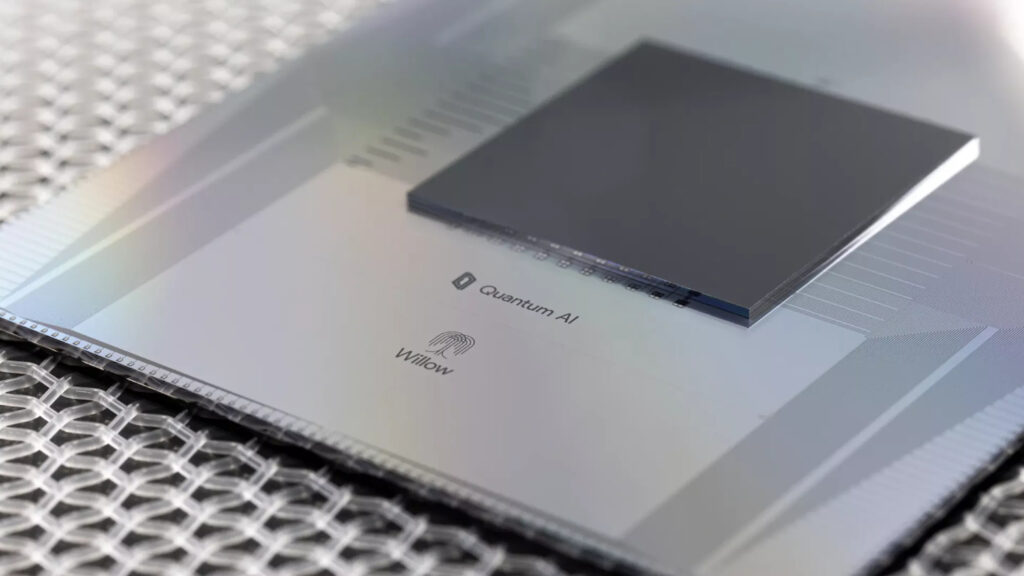
Willow runs on superconducting circuits cooled to temperatures near absolute zero.
Google also reported contextuality-related advantages in related tasks involving up to 105 qubits, extending the result beyond the magic square benchmark alone. Google’s Nebraska data center investments reflect the company’s broader commitment to cutting-edge computing infrastructure.
Where the Research Appears
The findings were published in one of science’s most selective journals.
The paper, “Quantum-classical separation in bounded-resource tasks arising from measurement contextuality,” appeared in Science on Nov. 19, 2026. It presents contextuality as a measurable source of quantum-classical separation demonstrated on working hardware, not only in abstract mathematics or small-scale theoretical models.
What This Result Does Not Establish
The magic square game is a benchmark, not a blueprint for a commercial application.
The experiment does not demonstrate a practical use in drug discovery, materials science, artificial intelligence, or any other applied field. This result does not show broad general-purpose superiority over classical supercomputers; it shows a measured advantage on a carefully constructed task.
The Open Question Ahead
Demonstrating that contextual behavior survives on modern hardware is the first step; harnessing it is the harder one.
Researchers now face the question of whether contextuality can be controlled, scaled, and incorporated into error-corrected algorithms that address real problems. This experiment supports the view that the effect is present and measurable on current quantum hardware. General-purpose quantum computing that outperforms classical machines on useful tasks remains a long-term research goal.