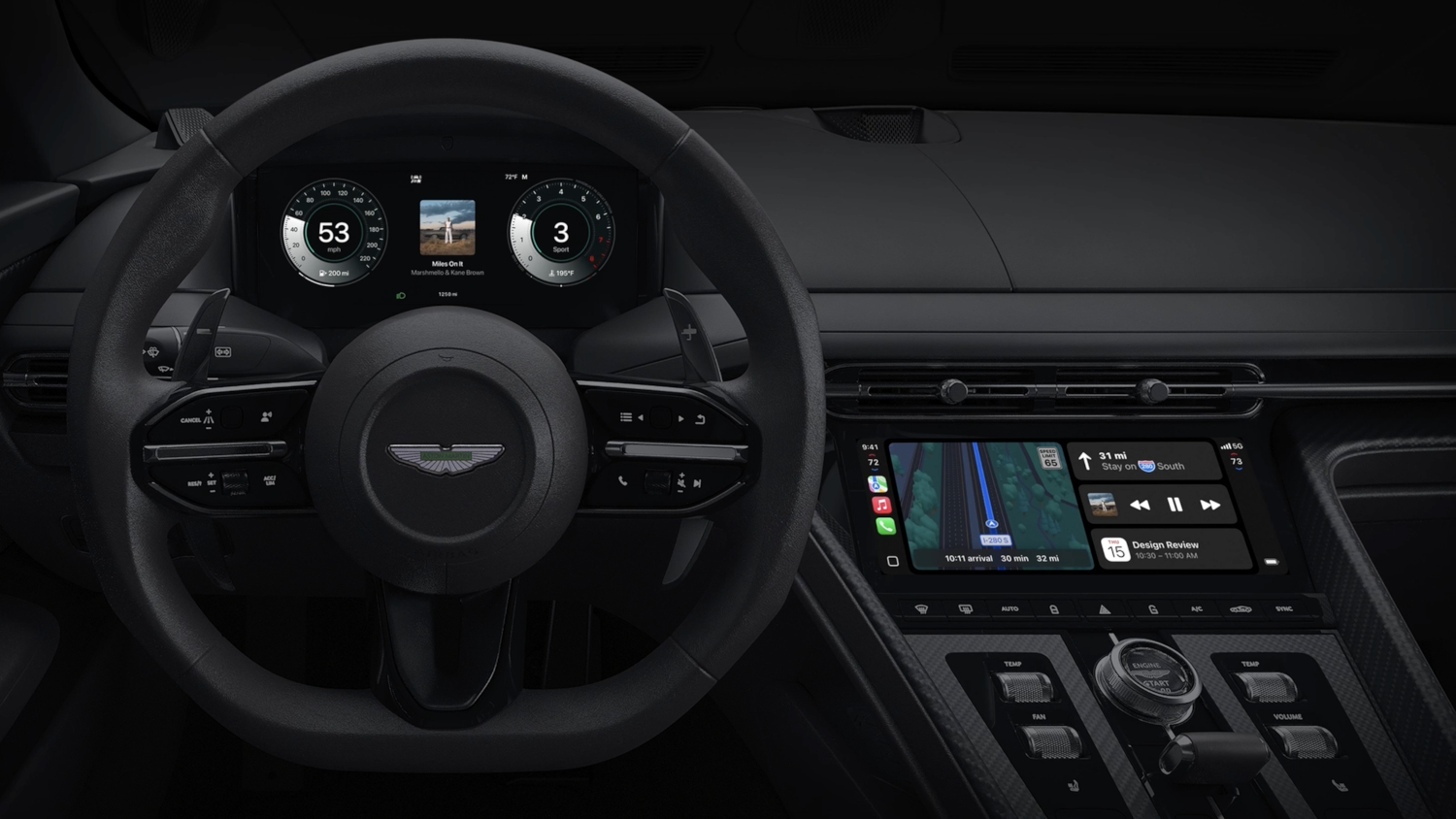
Apple announced CarPlay Ultra in May 2025 with considerable fanfare and a roster of automaker partners spanning the industry. As of November 2026, Aston Martin remains the only brand selling production vehicles with it, available on models including the DBX S, DB12, and Vanquish.
That gap between announcement and availability is not a minor footnote. It is the defining fact about CarPlay Ultra right now.
More Than Phone Projection
CarPlay Ultra expands well beyond the familiar center-screen mirror of its predecessor.
Standard CarPlay displays selected iPhone features on a compatible vehicle’s center screen. CarPlay Ultra goes further, integrating with the instrument cluster, center display, climate controls, and other vehicle functions that automakers have traditionally controlled.
That is a meaningful expansion, and it helps explain why the rollout has been anything but smooth.
A Long List of Intentions
Thirteen brands have been associated with CarPlay Ultra support, but association is not availability.
Apple and credible reporting have associated 13 brands with future CarPlay Ultra support. That group includes Acura, Aston Martin, Ford, Genesis, Honda, Hyundai, Infiniti, Jaguar, Kia, Land Rover, Lincoln, Nissan, and Porsche. Every name beyond Aston Martin represents a reported or announced intention, not a confirmed vehicle or launch date.
Hyundai, Kia, and Genesis were added as partners in 2025. Bloomberg’s Mark Gurman reported that at least one Hyundai or Kia model was expected to arrive with CarPlay Ultra in the second half of 2026. Neither Apple nor the automakers published a public schedule.
The Hyundai IONIQ 3 has been connected to possible support in published reports, but Hyundai has not confirmed that capability. Porsche was among Apple’s earliest named partners, with availability anticipated in 2024. That window passed without a production model or launch date, and the situation remains unresolved.
Ford CEO Jim Farley has expressed reservations about the first version of CarPlay Ultra, saying the company was considering support while criticizing the initial execution. That places Ford in the prospective column, not the confirmed one.
The Brands That Walked Away
Several automakers once linked to CarPlay Ultra have reversed course or gone quiet.
Mercedes-Benz reportedly dropped its plans in 2024, though that claim should be verified against a direct automaker statement before publication. Audi said it would continue offering standard CarPlay and would not integrate Ultra into its current lineup. Renault is no longer reported to be planning adoption, according to published reporting.
Polestar said it had nothing to share. Volvo said no decision had been made, despite reports describing the company as having no active plans. Apple’s original partner announcements, in other words, were not a compatibility list; they were a wish list.
The Deeper Tension
CarPlay Ultra extends Apple’s interface into dashboard territory that automakers have long treated as their own.
CarPlay Ultra pushes Apple’s interface into areas traditionally controlled by automakers, including vehicle data, branded displays, and the direct customer relationship. That is a significant concession, and not every automaker is prepared to make it.
The withdrawals and delays may reflect that strategic friction as much as any other factor.
What Buyers Should Actually Check
Standard CarPlay compatibility and CarPlay Ultra availability are entirely separate questions.
Apple’s standard CarPlay compatibility page lists more than 800 vehicle models, but inclusion on that page does not establish Ultra support. Anyone factoring Ultra into a purchase decision should verify the specific model year, trim level, market, and infotainment configuration directly with the automaker.
Until more brands move from the announced column to the available one, Aston Martin ownership remains the only way to experience CarPlay Ultra in a production car.