AMD-powered machines account for 202 entries on the November 2026 TOP500 list, representing more than 40% of all ranked systems. AMD says that figure reflects an approximately 14% increase from the prior comparison period, when the company held 177 systems on the list.
The TOP500 organization independently confirms rankings and benchmark values using the High-Performance Linpack test, published during SC26. Those figures do not include AMD’s 202-system count or the 14% growth claim, both of which originate from AMD’s announcement.
Lux Debuts at No. 14 With an AI-First Design
Developed through a public-private partnership, Lux enters the rankings as one of the few systems explicitly designed around AI workloads.
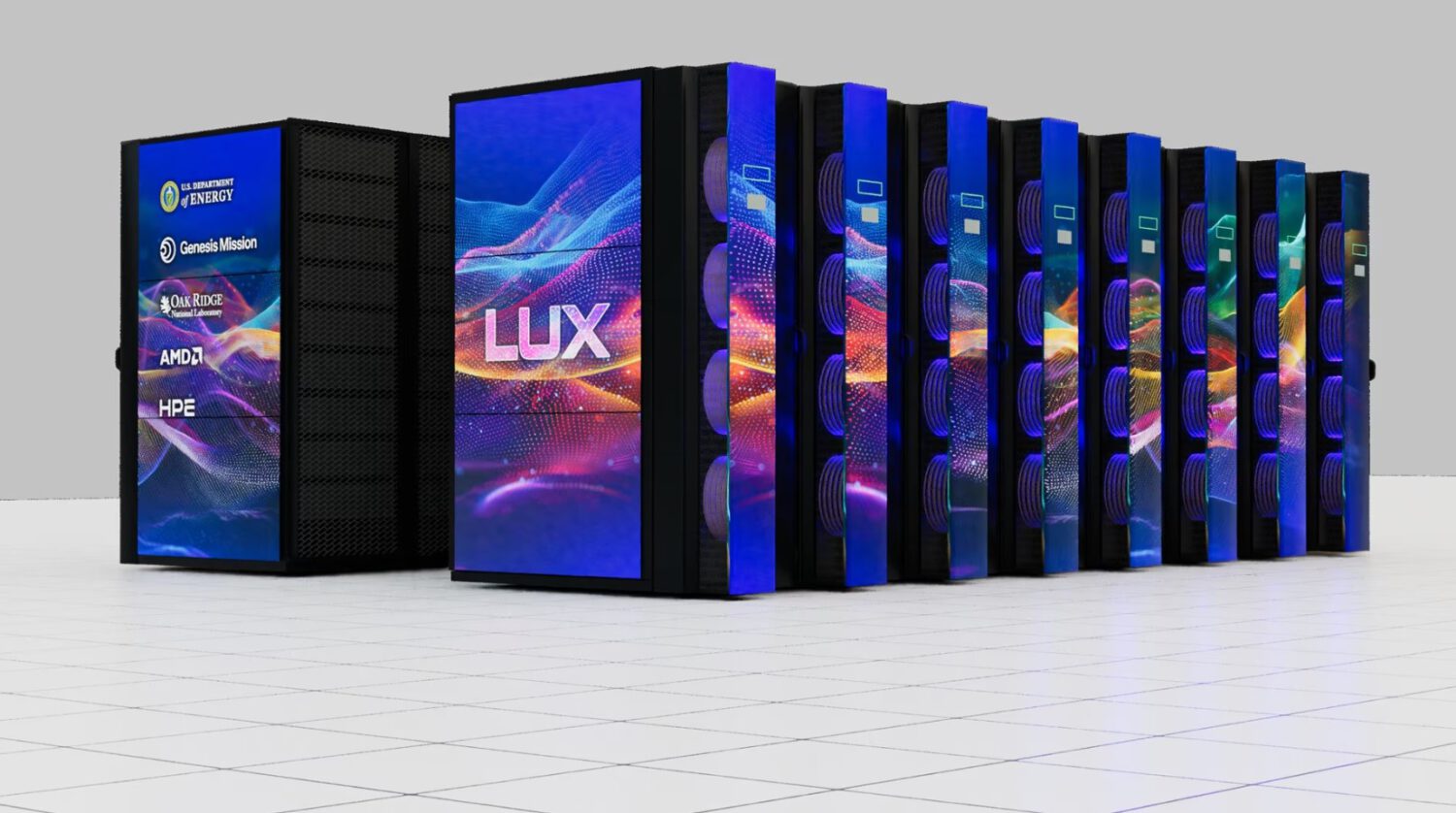
A new system called Lux entered the TOP500 at No. 14 with a measured HPL result of 220.79 petaflops. It is deployed at Oak Ridge National Laboratory and was developed through a public-private partnership involving AMD and the U.S. Department of Energy.
AMD and the DOE describe Lux as an AI-focused cluster supporting the DOE’s Genesis Mission, which the partners characterize as connecting national laboratory resources with modern AI infrastructure. HPE co-designed and built the system, supplying the underlying infrastructure.
The hardware stack combines AMD EPYC 9575F processors (64 cores at 3.3 GHz), more than 4,000 AMD Instinct MI355X GPUs, and AMD Pensando networking. AMD’s ROCm software completes the stack.
HPE deployed the system on ProLiant Compute XD685 nodes with direct liquid cooling and HPE Juniper networking. According to HPE, the cluster provides cloud-like, multi-tenant access for researchers running AI training, inference, and scientific workloads.
Where AMD Sits Across the Full List
Five of the top-ten ranked systems run AMD silicon, spanning three generations of accelerator hardware.
Lux lands inside a broader AMD presence at the top end of the rankings. El Capitan holds No. 2 at 1.809 exaflops, using fourth-generation AMD EPYC processors paired with Instinct MI300A accelerators. Frontier ranks No. 3 at 1.353 exaflops, built on third-generation EPYC CPUs and Instinct MI250X accelerators.
Italy’s HPC7 and HPC6 extend AMD’s top-tier showing, ranking No. 6 at 571.5 petaflops and No. 8 at 477.9 petaflops, respectively.
The No. 1 position remains with LineShine, installed at China’s National Supercomputing Centre in Shenzhen. It measures 2.198 exaflops; the TOP500 record identifies it as a LingKun system rather than an AMD-based one.
An AI Cluster That Scores on a Traditional Benchmark
Scoring competitively on a benchmark built for traditional simulation is an unusual result for a system designed primarily around AI workloads.
HPL measures the solution of dense linear systems and is a conventional HPC benchmark, not a comprehensive measure of AI performance. Lux’s No. 14 debut on that metric points to growing convergence between government science programs and commercial AI infrastructure.
HPE says Lux enables multi-tenant access for researchers running AI training and inference workloads, a model more common in cloud computing than in national laboratory environments.
A Note on the Numbers
The share and growth figures come from AMD; TOP500 independently verifies only list positions and benchmark values.
The 40%+ share of TOP500 entries and the approximately 14% year-over-year growth claim both originate from AMD’s announcement. The term reflects AMD’s count of ranked entries, not a measure of supercomputing revenue or installed capacity across the broader industry.
Lux’s 220.79-petaflop result is its measured HPL performance. AMD separately publishes theoretical or workload-specific figures, including FP64 metrics; those figures are not equivalent to the TOP500 benchmark result and should not be read as such.