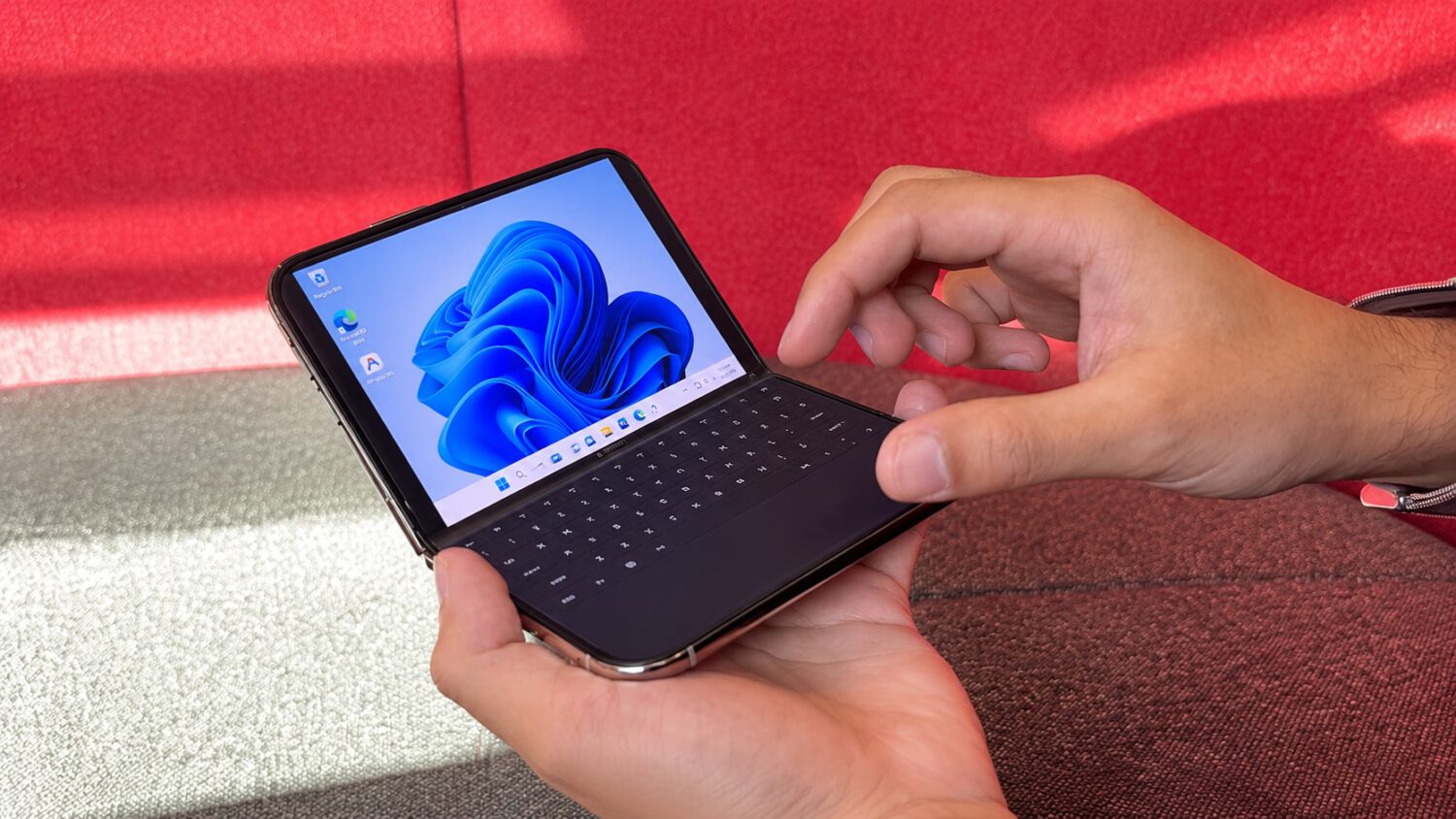
Windows 11 Arm64 runs locally on Apple’s foldable iPhone Duo without a jailbreak. The project is called WindowsiOS, and Ammaar Reshi, identified in reporting as a product and design lead at Google AI Studio, demonstrated it publicly in November 2026.
This is a developer experiment, not a consumer feature. That distinction matters before anything else.
What the Demonstration Actually Shows
The demo runs a recognizable Windows environment with touch controls on the Duo’s folding display.
Reshi’s demonstration showed Windows 11 24H2, Microsoft Edge, and Google’s Antigravity coding application running with touch controls on the Duo’s 7.6-inch internal display. Fold the device halfway and the lower panel functions as a keyboard and trackpad, while the upper panel displays Windows.
According to Reshi, the software runs on the device itself. This is not remote desktop streaming or cloud execution.
How WindowsiOS Works
The project translates Arm code to Arm code, skipping the slower approach that tripped up earlier attempts.
WindowsiOS does not use a jailbreak or Apple’s Hypervisor framework. It uses an Arm64-to-Arm64 dynamic binary translator and a software memory-management layer to convert Windows instructions into code the iPhone’s processor can execute.
Windows on Arm and Apple silicon both use the Arm64 instruction set. That shared architecture lets the translator skip the heavier burden of converting x86 code, which is what slowed earlier attempts considerably.
A 2024 project booted a stripped-down Windows build on an iPhone 15 Pro via the UTM SE emulator, but instruction-by-instruction software emulation stretched startup to roughly 20 minutes. WindowsiOS builds on Henge, an existing open-source translator connected to earlier efforts to run macOS on iPhones.
The repository credits the Windows-specific engineering to Google’s Gemini 4 Carbon model. A more accurate description is AI-assisted development built on a pre-existing low-level foundation, not a translator the model created from scratch.
The Setup Is Not Simple
Installation requires developer tools, a user-supplied Windows image, and a recurring debugger connection at every launch.
WindowsiOS is distributed as a GitHub developer project, not an App Store application. Getting it running requires an Apple Silicon Mac, Xcode, and a Windows 11 Arm image the user must supply independently.
Each launch also requires a debugger connection to enable the executable memory the translator’s JIT system depends on. That is not a step configured once; it is a recurring structural requirement. Users who run into computer problems during setup will find little in the way of consumer-friendly guidance here.
Memory, Performance Claims, and Fragility
The demonstrated environment trims Windows significantly and relies on iOS behavior that could change.
Windows receives roughly 4.5 GB of allocated memory; the Duo’s total memory is reported by secondary coverage as 12 GB. To reach a project-reported idle footprint of about 1.46 GB, more than 35 background services are removed, including Windows Defender. That trimmed configuration is not equivalent to a standard Windows installation.
Near-native JIT performance is what the repository claims. No independent benchmarks were identified in the available coverage, so that assertion reflects developer reporting rather than externally verified measurement.
Because the project depends on how iOS currently handles executable memory, a future update could break it. The available documentation confirms testing on the Duo; compatibility with other iPhone models is unconfirmed.
What It Actually Means
WindowsiOS is a proof of concept that shows what current Arm hardware and open-source translation can accomplish on a foldable device.
The source code is publicly available on GitHub for developers who want to examine or build on it. For general users, the setup process places this firmly in specialist territory for now. Those drawn to pushing iPhone hardware to its limits may also find interest in iPhone accessories that expand everyday usability in more practical ways.