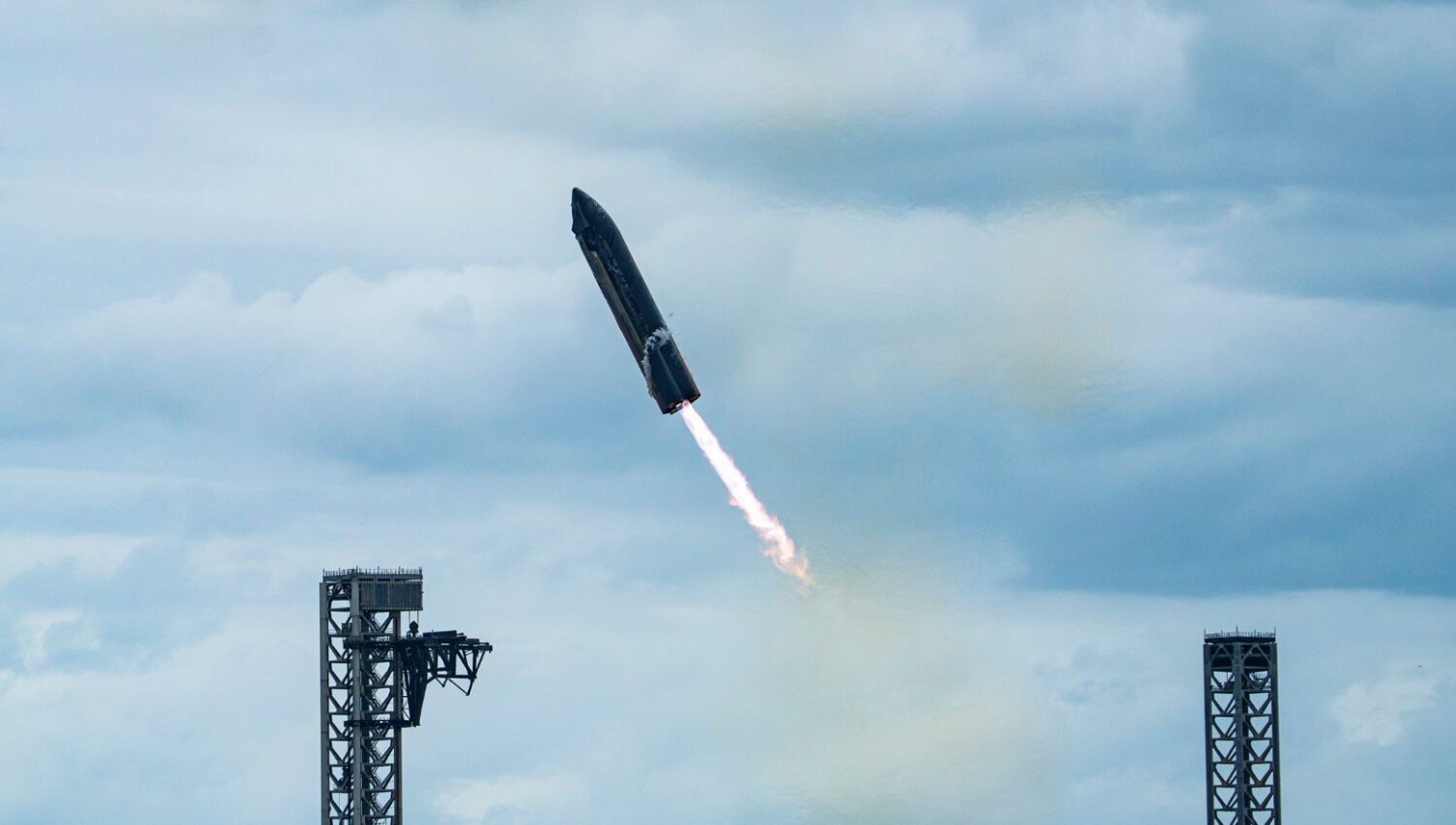
For the first time, a Starship spacecraft returned from orbit and was caught by the mechanical arms of its own launch tower at SpaceX’s facility in South Texas. The arms, known informally as “chopsticks” for their paired, clamping design, secured the vehicle at Launch Pad 2 after a precisely sequenced descent from orbit.
The catch required the spacecraft to survive atmospheric re-entry, relight its engines, execute a vertical flip, and align precisely enough for the tower arms to close around it. All four steps succeeded.
What the Mission Accomplished
Flight 15 spent nearly a full day in orbit and deployed a batch of commercial satellites before returning.
Starship Flight 15 spent approximately 22 hours in orbit and completed 14 loops around Earth before returning. During that time, the spacecraft deployed 26 Starlink V3 satellites, according to SpaceX.
Starship is a two-stage launch system: the Starship spacecraft serves as the upper stage, while the Super Heavy rocket acts as the booster that lifts it off the pad. SpaceX is developing both stages to be fully reusable, with the goal of catching each one back at the launch tower rather than discarding them in the ocean.
The Booster Did Not Make It Back
The Super Heavy booster was terminated over the Gulf of Mexico after an aborted return, leaving the program’s first dual-stage recovery incomplete.
The Super Heavy booster failed to return to the launch site and was terminated over the Gulf of Mexico after separating from the spacecraft. SpaceX said the boostback burn ended earlier than intended because of low fuel mass, after which the guidance, navigation, and control system triggered an automated abort.
SpaceX communications personnel said the engines shutting down prematurely contributed to the navigation problem, and engineers were investigating the underlying cause after the flight, according to Reuters.
The booster had been successfully caught by the tower arms three times during earlier Starship tests. Flight 15 was the program’s first attempt to recover both stages on the same mission simultaneously.
Why Catching the Spacecraft Matters
Returning a large orbital vehicle to its launch tower without a conventional landing pad is a meaningful step toward the rapid turnaround SpaceX is targeting.
Catching Starship at the tower, rather than discarding it in the ocean, could eventually reduce the cost and complexity of each launch if the vehicle proves reliable and safe to reuse. The sequence completed on Flight 15 demonstrates that an orbital spacecraft can be guided back to its own launch site without a dedicated pad.
NASA has a direct stake in that progress. SpaceX is under contract to develop Starship as a lunar lander for the agency’s Artemis program, and reliable orbital return capability is relevant to that role. Flight 15 did not itself demonstrate anything close to a lunar landing scenario.
A Partial Success With Real Work Still Ahead
The spacecraft recovery is a genuine first, but the booster failure means the full Starship system has not yet demonstrated reliable simultaneous recovery of both stages.
Flight 15 is accurately described as a partial success. SpaceX still needs to determine what caused the booster abort and demonstrate repeated dual-stage recovery on the same mission. Engineers must also validate refurbishment procedures that confirm the hardware can fly again safely before Starship can support Artemis lunar missions or high-frequency commercial launches. One successful spacecraft catch is a foundation, not a finish line.