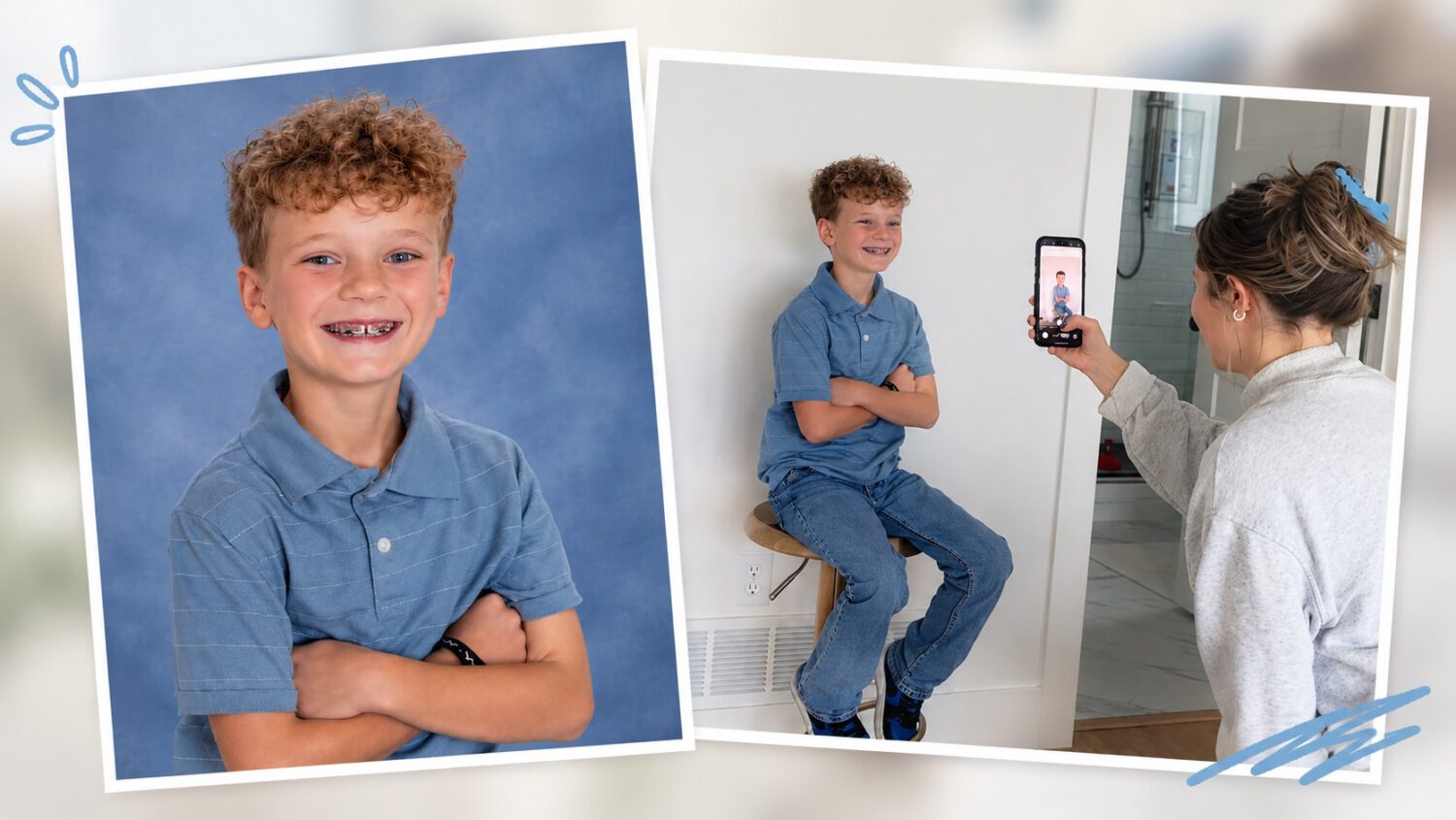
School photo packages commonly cost $25 to $60 per child, and families with multiple kids feel that total quickly. TikTok creator Carlie Bond’s reported workaround has been attracting attention: photograph your children against a plain wall at home, upload the images to ChatGPT, and prompt it to add a school-portrait-style gradient backdrop.
How the Workflow Works
The basic steps are straightforward, but results depend on your ChatGPT plan and how well the tool handles your child’s likeness.
The process requires a phone, a blank wall, and access to ChatGPT’s image-upload feature. OpenAI confirms this is a supported capability, though availability depends on your plan and account configuration.
According to Fast Company, Bond photographed all three of her children against a plain backdrop and used a prompt asking ChatGPT to preserve their appearances while adding a school-picture-style background. The tool reportedly produced results resembling the gradient backgrounds commonly seen in school portraits.
The Catch: Your Kid’s Face May Not Survive the Edit
Generative AI can alter a child’s appearance even when you ask it not to.
Some parents reported that their children’s faces changed during generation, even after explicitly asking ChatGPT to preserve their features, according to Dexerto. The result is more accurately described as an AI-stylized portrait than a faithful photograph. Before you consider the output finished, inspect the eyes, facial proportions, and hairline carefully.
Privacy Before You Upload
Uploading your child’s photo to a consumer AI platform carries trade-offs worth understanding before you start.
Per OpenAI’s privacy policy, uploaded images count as user content. Files remain associated with an account for the retention period of the corresponding chat, per OpenAI’s help documentation, though handling may vary depending on features such as Library storage or custom GPTs.
OpenAI does offer controls. You can opt out of model-improvement training, use Temporary Chat to keep the session out of your history (though OpenAI notes it may retain a copy for up to 30 days for safety purposes), delete conversations, and export your account data. OpenAI also requires parental or guardian permission for users under 18 and provides a contact route for reports involving children under 13.
One Thing This Is Not
Using AI to erase a watermark from a professional proof is a separate issue with different implications.
A separate practice circulating on social media involves using AI to remove watermarks from professional school-photo proofs rather than purchasing the finished images. That is a materially different situation from the Bond-style workflow and raises copyright and licensing questions for the photographer involved; whether it is unlawful depends on the contract and jurisdiction.
The workflow may reduce costs for some families. The trade-offs around likeness accuracy and children’s data are equally concrete. Understanding both before picture day is the smarter starting point, and exploring best cameras for home photography may also be worth considering as a longer-term alternative.