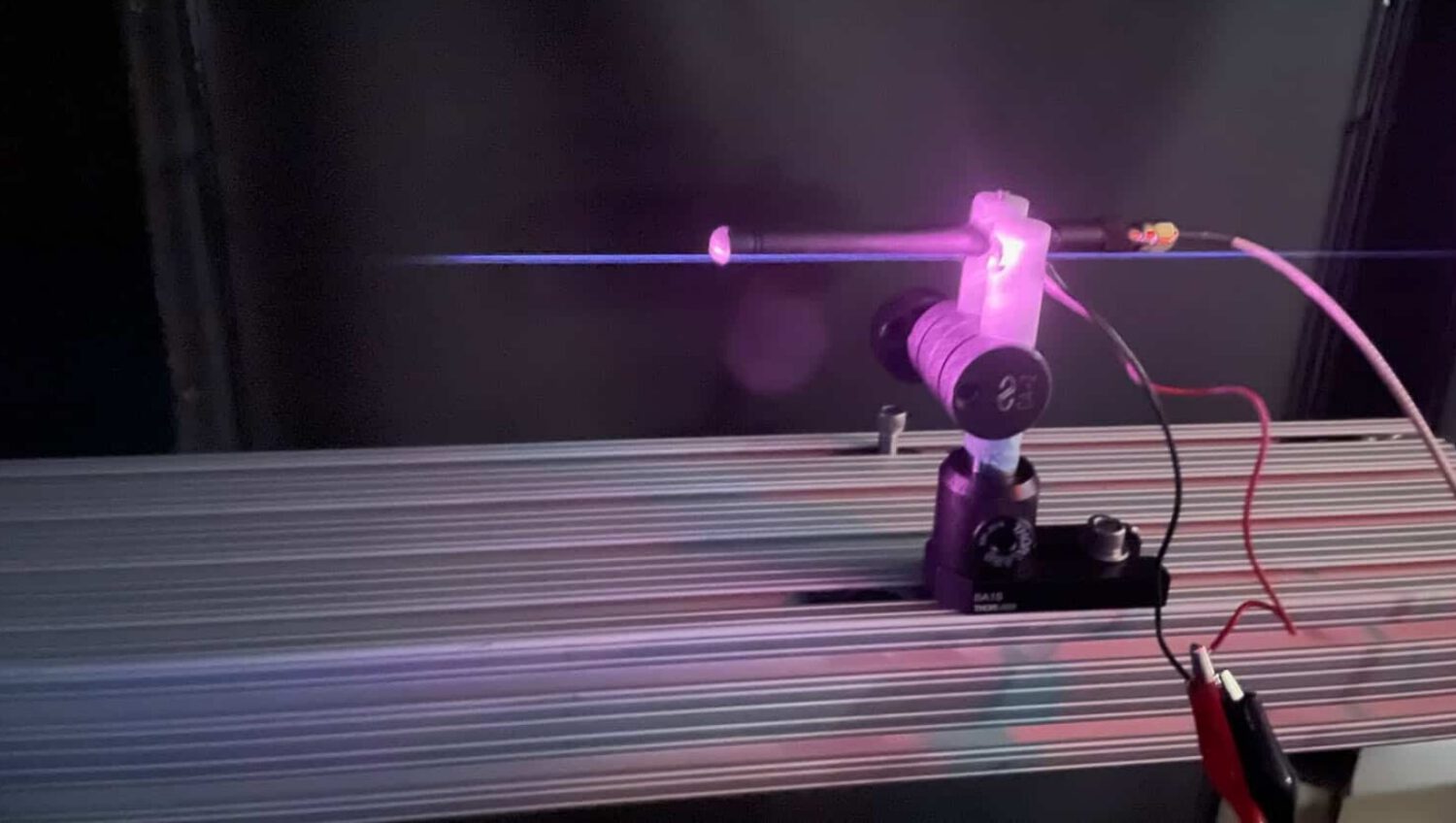
Fire a laser through open air, and you get a thin, glowing column of ionized atmosphere. Researchers at North Carolina State University, Texas A&M University, and Princeton University have demonstrated that this plasma filament can transmit a radio-frequency signal, producing a 2.5-times increase in received signal strength, equivalent to a 150% gain, at 30 MHz.
Published Sept. 1, 2026 in the IEEE Journal of Microwaves, this is a laboratory feasibility demonstration, not a commercial antenna replacement.
How Ionized Air Becomes an Antenna
The key is what a laser does to air molecules along a narrow path.
A laser ionizes a thin channel of air molecules, producing a plasma filament with mobile electrons along its edges. Those electrons give the filament enough electrical behavior to radiate radio-frequency energy outward.
Direct metal contact would distort the filament, so the team engineered a contactless solution. A metal ring surrounds the laser path and couples the radio signal into the plasma capacitively, transferring energy through an electromagnetic field without physically touching the filament.
“The plasma beam antenna looks like a lightsaber and is tunable, meaning we should be able to transmit across a broad range of frequencies.” , Prya Darshni, NC State doctoral student and corresponding author.
What the Experiment Actually Showed
The reported results confirm transmission, but several capabilities remain unverified.
Published under DOI 10.1109/JMW.2026.3722433, the paper lists Prya Darshni and Paul D. Franzon of NC State, along with Arthur Dogariu of Texas A&M and Princeton, as authors. It reports transmission at 30 MHz with a 2.5-times signal strength gain over the laser-blocked condition. The authors describe this as the first demonstration of that particular concept.
What it did not show is equally important. Reception has not been tested, and efficiency, transmission range, and power handling were not established in the available report. Broad frequency tuning is a proposed capability, not yet a verified one.
Tunability is where the concept gets genuinely interesting. Changing laser parameters adjusts the filament’s length, which shifts the antenna’s operating frequency without physically moving anything. Steering the beam could redirect the antenna’s orientation, though that too remains a proposed application rather than a demonstrated result.
“This is an exciting new concept that enables one to be able to have a customized antenna without complex mechanical deployment mechanisms.” , Paul Franzon, NC State professor of electrical and computer engineering.
Where This Could Go Next
Satellites, aircraft, and radar systems are the research team’s stated areas of interest, though all remain prospective.
On platforms where mass and mechanical complexity carry real costs, a laser-generated antenna with dynamic reconfiguration potential has appeal. Franzon noted that sufficient air exists in low Earth orbit to form plasma, which the researchers identify as a factor supporting further investigation. Whether a plasma antenna would operate efficiently or safely in orbit remains unverified.
Significant Engineering Challenges Remain
A long list of open questions separates this proof of concept from any practical deployment.
Reception is untested, and how this system compares to conventional metal antennas in efficiency is currently unknown. Laser power requirements, thermal management, optical safety, atmospheric turbulence tolerance, and beam alignment reliability are each open engineering questions at this stage. The plasma filament is transient and decays after laser generation, a practical constraint any operational system would need to address.
Nothing in the current results suggests it displaces any antenna in active use today. Independent researchers not involved in the study have not yet publicly commented on the findings.
Next steps for the team include demonstrating signal reception, testing across a wider frequency range, and validating beam steering. If those experiments succeed, a laser-generated, frequency-agile antenna moves from a compelling laboratory result to something engineers in aerospace and radar can seriously evaluate.