Researchers at Israel’s Weizmann Institute of Science have built an AI system that reconstructs images a person is actively viewing by analyzing brain-scan data, and it now adapts to a new participant in roughly one hour. Earlier systems required approximately 40 hours of scan data to calibrate for each new person. The system, called Brain-IT, earned acceptance at ICLR 2026 and was developed by Professor Michal Irani alongside researchers Roman Beliy, Amit Zalcher, Jonathan Kogman and Navve Wasserman.
Brain-IT works by reading functional magnetic resonance imaging data: scans that measure blood-oxygen changes tied to neural activity while a participant views an image. The architecture centers on a Brain-Interaction Transformer, or BIT, which learns visual-response patterns shared across different people. A related component, the Universal Brain Encoder, predicts how a brain responds to a given image, while Brain-IT itself reconstructs an image from the brain’s recorded response.
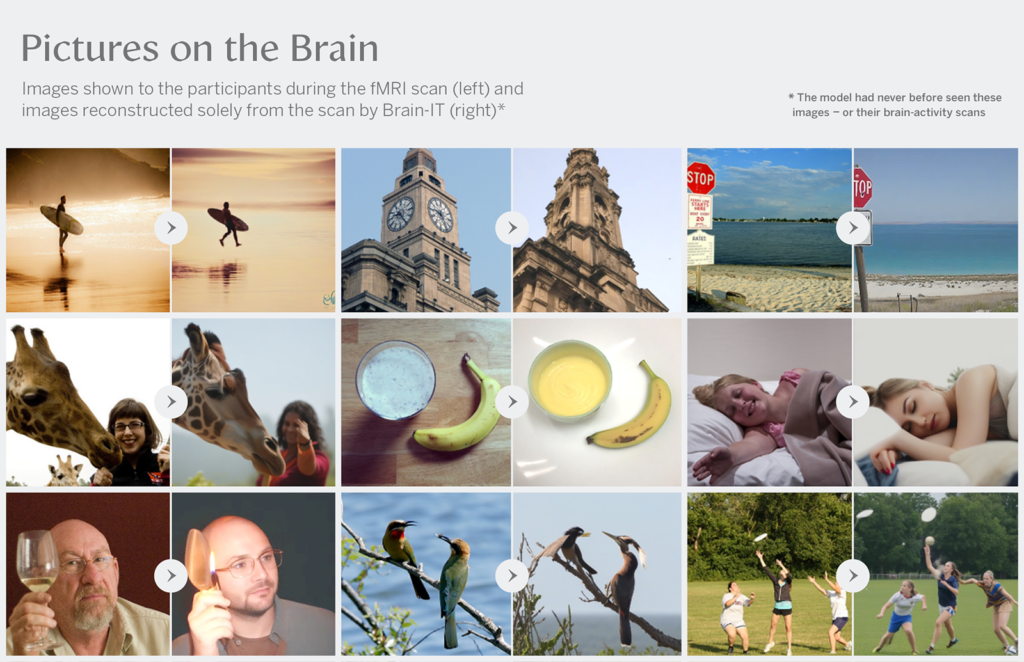
That one-hour calibration figure compares with the roughly 40 hours of fMRI recordings prior methods used to adapt to a new participant.
Earlier brain-to-image approaches could preserve broad semantic meaning but reportedly lost visual specifics such as composition and color. Professor Irani described the baseline in the Weizmann Institute announcement: “There exist nowadays models that translate brain activity into images, and they can even produce impressive reconstructions that preserve the semantic meaning of the image reasonably well.” Brain-IT reportedly improves on both content fidelity and visual detail.
The model also identified 128 functional brain regions shared across participants. Among them, the researchers report what they describe as a newly identified division within the parahippocampal place area, a region associated with processing places and scenes, separating activity linked to indoor and outdoor environments. Eight volunteers each viewed several thousand images during fMRI sessions to train the system, which researchers then tested on scenes including a baseball game, a dog leaning from a car window and people crossing a snowy landscape.
What the system cannot do deserves equal attention. Brain-IT reconstructs externally presented images under defined experimental conditions; this study did not demonstrate decoding of private thoughts, beliefs, memories or intentions. Dream decoding remains speculative and is undemonstrated by this research, and fMRI presents hard physical constraints: the equipment is bulky and expensive, and the entire process requires a controlled research environment.
The team is investigating EEG-based decoding, which uses scalp sensors and could eventually offer a more portable alternative, though the available research does not establish that an EEG version has matched fMRI performance. Auditory decoding is also under investigation, according to reporting on the project. Video decoding presents a steeper challenge, because fMRI’s slow acquisition rate creates a timing mismatch with rapidly changing frames. If you follow coverage of neural decoding research, that constraint is worth keeping in mind whenever headlines suggest the technology is close to real-time use.
A long-term possibility for assistive communication, particularly for people who cannot speak or move, remains a genuine research direction. Any clinical application would still require safety review, consent frameworks and neural data protections. The one-hour calibration result is a concrete step forward for the field, but closing the gap between laboratory capability and real-world deployment still depends on portable hardware, robust performance across diverse populations and clear governance of the neural data such systems would collect.