The world’s best solar real estate has a persistent problem: a fine, relentless coat of dust that steadily cuts into energy output. Fixing it traditionally means water use, cleaning crews, and a steady drain on a resource that desert regions can least afford to waste. Ecoppia, an Israeli solar-technology company founded in 2013, built its business around that contradiction.
Dust Is Cutting Into Solar Output
Soiling losses are far larger than most operators expect, and the damage compounds while panels sit idle overnight.
Annual energy losses from panel soiling vary widely, according to the National Renewable Energy Laboratory (NREL). In parts of the United States the figure runs roughly 7%. In parts of the Middle East it can reach 50%.
The problem compounds after dark. Overnight, panels cool and attract morning dew, which binds dust particles to the glass in a process researchers call cementation. Lin Simpson, a senior scientist involved in soiling research at NREL, noted that cemented dust can resist removal even during heavy rain.
Cleaning every day or two can help prevent that bond from forming.
Brushes, No Buckets
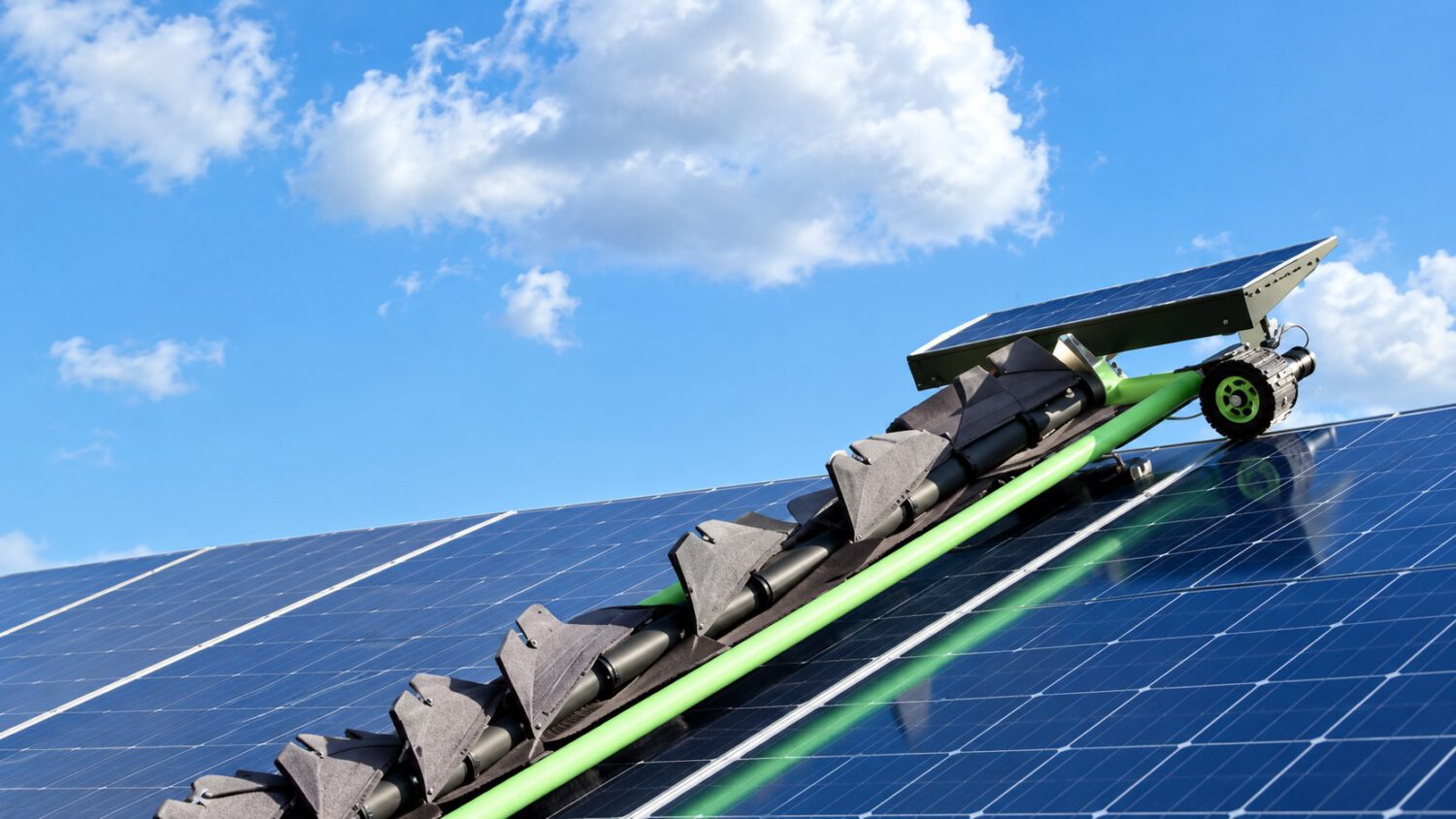
Ecoppia’s robots move along panel rows each night, removing dust with rotating microfiber brushes and no water at all.
Ecoppia’s robots operate autonomously after dark, traveling solar-module rows and removing accumulated dust with rotating microfiber brushes. No water is involved. The cleaning operation can also be automated without a conventional on-site washing crew.
The company says its systems are designed for utility-scale installations and operate at large solar farms worldwide. According to Ecoppia, its deployed fleet has saved approximately 9.8 billion liters of water, roughly 2.6 billion U.S. gallons. That figure comes from the company’s own reporting; no independent audit of the total was identified in the sources reviewed.
The nightly schedule also serves a technical purpose. NREL’s research indicates that cleaning panels every day or every other day can keep cementation from forming, a finding that aligns with Ecoppia’s operating cadence.
Water Is the Other Cost of Keeping Panels Clean
MIT researchers estimated that global solar-panel cleaning consumes roughly 10 billion gallons of water every year.
MIT researchers estimated that global solar-panel cleaning uses roughly 10 billion gallons of water every year. That volume is potentially comparable to the drinking-water needs of up to 2 million people.
For solar farms sited in deserts, where freshwater is expensive to transport, that figure is a structural liability. Waterless cleaning attempts to cut that dependency at the source.
Ecoppia Is Not the Only One Trying
MIT researchers tested an electrostatic system that recovered up to 95% of dust-related power losses under controlled laboratory conditions.
MIT researchers also tested a fundamentally different method: an electrostatic system that uses electrical charge to repel dust from the panel surface without physical contact or water. In laboratory testing, that approach recovered up to 95% of the power output lost to soiling. Those results come from controlled lab conditions, not commercial deployment, and the technology is distinct from Ecoppia’s mechanical robots.
Both paths point toward the same underlying goal: solar power that does not trade one scarce resource for another.
Beyond the Operational Math
The long-term case for waterless cleaning extends well past maintenance savings.
The strongest long-term opportunity here is not reduced operating costs. It is the possibility of expanding solar development into water-stressed regions without making freshwater consumption a routine part of generating clean electricity.