Smoke is filling a room. Someone is shouting. You know a workplace safety tool like a fire extinguisher is nearby, but the designer made it disappear behind a flush panel that matches the wall perfectly.
That is not a design triumph.
The Price of Aesthetic Perfection in a Crisis
A clean environment is worth pursuing, but erasing safety infrastructure from the visual field is a different thing entirely.
A clean wall that conceals emergency equipment without any visible identification is not good design. It is a functional failure dressed up in a coordinated finish.
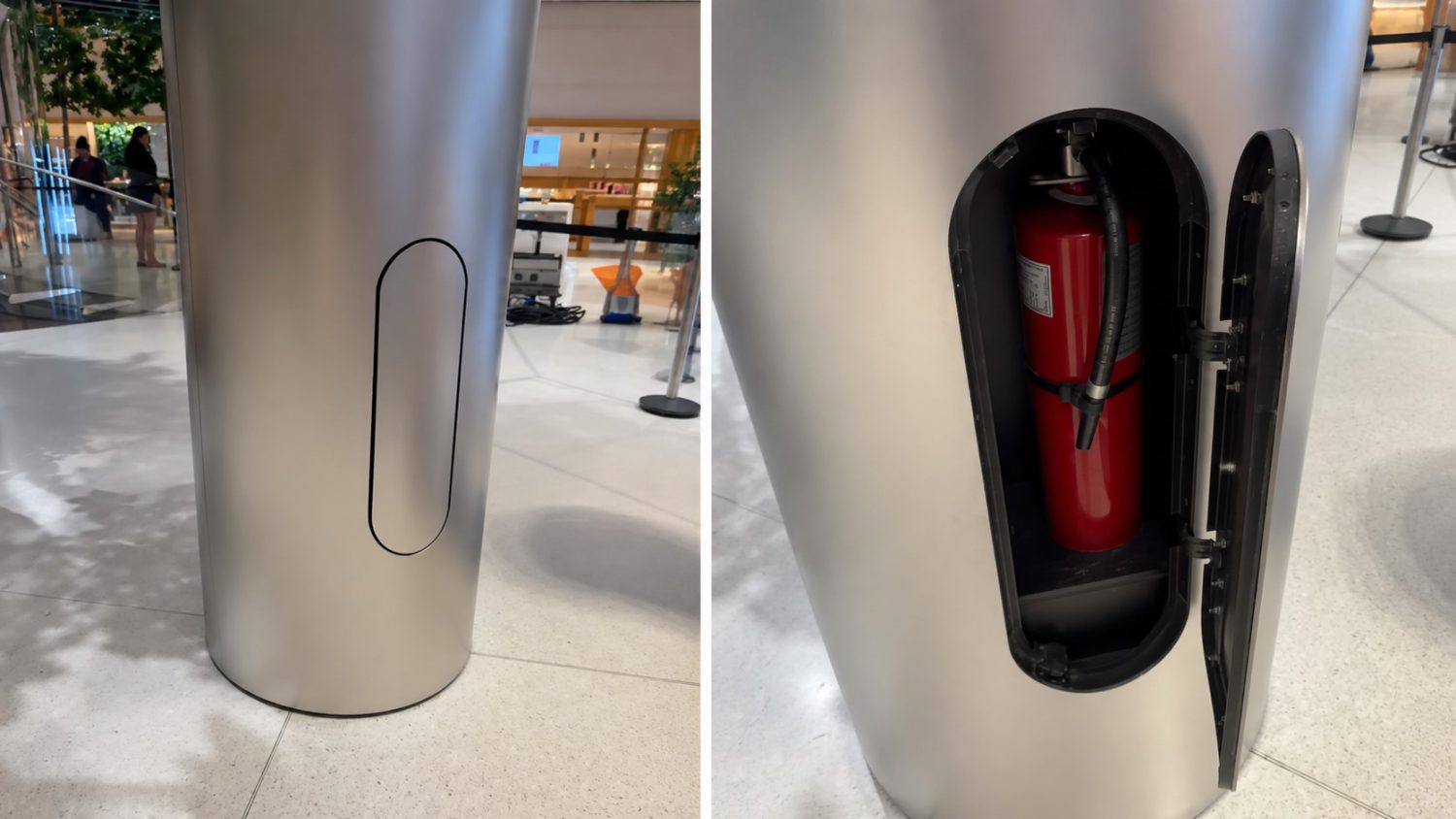
Reportedly, an Apple retail or office installation has been circulating as an example of this trade-off. It allegedly shows fire suppression equipment integrated so seamlessly into the surrounding architecture that it effectively disappears from view.
No official Apple statement, architectural document, or verified primary image has surfaced to confirm the specifics. No such source was identified in the research reviewed for this article.
What the circulating example does clarify, regardless of its origin, is a pattern worth examining. Brand loyalty can short-circuit critical thinking fast enough to make observers praise a design choice before asking whether it actually works under pressure.
The regulatory framework is not ambiguous:
- OSHA 1910.157 requires workplace extinguishers to be mounted, located, and identified so employees can reach them without being subjected to possible injury.
- NFPA guidance requires extinguishers along normal paths of travel, generally visible or clearly marked with signage when an obstruction exists.
- A recessed cabinet is not automatically noncompliant; concealment without effective identification is the core problem.
- Maximum travel distance to an extinguisher depends on hazard classification, and accessibility is treated as a functional requirement, not a preference.
The rules leave room for elegant solutions. They leave no room for unmarked panels and hidden handles.
Good-Looking and Compliant Are Not Mutually Exclusive
A clearly labeled cabinet with a coordinated finish is not a design compromise; it is the correct answer.
NFPA guidance describes portable extinguishers as a first line of defense against incipient fires, with accessibility treated as a non-negotiable functional requirement. That framing reorients the entire debate: an extinguisher is infrastructure you design for, not furniture you style around.
The confusion underlying this kind of praise is treating visual cleanliness as a proxy for good design. Consider the difference between a minimal app interface that buries the emergency logout button six menus deep and one that simply puts it where you can find it. Both might look polished. Only one works when it counts.
Facilities teams and designers can still use recessed installations, coordinated finishes, and orderly placement. The non-negotiable constraints are prominent labeling, unobstructed access, and location along normal travel paths. Those are not aesthetic concessions.
During an emergency, a recessed cabinet without signage is indistinguishable from drywall.
The standard applied to an allegedly hidden extinguisher in any sleek, brand-conscious space should be the same standard applied to every warehouse, office park, and retail chain: accessible, identified, and reachable without delay. Emergency equipment is not a brand decision. Design around it accordingly.